Showing posts with label Piske. Show all posts

Wednesday, October 25, 2023

Good Old Reliable LaVerne

Since he was mentioned in the brick house article, I just wanted to take a look at LaVerne Manteuffel and the long-time Hobart business he was associated with.

2023-10-25. 1922 Aurora
(Click on image to enlarge)
From Hobart High School's annual, the Aurora, 1922.


LaVerne Paul Manteuffel was born in 1905 in Hobart, to William Paul and Emilie Manteuffel. Emilie was a widow and a business owner when she married Paul (he often went by his middle name) in 1898.

Her first husband, Herman Carl Piske, had been born in Prussia around 1858, and came to the U.S. with his family around 1868. The Piske family shows up in North Township, Lake County, Indiana (probably Tolleston, as we shall see from a later source) in the 1870 Census. By 1880, Herman was on his own, living in a Chicago boarding house and working as a shoemaker (1880 Census).

In September 1880 Herman married Bertha Boldt in Lake County, Indiana. Her family had also immigrated from Prussia and settled in North Township (1870 Census),[1] so perhaps the young people had met each other there.

Around the time of his marriage, Herman opened a shoe store in Hobart, called the "Reliable Boot & Shoe Store." I do not know how much time passed before the word "Old" started appearing before "Reliable."

In 1885 Bertha gave birth to a daughter, Clara. Not long afterward Bertha died. I suppose Herman's relatives stepped up to help him with the baby.

In May 1886, Herman married Emilie Voigt. She, like Herman and his first wife, came from a German immigrant family, possibly also Tolleston residents.[2] Her 1956 obituary (see below) says that she became a Hobart resident in 1884.

Herman and Emilie had two children: Elsa (b. 1888) and Walter (b. 1890). Herman continued operating the boot and shoe store, probably with considerable help from Emilie.

Here is an undated photo of the Piske store.

2023-10-25. Piske shoe store (undated)
(Click on image to enlarge)
Image courtesy of the Hobart Historical Society, Hobart, Indiana.


Although no one in the photo is identified, I suppose that's Herman and Emilie standing in the doorway.[3] The children may be Clara, Elsa, and Walter. Judging by the cut of Emilie's dress (and, if the little boy is Walter, his apparent age), I would guess the photo was taken around 1893-4.

At that time, I believe the store stood at 313 Main Street, a building known as the Stocker Block.[4]

In 1895, Herman died.

2023-10-25. Piske, H.C. obit, Hobart Gazette, 1895-10-18
(Click on image to enlarge)
Hobart Gazette, 18 Oct. 1895.


Emilie took over operating the Old Reliable herself.

In the spring of 1896 came the death of her only son, Walter, as described in this story from the Hobart Gazette of May 22, 1896, titled, "Scarlet Fever."
One day last week Mrs. H.C. Piske's little girls were taken sick and in time it was discovered that they had a light type of scarlet fever. On Friday her little boy about 7 years old was taken with it and became much worse than his sisters. On Monday evening about 8 o'clock the little fellow breathed his last.

Owing to the nature of the disease his body was buried on Tuesday and no funeral services were held except at the house where Rev. Schuelke spoke words of good cheer to the family and friends. His death is extremely sad and our citizens sympathize with the mother in the hours of her bereavement.
On April 1, 1898, as I've mentioned, Emilie married Paul Manteuffel, another German immigrant.[5]

Any attempt to sketch out Paul Manteuffel's history is complicated by the fact that there were two local Paul Manteuffels. They were cousins. Their fathers were brothers, Julius and Louis Manteuffel, who married two sisters, Auguste and Hermine Poppe.[6] Louis and Hermine Manteuffel lived in East Gary (Lake Station), and their Paul — sometimes called "Paul C." or "P.C." — eventually moved to Chicago. In cases where those details are included in a newspaper report about a Paul Manteuffel, I'm able to tell the East Gary/Chicago one from the Hobart one, but they are not always included, so I'm not always sure I'm talking about the right Paul.

As for Hobart's Paul Manteuffel — it appears that he did not join with Emilie in operating the Old Reliable: he had other occupations. In 1897 he had begun operating a saloon in the basement of the Hobart House, and continued in that business for several years.[7] In 1903, we find him filling in for the town's ailing night watchman.[8] Around 1904 he started working at Aetna, possibly at the munitions factory.[9] When the 1910 census was taken in April, Paul was working at a brickyard, but in May he took a position as "night foreman at the [Hobart] water and light plant."[10] By 1920 he was again working at the brickyard, and that is the last information I have about his occupations.

In May 1899, Emilie gave birth to a daughter, Evelyn.

Sometime after the 1900 census, Clara Piske left her stepmother's home. By 1904 she was described as "Miss Clara Piske of Chicago" when she came back to Hobart for a visit.[11] Beyond that, I have not been able to find any information about her.

Late in March 1905, the Manteuffels rented the "Gordon brick": 332-334 Main Street, known to us today as the former location of the Bright Spot restaurant. They moved the Old Reliable into the first floor, while the family occupied living quarters behind the store, and/or upstairs.[12]

In May of that year, Emilie gave birth to a son, LaVerne Paul — her last child.

The 1910 Census shows Emilie operating the shoe store while Paul worked in the brickyard. Elsa Piske, 22 years old, worked as a post-office clerk. In January 1918, Elsa married Allen Mummery (Indiana Marriage Collection). The two of them would be lifelong Hobart residents.

By the 1920 Census, Evelyn Manteuffel, at 20 years of age, was working as a "saleslady" in a "store": I suspect it was her mother's shoe store, as the early 1920s newspapers report several instances of her attending National Shoe Retailers' association conventions in Chicago with her mother.[13] Her brother, LaVerne, upon receiving his high-school diploma in 1922, also made the Old Reliable his full-time job.

Evelyn married Walter Boal in 1926[14] and became a stay-at-home wife.

In 1929, William Paul Manteuffel died — that is to say, there is a stone in Hobart Cemetery with his name and "1929" carved on it. But I have not been able to find a word about his death in the Hobart Gazette, nor can I find his death certificate on Ancestry.com. (I have found a record of a Paul Manteuffel dying in Cook County, Illinois, in April 1929, but the record doesn't include enough information to determine whether it was this Paul.) In the 1930 Census, the enumerator describes Emilie as married, which could simply be an error. The 1940 Census describes her as widowed. A search of Indiana and Illinois newspapers available online doesn't turn up any relevant Manteuffel death notices. I am going to have to do some more reading of microfilm.

Emilie carried on with the Old Reliable business. It earned enough money that in 1936 she was able to buy the building it occupied.[15]

The family suffered a tragedy in 1937, when Evelyn Manteuffel Boal died of cancer just short of her 38th birthday. She had no children.

In July 1939, Emilie sold the Old Reliable business to LaVerne and announced her retirement. The following November, LaVerne married Leotta Flick.

2023-10-25. 1939-11-27, The Hammond Times, Hobart -- Flick-Manteuffel
(Click on image to enlarge)
Hammond Times, 27 Nov. 1939.


Leotta had a lovely singing voice, it seems: she was a church soloist and often sang at weddings, funerals, and other social occasions. In the 1940s she was repeatedly elected director of a local choral club.[16] She and LaVerne had two children: Marvin (b. 1941) and Dorothy (b. 1947).

1956 was the year everything changed. On May 14 Emilie died.

2023-10-25. 1956-05-17 Gazette, Manteuffel Rites To Be Held This Friday
(Click on image to enlarge)
Hobart Gazette, 17 May 1956.


And in August, LaVerne closed the doors of the Old Reliable Boot & Shoe Store forever.

2023-10-25. 1956-08-09 Gazette, Manteuffel Store To Close Doors  This Week
(Click on image to enlarge)
Hobart Gazette, 9 Aug. 1956.


I think we can attribute the "81 years" and the "1875" in this article to the mutability of memory and oral history. The writer didn't have the 1880 Chicago census at hand.


LaVerne died in 1983.

2023-10-25. 1983-01-19 Gazette, LaVerne P. Manteuffel
(Click on image to enlarge)
Hobart Gazette, 19 Jan. 1983.


His daughter wrote this touching tribute to him:

2023-10-25. 1983-02-09 Gazette, In Memoriam (Paul Manteuffe)
(Click on image to enlarge)
Hobart Gazette, 9 Feb. 1983.


A garden still grows around his former home, 465 East 8th Street, but I don't know if any of it is LaVerne's work.

And if you'd like to learn how to play "the bones," there's a cute tutorial here.

♦    ♦    ♦

In conclusion, I would like to post two ads I found interesting.

The first is from the Hobart Gazette of October 31, 1889:

2023-10-25. Hobart-Gazette-October,31-1889-p-4
(Click on image to enlarge)

Per the old-timers' memories collected in 1979, B.W. Strattan did once operate a "general merchandise store" in the Strattan building. The second door south of that would be on the west side of Main Street. Thus perhaps the Gazette was correct in 1905 when it said that the store had been located on the east side of the street only from around 1894 (see footnote 12). (Also, Herman's initials in this ad are "C.H." instead of "H.C." as in the photograph of the store posted above.)

This ad, from the Gazette of April 7, 1910, is mystifying.

2023-10-25. Hobart-News-April,7-1910-p-5
(Click on image to enlarge)

218 Main is now the Ben Ack Building, but in 1910 only a frame house stood there.

_______________
[1] Her brother, William, married Mary Sullivan.
[2] Both of her parents were born in Germany: John/Johann (b. 1829) and Ernestine/Ernstena (b. 1827). The family came to the U.S. in 1874 or 1875 (as reported by Emilie in the 1910 and 1920 censuses). As of 1896, her parents lived in Tolleston ("Local Drifts," Hobart Gazette, 8 May 1896), and they died there within a decade — Ernestine in 1903 and John in 1905). But I have not been able to find them in any census.
[3] I have no idea who the guy lounging under the awning at left is. Note his sleeve protectors, which were often worn by storekeepers, bank tellers, bookkeepers, and even bartenders.
[4] The history of the store's location is a bit confused and has to be inferred from newspaper articles that don't mention addresses, oral histories that don't mention dates, and anonymous handwritten notes on the back of photographs in the Hobart Historical Society files.
[5] He was a son of Julius Manteuffel.
[6] "Local Drifts," Hobart Gazette, 2 Feb. 1917.
[7] "Application for License," Hobart Gazette, 5 Feb. 1897; "Local Drifts," Hobart Gazette, 5 Mar. 1897; 1900 Census.
[8] "Local Drifts, Hobart Gazette, 1 May 1903.
[9] "Local Drifts," Hobart Gazette, 18 Nov. 1904.
[10] "Local Drifts," Hobart Gazette, 6 May 1910.
[11] "Local Drifts," Hobart Gazette, 27 May 1904.
[12] "Local Drifts," Hobart Gazette, 17 Mar. 1905 and 31 Mar. 1905. The March 17 item mentioned that the shoe store had been in the Stocker Block location (313 Main) for the past eleven years, which would take us back to 1894. If this is not an error, it suggests that the original ca.-1880 store was in yet a different location.
[13] See, e.g., "Local and Personal," Hobart News, 21 Feb. 1921; "Local Drifts," Hobart Gazette, 22 Feb. 1922.
[14] He was a carpenter and helped to build the house at 5501 S. Liverpool Road.
[15] "Hobart," The Hammond Times, 5 Feb. 1936.
[16] "Leota Manteuffel to Direct Choral Club," Hobart Gazette, 27 Sept. 1945.

Friday, August 30, 2019

Thomas and Harriet Tierney

One of the few historical photos we have of Merrillville's "Old Mill" building dates from the 1930s, when it housed Tierney's restaurant. The proprietor was Harriet Tierney, a widow. It is the news of her husband Thomas' death on August 26, 1923, that has prompted me to start researching them.

2019-08-30. Tierney, News, 8-30-1923
(Click on image to enlarge)
Hobart News, Aug. 30, 1923.


Thomas Tierney and Harriet Piske (or Pieske) had been married in May 1913 in Berrien County, Michigan[1] — a sort of elopement, I gather, since both were living in Gary at the time. Thomas was 44, Harriet 34; this was his first marriage and her second. Harriet had previously been married to a Fred Woods, but I can't find a record of that marriage. I got Fred's name from the death certificate of their only son, Ernest.

It's interesting that the 1910 Census shows Thomas and Harriet living together, calling themselves husband and wife. Ernest was not living with them. Harriet's father, Carl Piske, was. Thomas gave his occupation as proprietor of a saloon.

Looking at the 1900 Census, I can't find either Thomas or Harriet; but I do find Ernest Wood (spelled without the s at the end) living with his grandfather, Carl Piske, in Calumet Township. Carl may have been on his second marriage by then: his wife's name is given as Minnie, whereas, in the 1880 Census, he's married to a Fridericke. In 1880 the Piske family lived in North Township.[2] Their children were Albert, Gusty, Emma, and the two-year-old Hattie (Harriet).

I can't find Thomas Tierney, or his family, at all before 1910.

Anyway, the first news I have of the Tierneys in Merrillville is an item in the "Ross Township" column of the Hobart News of May 15, 1913: "Mrs. T. Tierney has opened an ice cream parlor and automobile rest at Merrillville." This may or may not have been in the "Old Mill" building.

The 1920 Census records Thomas and Harriet in Merrillville. Thomas described himself as the landlord of a hotel. Harriet allegedly had no occupation. The enumerator recorded them right next to the Walter family, three of whom were operating a garage, which suggests (but doesn't prove) that the Tierneys' hotel was in the "Old Mill" building.

And then, as we've seen, Thomas died.

In the 1930 Census, Harriet, 52, described herself as the proprietor of a restaurant. Also in the household was a 51-year-old single man, Robert Gerber, who worked as the manager of a restaurant — Harriet's, I'm inclined to think. And her son, Ernest Woods, was recorded as living with her, although he had married Agnes Szikora in 1920 (Indiana Marriage Collection) and was also recorded living with Agnes and their two children in Gary. In both cases, Ernest's occupation was clerk in a grocery store.

Ten years later, Harriet's household consisted only of her and Robert. Under "Relationship to head of household," both were "Partners," and for occupation, both were restaurant proprietors. Ernest and Agnes Woods were living together in Gary with their two children, operating a grocery store.

In 1942 Ernest died; Harriet in 1944. Both of them, as well as Thomas Tierney, are buried in Calumet Park Cemetery.[3] As for Fred Woods and Robert Gerber, I have no clue what became of them.

I find Harriet an interesting lady, and I hope to get more details about her life.

♦    ♦    ♦

I marked the item below Thomas' death notice on the image above because it mentions "Postmaster and Mrs. J.J. Wood," and these days I'm supposed to be paying attention to the Wood family. So let me set down the basic facts of the Postmaster and his Mrs. for my own benefit.

John J. Wood was born October 26, 1856 (Indiana Death Certificates) to Augustus and Jessie Wood. At that time the family lived in the village of Deep River, but sometime after the 1880 census they moved to Hobart. In 1882 John married Mary Rifenburg (Indiana Marriage Collection), daughter of William H. Rifenburg by his first wife, Rebecca Stearns (Lake County Encyclopedia). So Maude Rifenburg Arment was actually Mary's youngest half-sister.

John and Mary Wood continued living in Hobart. They had three children: Edith, Ralph, and Dorothy. John operated a store — sometimes grocery (1900 Census), sometimes general merchandise (1910 Census); in 1914, he was elected Hobart Township Trustee;[4] in 1921 and again in 1926, he was appointed postmaster.[5] He died in 1929. If I ever get to 1929 in my microfilm reading, perhaps I'll be able to produce his obituary.


_______________
[1] Ancestry.com. Michigan, Marriage Records, 1867-1952 [database on-line]. Provo, UT, USA: Ancestry.com Operations, Inc., 2015. Original data: Michigan, Marriage Records, 1867–1952. Michigan Department of Community Health, Division for Vital Records and Health Statistics.
[2] It may have been only the township boundaries that changed, rather than the Piskes' actual location.
[3] The Hobart News item about Thomas' death says he was buried in the Turkey Creek Catholic Cemetery, i.e., SS. Peter & Paul; his death certificate gives the place of burial as Turkey Creek, Ind.; but NWIGS' Ross Township Cemeteries book does not record him there. Findagrave.com records him in Calumet Park, which was not opened until 1928 according to its website. It's quite possible that they are all correct, and his body was moved from the one to the other sometime after 1928.
[4] "Official Election Returns," Hobart News, Nov. 6, 1914.
[5] Ancestry.com. U.S., Appointments of U. S. Postmasters, 1832-1971 [database on-line]. Provo, UT, USA: Ancestry.com Operations, Inc., 2010. Original data: Record of Appointment of Postmasters, 1832-1971. NARA Microfilm Publication, M841, 145 rolls. Records of the Post Office Department, Record Group Number 28. Washington, D.C.: National Archives.

Wednesday, May 29, 2013

Farmhouse Under Construction

Sometime in 1938, a gentleman from Chicago bought up a good deal of land east of Ainsworth, including the old Harms farm on Ainsworth Road. The sellers in that case, I believe, were Henry and Anna Harms; I think they still owned that property, though their son, Herman, and his family lived and worked there.

The younger Harmses moved, but not far. Within walking distance of the old homestead — straddling 73rd Avenue on the east side of Randolph Street — lay another 80 acres owned by Henry and Anna Harms. Herman and Minnie bought the nine acres north of 73rd (excluding the corner lot where the old Deep River schoolhouse sat).

H. & M. Harms farm post-1938
(Click on image to enlarge)
From the 1926 Plat Book.


Among the steamer trunk treasures were these two little notes that seem to memorialize that transaction.

6-b Herman Harms debt
(Click on images to enlarge)
Images courtesy of E.H.


6-c Herman Harms debt

There was no house on that parcel, so the younger Harmses set about building it. Herman and his sons dug out the basement by hand. They hired Ed Piske to lay the blocks for the foundation. A Mr. Reese (first name unknown) did the carpentry.

This photo shows the house nearly completed.

1a - Harms house under construction

The house was located just slightly east of the house now standing at 7802 E. 73rd Avenue. It has since been demolished.

Monday, July 9, 2012

Another Farm Suddenly Empty

Just four months after one little farm family was wiped out by a train in Wheeler, the same thing happened in Merrillville.

Gustav Piske, his wife, Alice, and their only child, Arnold, had been renting part of the Blachly farmland, west of Ainsworth, from J.B. Blachly. Late in July 1919, they had visitors from Hammond: Emil and Anna Ebert, and their two young daughters, Esther and Ruth. The visit lasted a couple of days — great fun, I'm sure, for Esther and Ruth; their father was a factory worker, so the farm would have been a novelty to them, and they probably enjoyed playing with six-year-old Albert.

On the evening of Saturday, July 26, the time came for the Eberts to return to Hammond. Gust Piske would drive them, so both families crowded into his almost-brand-new car. Gust set out west on the Lincoln Highway; at Merrillville he turned north onto the Merrillville-Gary road (now called Broadway). Just a ahead, the C. & O. Railroad crossed the road. Gust approached the tracks cautiously, for the crossing was (in the words of the Gazette) "a dangerous one, the approach … each way being a steep grade" that limited a driver's view of the tracks. But Gust saw and heard nothing, so he accelerated up the grade and onto the tracks.

And at that moment a train came out of nowhere — "two engines running light, with only a caboose, at high speed" — and slammed into the auto.

Gust and his son were killed instantly. So too were Emil Ebert and his younger daughter, Esther, just nine years old. Rescuers found Alice Piske still alive on the pilot of the engine and rushed her to Mercy Hospital in Gary, but she died there.

Anna Ebert was also taken to Mercy Hospital, with fractures of the left leg and arm, but she was expected to live. Her 11-year-old daughter, Ruth, somehow escaped with only bruises and cuts.

And so the farm was suddenly empty, but for whatever animals the Piske family might have had. I do wonder what happened to the animals in such cases. I expect the neighbors stepped in and took care of the cows and whatnot, until some orderly settlement of the estate could be made.

The little Piske family now rests together in Waldheim Cemetery in Gary.


Sources:
♦ 1910 Census.
♦ "Five Killed at Merrillville." Hobart Gazette 1 Aug. 1919.
♦ Indiana Marriage Collection.
♦ Indiana WPA Death Records Index.
♦ "Two Families Nearly Wiped Out at Merrillville." Hobart News 31 July 1919.

Friday, April 1, 2011

An Exodus of Blachlys

In October 1917, having sold her farm to S.J. Craig, May Blachly and her mother, Amelia, moved to a home they had bought in Crown Point. (The next month Amelia's eldest son, Earl, paid them a visit, bringing along his latest wife, Annie.)

In December, Amelia's second son, J.B., decided on a change of careers — in the same half-hearted way as his brother Earl: he'd give up farming, but not the farm. He would hang onto that, renting it out, while he went into the business of selling silos and tractors.

J.B. advertised an auction to sell off his livestock and equipment (even his "nearly new" typewriter!).

Blachlyauction1917
(Click on image to enlarge)

A good crowd turned out for the auction on December 11, in spite of the cold weather. J.B. had a fine herd of cows, and they brought good prices. A neighboring farmer, Henry Sievert, bought the best cow in the herd for $197. Altogether, J.B. took in about $5,000.

Although he'd already contracted with Gust Piske to rent the farm, J.B. hadn't quite figured out yet where he was going. That decision took a few more days, but on January 3, 1918, J.B. moved with his wife, Belle, and 17-year-old son, Clifford, to Merrillville.


Sources:
♦ "General News." Hobart Gazette 4 Jan. 1918.
♦ "Local and Personal." Hobart News 29 Nov. 1917; 20 Dec. 1917.
♦ "Local Drifts." Hobart Gazette 7 Dec. 1917.
♦ "Public Sale." Hobart Gazette 7 Dec. 1917.
♦ "Public Sale." Hobart News 6 Dec. 1917.
♦ Untitled social column. Hobart News 11 Oct. 1917.

Wednesday, April 14, 2010

Our Musical Postmaster

4-14-2010 Dotzer piano ad
(Click on image to enlarge)
Advertisement from the Hobart Gazette of May 13, 1904.


Hugh Dotzer came to the United States from Germany in 1881 or 1882 at about 20 years of age. In 1888 he married Eva Peck in Porter County, Indiana. By 1900 they were living in Union Township, Porter County, and had three children: Matilda, 11; John, 6; and Valeska, 2. Hugh called himself a farmer, but out among the cows and the corn he worked with the soul of a musician.

Sometime between 1900 and 1904 he began selling Adam Schaaf pianos. I do not know precisely when he moved to Ainsworth, or if there were intervening residences between Union Township and Ainsworth — the family's later history showed a tendency to move around.

On January 28, 1904, Hugh was appointed postmaster of Ainsworth, succeeding Frank Coyle, who had resigned.

The appointment apparently caused some disruption to Hugh: a month later, he announced: "Having taken charge of the Post Office at Ainsworth, I will be selling stock of Adam Schaaf pianos and organs at cost, warranted ten years. This offer good for a few days only."

He may have sold them at cost for only a few days, but he continued selling them at a profit for the remainder of his stay in Ainsworth. He ran ads like the one pictured above regularly throughout 1904 and early 1905.

In May 1904, when the people of Ainsworth organized a Sunday school, Hugh served as organist. That same month he began advertising to give piano and organ lessons every Friday to students in Ainsworth and Hobart.

Hugh's tenure as postmaster was brief. By late May he asked to be released from his duties "for the good of the service" because, as far as I can tell, the quarters he occupied did not offer suitable space for a post office. He recommended William Raschka to replace him, and William was appointed postmaster on May 24, 1904.

Hugh's living space must have been small, or else overrun with pianos and organs. The Grand Trunk's Ainsworth agent, P.H. Swain, and his wife lived for a time with the Dotzers. In September, Swain announced that because the "Dotzer house [was] too small" he and his pregnant wife were going to move to the "Chester house." If he meant they were going to live with Henry Chester, the crowding chez Dotzer must have been terrible indeed to make a man willing to run such a risk.

When the Ainsworth baseball team gave a dance at Ed Sauter's hall in June, Hugh was among the musicians.

At the late-summer Lake County fair, Hugh had the largest musical display — four Adam Schaaf pianos, an organ and over a thousand pieces of sheet music — beating even the Lion Store and the Kimball Co. He had to cancel his usual Friday lessons that week so he could supervise his fair display. In September, he reported that he had sold pianos to Frank Abel, a Hobart builder; Sedley's James Hardesty; and Frank Graves, who lived near Valpo.

That same month, he also announced that he had purchased ten acres in Crown Point and intended to move there in March 1905.

His musical business went on as he made improvements to his Crown Point property. In October he furnished the new Deep River church with an organ; in November he made a trip to Hammond to sell pianos; in December, Christ Heck bought a piano and Miss Martha Heck became one of Hugh's pupils.

On New Year's Day 1905, the Dotzer family hosted a large dinner, the guests including the Morgan Blachly family, Mr. and Mrs. J. Watts and the Frank Graves family. In the evening Mr. and Mrs. Fred Harney and the whole Michael Foreman family visited the Dotzers.

Hugh assured his students that he would continue to teach them after his move to Crown Point. He planned a class recital to take place on February 18.

In January 1905, a "Notice of Commendation" appeared in the Hobart Gazette, placed by some of Hugh's students or their parents:
We, the undersigned patrons of Mr. H. Dotzer, hereby express our esteem and regard for him as a teacher. We are sorry to see him move away from our midst, yet are glad to know that he will continue as our teacher, and heartily recommend him to all.

Elsie Piske, May Abel, Mrs. D. Owens, Ella Jonas, W. Wilson, Dr. Morton, C. Heck, S. Lightner, C. Schnabel, M. Blachly, W. Raschka, M. Wagoner, John Gruel, Miss T. Triebess, John Springman, H. Carey, Clara Sauter, Etta Mander, H. Stevens.
Early in the afternoon on Saturday, February 18, two sleighloads of pianists and spectators drove from Ainsworth to the spacious home of Mr. and Mrs. Seward Lightner in Hobart, where the recital began at 2:00 p.m. It was well attended, with about 20 student performers from Hobart and Ainsworth, and an audience of their family and friends; fortunately Alwin Wild, a Hobart undertaker, had furnished additional chairs.

March came and Hugh went to Crown Point, suspending lessons for three weeks while he got settled.

Whether he resumed them, and for how long, I do not know. In May of 1907 the Gazette mentioned, rather off-handedly, that Hugh had moved to Danville, Illinois. November of 1907 found him in Fort Wayne, Indiana, offering piano and organ lessons as well as the tuning and repairing of instruments.

After that we lose sight of him. It seems he stayed in Fort Wayne; he died there in March 1918. The 1920 census reports the widowed Eva Dotzer working as a live-in servant in a Fort Wayne home.

Sources:
♦ 1900 Census.
♦ 1910 Census.
♦ 1920 Census.
♦ "Ainsworth Pick-Ups." Hobart Gazette 9 Sept. 1904; 23 Sept. 1904; 30 Sept. 1904; 7 Oct. 1904; 21 Oct. 1904; 4 Nov. 1904; 25 Nov. 1904; 23 Dec. 1904; 6 Jan. 1905; 13 Jan. 1905; 27 Jan. 1905; 17 Feb. 1905; 24 Feb. 1905.
♦ Ballantyne, Dorothy and Robert Adams. Along the Route: A History of Hobart, Indiana, Post Offices and Postmasters. Hobart: The Hobart Historical Society, Inc., 1992.
♦ Dotzer, Hugh. Advertisement. Fort Wayne Journal-Gazette 24 Nov. 1907.
♦ Dotzer, Hugh. Advertisement. Hobart Gazette 13 May 1904.
♦ "General News Items." Hobart Gazette 26 Feb. 1904; 27 May 1904; 3 June 1904; 10 June 1904; 26 Aug. 1904; 9 Sept. 1904; 9 Dec. 1904; 10 May 1907.
♦ Indiana Marriage Collection.
♦ Indiana WPA Death Records Index.
♦ "Local Drifts." Hobart Gazette 5 Feb. 1904; 10 Mar. 1905.
♦ "Notice of Commendation." Hobart Gazette 6 Jan. 1905.
♦ "Sunday School Organized at Ainsworth." Hobart Gazette 20 May 1904.

Sunday, January 17, 2010

A Distant Tragedy

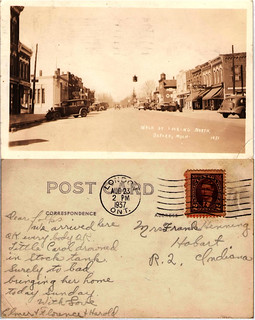
Henningpostcard
(Click on image to enlarge)

This postcard was addressed to Mrs. Frank (Bertha) Henning, who lived across the county line in Union Township, Porter County. When the Vidette-Messenger took notice of the Hennings' social activities, it did so under the heading of "Sedley News," in spite of their address on Hobart's rural delivery route.

Elmer was Frank and Bertha's son, Florence their daughter-in-law, Harold their grandson.

"Little Carol" was two-year-old Carol Piske. On August 20 she had drowned in a water trough on her parents' farm near Oxford, Michigan. I expect that this Piske family was related to the Ross Township Piskes (of which there were at least two households) and perhaps even lived in this area before moving to Michigan. I can't find Carol's parents' given names.


Sources:
♦ Ancestry.com. 1930 United States Federal Census [database on-line]. Provo, UT, USA: Ancestry.com Operations Inc, 2002. Original data: United States of America, Bureau of the Census. Fifteenth Census of the United States, 1930. Washington, D.C.: National Archives and Records Administration, 1930. T626, 2,667 rolls.
♦ "Drowns in Horse Trough." Evening Chronicle (Marshall, Mich.), 21 Aug. 1937 (Access Newspaper Archive).
♦ "Sedley News." Vidette-Messenger (Valparaiso, Ind.), 18 June 1937 (Access Newspaper Archive).