Showing posts with label Sigler. Show all posts

Monday, February 24, 2020

Miss Margaret and the Woodses of Ross Township

I must have been in a bad mood seven years ago when I wrote the post about Samuel B. Woods: I put so little effort into it. Now Sam's youngest child is getting married, so maybe I should take this opportunity to educate myself a bit more.

2020-02-24. Woods, News, 11-1-1923
(Click on image to enlarge)
"Local and Personal," Hobart News, Nov. 1, 1923.


The home of the bride's parents stood, according to A Pictorial History of Merrillville, "on West 57th Avenue, near the intersection of 57th and Cleveland Street (Route 55)." That certainly helps me figure out which of the various parcels owned by the Woodses was where they actually lived.

2020-02-24. Woods 1908
(Click on image to enlarge)
From the 1908 Plat Map.


Samuel Bartlett Woods was born in Ross Township in 1856 to Bartlett and Ann Eliza Woods. Bartlett Woods was among the early settlers of Ross Township and a prominent citizen; you can read more about him in Lake County Encyclopedia. Ann Eliza Sigler, who became Bartlett's wife in 1847 (Indiana Marriage Collection), was the daughter of Samuel and Ann Sigler, early settlers of Hobart Township.

In 1882, Samuel Woods married Mellue Vilmer.[1] They had three children. The first was a son, Harold, who died in 1908. The second was a daughter, Wilma, who married Francis Malmstone in 1915 and lived with him in Griffith. The last was our Miss Margaret.

Now, Chester Clark and his new wife may have spent some of their early married life on his "large farm" at Carthage, Illinois, but we know from the 1930 Census that within seven years they moved back to live on her parents' farm.

♦    ♦    ♦

At the top of the right-hand column on the page above, we find another happy event: at the farm on Cleveland Avenue, Lois Harms turned eight years old. Esther Palm was a neighbor; Ruth and Loretta Schavey were maternal relatives, I'm sure, but I don't know their exact relation.

♦    ♦    ♦

Lower down in that same column, another item that interested me was A. Johnson's public sale "at the old Collver place." I've just barely mentioned the name of Collver and identified the Collver property without understanding precisely where it was …

2015-9-5. Collver 1908
(Click on image to enlarge)
Image from the 1908 Plat Map.


… and now I'm going to try to figure that out. When I wrote the linked post, in 2015, the Lake County Surveyor GIS website may not even have been online — or if it was, my internet connection was not good enough to use it. But now I can use it, and do, and it's very helpful.

Anyway, we can see from the plat map above that the Collver place was bordered on the south by South Side Addition 2. Per the Lake County GIS, South Side Addition 2 is a strip of land running along the north side of 13th Street, from S.R. 51 east to just past Fleming Street (now occupied by a commercial building and several houses). And we have a pretty good idea where the Sapper land was and still is, don't we? So the Collver place was between the Sapper land and South Side Addition 2. Just north of South Side Addition 2 is a cute little house, built in 1919 per the county records, that must have stood on the old Collver place, and was probably occupied by this A. Johnson — maybe even by the Collver family.

And who was the Collver family? The member we're dealing with today — the auctioneer at this public sale — was born Sylvanus Roy Collver in Canada in 1873, but always went by Roy or S.R. He came to the U.S. sometimes around 1890[2], following his father, mother, and brother. In 1900, the family was living in Chicago. Roy was a fruit salesman. In January 1896 Roy had married Margrete Prendergast (Cook County, Illinois, Marriages Index); in June of that year they had a son, whom they christened Sylvanus Albert.

Since Roy was in his early twenties when he married Margrete, that was probably his first marriage. It wasn't his last. I don't know what happened to Margrete, but by 1905 Roy was free to marry Mary M. O'Donnell (Cook County, Illinois, Marriages Index). I think she is the "Mae" who shows up with him the 1910 Census, living in Hobart Township, in their own home. In January 1917, Roy sued Mae for divorce.[3] The divorce must have gone through: in May 1917, Roy married Leah Herman (Indiana Marriage Collection). I can't find them in the 1920 Census, and Roy didn't live to be counted in the 1930 Census. He was still married to Leah when he died in 1927 (Indiana Death Certificates).


I cannot identify the A. Johnson who started all this by having a public sale on the old Collver place.


_______________
[1] I believe that her brother, William E. Vilmer, was a local photographer.
[2] 1893 per the 1900 Census; 1889 per the 1910 Census.
[3] "In the Divorce Courts," Hobart Gazette, January 19, 1917.

Monday, July 30, 2018

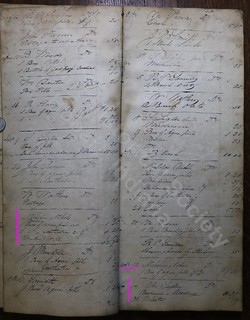
Who Built the Bridge on the Tumbling Dam?

These guys did.

2018-7-30. DayB1840 220, 221
(Click on image to enlarge)
Image courtesy of the Hobart Historical Society.


Construction was going on, apparently, in January 1849 — cold working conditions! I assume this is the tumbling dam at George Earle's grist mill in Hobart.

"Cady" might be Cady Preston, a 33-year-old Hobart resident who came from New York via Michigan, per the 1850 Census. He must have been good friends with the ledger-keeper to be on a first-name basis. (Another possibility is Samuel Cady, but thus far I've found him in the ledgers only up to 1840, and only in the 1840 Census.)

George Cregg (or Craig) has been showing up in the ledgers but I can't identify him in a census.

Mr. Bush's initials may have been O.E., per another entry in the ledger, but otherwise he is a mystery to me.

We've already met Jesse Albee.

"F. Eastling" was probably Ferdinand Eastling, one of five children in the family headed by Luther and Maria Eastling. (Judging by the ages of the older children, I'd say Maria was Luther's second wife.) They farmed the southeast quarter of Section 33, on the west side of County Line Road where it meets State Road 130 (Early Land Sales, Lake County), so when the Pittsburgh, Ft. Wayne & Chicago Railroad came through circa 1858, it cut through their land.

"S. Sigler" may have been either Samuel Sr. or Samuel Jr.

Per the 1850 Census, the Carothers family had a John Sr. and a John Jr. In January 1849, John Jr. was only 12 years old, so I'm inclined to think this entry is for John Sr. He was born in New York circa 1805, died in Hobart in 1864, and is buried in the Old Settlers Cemetery. (Also listed there are a George Carothers — probably John's son — and a Charles, whom I can't identify; they were both Civil War veterans.) John Carothers owned much of the southwest quarter of Section 30, so Old Ridge Road, as it moves from N. Lake Park Avenue to Wisconsin Street, crossed his land (Early Land Sales, Lake County).

Thursday, May 10, 2018

It Could Go Either Way

The merchant of the 1840 daybook occasionally sold medicine along with the various household goods, hardware and tools, farming implements, cloth and clothing, and footwear he carried. But in the autumn of 1843 he seems to have sold little else besides medicine.

Note the entry for September 24, 1843, where Nicholas Nichols buys medicine … and writes his will.

2018-5-10. DayB1840 118, 119
(Click on image to enlarge)
Image courtesy of the Hobart Historical Society.


If the "ague pills" he bought contained quinine, they might actually do some good. The "cathartic pills" — if Nicholas intended to use them to treat fever — were part of the accepted medical standard at the time, and worse than useless. However, from the next page, we see that Nicholas survived at least until November 12, when he bought more ague pills.

Just below that second entry, we find Eli Sigler coming in for other examples of the era's standard medical practice: bleeding and blistering.[1]

I found a rather interesting blog post about such treatments here.

♦    ♦    ♦

Since I haven't been able to find Nicholas Nichols (or Nickels) at all in the census records, I don't know how long he survived beyond 1843.

Eli Sigler was the son of Samuel (Sr.) and Ann Sigler. He survived his bleeding and blistering to reach a ripe old age, and now lies in Hebron Cemetery.


_______________
[1] Long ago I posted a story showing that even in 1904 folk medicine still used a cousin of blistering: namely, the counterirritant of a mustard poultice.

Sunday, January 21, 2018

A Tragedy in Two Purchases

Here is a page from a daybook I have been indexing, which shows transactions in 1839. Among some familiar old-settler names — Sigler, Mundell, Pierce — we find a Charles Walton who, in early September 1939, made two purchases telling a grim story:

2018-1-21. DayB1836 016, 017
(Click on image to enlarge)
Image courtesy of the Hobart Historical Society.


You can fill in the blanks.

I do not know the full name of the deceased brother. Charles Walton does show up among the locals in the 1840 Census, but that census gives so little information that I cannot trace him any further.