Showing posts with label Sievert. Show all posts

Sunday, April 14, 2024

"Destroying Church"

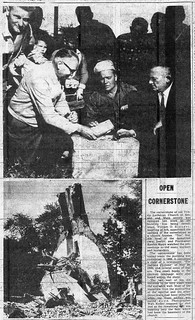
In September 1963 the old Trinity Lutheran Church at Main and Second was demolished. The Gazette printed a photo of the beginning of the end …

2024-04-14. Destroying Church, Gazette, 12 Sept. 1963
(Click on image to enlarge)
Hobart Gazette, 12 Sept. 1963.


… and the very end, as the last wall fell.

2024-04-14. Open Cornerstone, Gazette, 19 Sept. 1963
(Click on image to enlarge)
Hobart Gazette, 19 Sept. 1963.


On a personal note, it appears that I am too old and tired to do everything I've been doing and still maintain a history blog. I'm hoping that when the spring yard and field work is done, and the foster kittens have gone back to the shelter, I'll be able to post more often.

Friday, October 21, 2022

Holy Nosegay!

In the Sievert-Thompson collection at the Merrillville-Ross Township Historical Society Museum are several personalized bibles, with their covers bearing the name of a Sievert family member and a year — the year, I suppose, when the bible was presented as a gift to the family member, at Christmas or on a birthday or some special occasion.

Here we have one given to Ida Lewin Sievert in 1903. Ida was then about 28 years old. She and her husband, Henry, farmed just west of Ainsworth, and had a little daughter (a son was yet to come). It is a German-language bible, die Heilige Schrift.

2022-10-21. Sievert307
(Click on images to enlarge)
Images courtesy of the Merrillville-Ross Township Historical Society.


Ida, like nearly every other owner of a bible or prayer book, slipped things between the leaves — for example, the little card above from her neighbor, Pearl Ols.

She also pressed flowers in it, like this little nosegay with its stems still bound by a thread.

2022-10-21. Sievert308

I think there are two roses in there, along with some clover blossoms and a couple of many-petaled blooms like chrysanthemums or zinnias. (By the way, 4 Mose = Numbers, for us English-speakers.)


The card from Pearl Ols mentions a 25th wedding anniversary, which was probably Ida's and Henry's. That fell on March 17, 1921, just about four months before Ida's death.

Monday, October 3, 2022

Ainsworth Then and Now: the Sievert Farmhouse

Circa 1942, and 2022:

2022-10-03. Sievert137
2022-10-03. Sievert house from Google street view 2022
(Click on images to enlarge)
Top image courtesy of the Merrillville-Ross Township Historical Society.


Thank goodness for Google street view, which saves me from having to go park my car on the shoulder-less 69th Ave. or DeKalb Street to get a photo of the old Sievert farmhouse.

Which, it turns out, is probably the old Brown farmhouse, since the county records show 1850 as the year it was built, and that was before the Sieverts came to Ross Township. The earliest record I can find of ownership of that land, from Early Land Sales, Lake County, is its purchase in May of 1844 by Severn Brown, who bought 80 acres constituting the west half of Section 7.

Severn Brown rests in the Chester Cemetery, along with his wife, Elizabeth.

I shall certainly have to write more about the Brown family, as well as the Sievert family, but at present my brain is very, very tired and has taken a leave of absence to rest and recuperate, and I don't know when it will return.

Friday, September 2, 2022

"My Dearest Sweetheart"

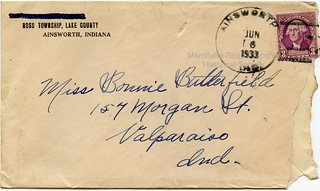
It was 9:00 PM on Monday, June 5, 1933, when the 24-year-old Walter Sievert picked up his fountain pen, grabbed a couple sheets of his father's official Ross Township Trustee stationery, and wrote this letter to the young woman he loved.

2022-09-02. Sievert096
(Click on images to enlarge)
Images courtesy of the Merrillville-Ross Township Historical Society.


2022-09-02. Sievert097

2022-09-02. Sievert095

I haven't seen anything this sweet since the courtship correspondence between Minnie Rossow and Herman Harms. And that young couple couldn't pour out their hearts to the same extent because, of course, they were sending postcards, which could be read by any nosy person in the post office and at the recipient's home.

Walter and Bonnie were married on July 24, 1933, as reported in the Valparaiso Vidette-Messenger of August 1.

2022-09-02. Vidette_Messenger_of_Porter_County_Tue__Aug_1__1933_


I feel that I've neglected the Sievert family of Ainsworth, although I have mentioned Walter's mother and sister. But I'm going to be talking more about them in the near future, because the Merrillville-Ross Township Historical Society has recently been given a treasure-trove of Sievert items, mostly photographs and papers, one of which was the letter above.

Monday, March 28, 2022

The Phantom Road

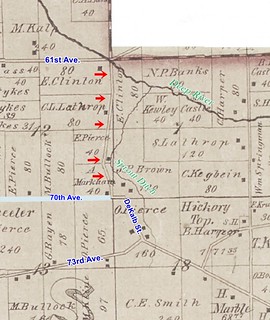
I have always been puzzled by the fact that the Ross Township plat maps — from the earliest we have onward through the mid-20th century — all show a public road where today there is none.

Here is that road on the 1874 Plat Map. It runs north and south along the section line between Sections 12 and 7, except where it bows out westward to avoid Sprout Ditch, and it connects present-day 61st and 70th Avenues.

2022-03-28. Unidentified road, Ross1874
(Click on image to enlarge)

I had to draw in 70th Avenue myself, since it doesn't show up on this map, except for that brief east-west line connecting DeKalb and the phantom road.

Naturally I wondered whether the 1874 cartographer made a mistake. That would not be the only possible error I've encountered on a plat map. Perhaps subsequent mapmakers didn't bother to verify and just copied the original error.

However, I recently came across an announcement in the microfilm newspapers that throws a wrench into the works of the "mistake" theory.

2022-03-28. Vacation of Highway, Gazette, 3-16-1933
(Click on image to enlarge)
Hobart Gazette, March 16, 1933.


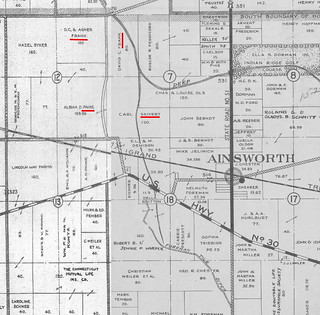
The announcement mentions the surnames of three property owners whose land is adjacent to the road: Frank, Paine, and Sievert. Those match up with the property owners shown in the 1939 Plat Book.

2022-03-28. Unidentified road, Ross 1939
(Click on image to enlarge)
I had to patch two pages together.


The announcement names Henry Sievert, while the plat map shows Carl Sievert owning the land, but I think the plat map just hadn't caught up with the reality that Carl had died in 1929 and his son, Henry, now owned the land.


The announcement seems a little garbled — its heading and opening line specify "vacation" of a highway — that is, abandonment — but it goes on to speak of a "proposed highway" that "will pass through" the described land, as if the road were to be built, not abandoned. And then it says the highway is, or will be, 66 feet in width! That's quite an impressive highway. I'm inclined to think that there was a little carelessness in the drafting or the typesetting of the announcement, rather than that a 66-foot-wide local road was proposed to be built during the Great Depression.

I have searched in vain in the Hobart papers for any information about the outcome of the April 4 hearing mentioned in the announcement. Was the highway officially vacated?

As we see above, the 1939 Plat Book still seems to take notice of a public road there. On the 1939 aerial view, we can still trace the line of the road …

2022-03-28. unidentified road 1939 aerial view
(Click on image to enlarge)
Image via Indiana University's Indiana Historical Aerial Photo Index.


… though it doesn't appear to connect directly with 70th Ave. (and it certainly is not 66 feet in width).

The road is drawn on the 1950 plat map , but not on the 1972 plat map.

Today, if you really zoom in on the Google satellite view, you can see that a wagon-wheel sort of path, probably used by farm machinery, still follows the line of the abandoned road.

That road would come in handy when both the DeKalb Street and the 70th Avenue crossings of the Canadian National Railroad are blocked by freight trains. As this area gets ever more developed, perhaps someday the road will be un-vacated.

Saturday, June 27, 2020

Wedding Report

In late November 1923, a flurry of weddings involving people we know.

The first took place on the farm of Theodore and Annie Rossow. Harry, born in 1898, was their youngest son, but not their youngest child.

2020-06-27. Rossow-Friel, News, 11-29-1923
(Click on image to enlarge)
Hobart News, Nov. 29, 1923.


The young couple stayed in Gary, to judge by the 1930 Census and the 1940 Census, and had no children of their own as far as I can tell; but in 1940 their household included a young niece and nephew. I wonder what the story behind that was.


The next wedding, further down in the same column, involved Isaac Small, descended from the Smalls of Small's Crossing. Isaac's father, Richard, was one of the children of John E. and Mary Jane (Riley) Small, and had died in 1916, which is why only Isaac's mother, Carrie, is mentioned.[1]

Frances' father, Severin (aka Siegfried), was a baker with a shop on Main Street (bought out in 1922 by his son, Fred). Her mother, Lena (Conrad), had died in 1910.

♦    ♦    ♦

The third wedding involved the Moehl family, members of which eventually ran a garage at East and Second Streets in Hobart, near the flat where the article says the newlyweds would live.

2020-06-27. Moehl-Born, News, 11-29-1923
(Click on image to enlarge)
Hobart News, Nov. 29, 1923.


As for the Born family, I can't say I've learned anything about them since the one and only time I mentioned them before, so perhaps it's time for me to do a little research.

Viola Born's grandparents, Charles (aka Carl) and Hanna (aka Johanna) — both German immigrants — brought their family down from Chicago sometime after the 1880 Census. The 1891 Plat Book shows them owning over a hundred acres of farmland west of Hobart. Here is the Born farm as it appears on the 1908 Plat Map:

2020-06-27. Born 1908
(Click on image to enlarge)

It was the same in 1891 but for those southeasternmost 20 acres.

If I'm reading this all correctly, the brick house at 5050 Liverpool Road — built in 1900 per the county records — is probably the old Born place. And the Borns were neighbors of the Ewiglebens.

Viola's father, Paul, was the eldest child. By the 1900 Census he had five siblings. In 1901 he married Emilie (aka Amelia) Bastian (Indiana Marriage Collection). In the 1910 Census, Paul and Amelia, with Viola, Lauretta and a newborn daughter (as yet unnamed) were farming rented land in the same neighborhood — possibly part of his father's property.

Paul's mother died in 1904, his father in 1917. The 1920 death notice of his sister Anna gives a little snapshot of the family at that time:
The funeral of Mrs. Wm. Medrow was held from the home of her sister, Mrs. Bertha Thurber, of West Third street …. Burial was in Crown Hill cemetery.

Mrs. Anna Medrow died Monday at her home in Chicago after an illness of some time from tuberculosis. She was born in Hobart, her age being 46years, 4 months and 2 days, and lived here most of her life. Besides her husband she leaves seven children, six sons and one daughter, also three sisters, Mrs. Bertha Thurber, Mrs. Edward Rohwedder and Mrs. Edwin Sievert, and three brothers, Paul Born of Hobart, and Otto and Fred of Illinois.[2]
The 1920 Census shows Paul's family (now including four daughters) living on their own farm, which, according to the 1926 Plat Book, was formerly his parents' land.

Viola and Ernest Moehl are recorded in the 1930 Census living in their own home (with a radio) at 901 Garfield Street. He was employed by a lumber company as a truck driver.

_______________
[1] Carrie's maiden name was Haxton and she married Richard in 1881 (Indiana Marriage Collection).
[2] "Funeral of Former Hobart Girl Held Wednesday Afternoon," Hobart News, May 20, 1920.

Friday, April 20, 2018

Fast Time

Our friend Fred Rossow lost nearly all his cows in April 1923, as the tuberculosis testing of local herds finished up.

2018-4-20. Fast Time
(Click on image to enlarge)
Hobart Gazette, April 20, 1923.


No one else lost as many in this round of testing, and most of the herds tested clean. "John Harnes" is a misprint for "John Harms."

There is so much material on this page! In the far-left column, Bess Hayward is selling off livestock and farming implements from her parents' estate.

In the next column, just below the cow-testing story, confusion arises from the inconsistent adoption of "fast time" — Daylight Saving Time. (And below that, yet another dance at the Niksches' Deep River Hall.)

In the right-hand column, we find an entertainment planned at the W.G. Haan School.

2018-4-20. brookdale farm synopsis
From Plays of the 19th and 20th Centuries, Volume 27 (1884)

And at the bottom of the column, some Severance-Yager socializing. From the 1920 Census, it would appear that George (Sr.) and Agnes Severance, who always rented the farms they operated, had moved from their previous home, a Ross Township farm west of Hobart,[1] to land in southeastern Hobart Township: their neighbors are Malones, Ensigns and Fasels.

♦    ♦    ♦

I was able to confirm the Harnes/Harms misprint above through the News version of the cow-testing story. That paper also carried a story about Ruby Fisher's marriage to a Hobart chiropractor named Alfred[2] C. Wickham, whom I never heard of before …

2018-4-20. Fisher wedding
(Click on image to enlarge)
Hobart News, April 19, 1923


… or after, either — I can't find them in the 1930 Census.

_______________
[1] "Celebrate Silver Wedding," Hobart Gazette, July 20, 1917.
[2] Indiana Marriage Collection.

Friday, December 22, 2017

South of Deepriver, March 22, 1923

2017-12-22. South of Deepriver 3-22-1923
(Click on image to enlarge)
Hobart News 23 March 1923.


Among all the other social news, we find Maybelle Guernsey marrying Lloyd Moreland of Sedley, who thus far has figured in this blog only as a visitor in other "South of Deepriver" columns. But looking into his background a little, I find that his family goes back to the 1870s in Union Township, Porter County. His grandparents were Joshua and Margaret Anna. I believe that Joshua, born in Ohio in 1834 (Indiana Death Certificates), shows up in Union Township in the 1870 Census with his name spelled Moorland. The following year he went back to Ohio to marry his sweetheart, Margaret Anna McConkey.[1]

The young couple probably returned to Indiana soon after their marriage. The 1876 plat map for Union Township shows a J. Moreland owning a nice big parcel of land not far southeast of where Sedley would be after the Grand Trunk Railroad came through.

Around 1874, Joshua and Margaret had a son named Harrison (1880 Census). In 1896, Harrison married Jessie Wilson (Indiana Marriage Collection). Their son Lloyd was born in 1898 (Indiana Death Certificates).

Per the Union Township plat map of 1921, Harrison Moreland owned nearly 200 acres around Sedley.

2017-12-22. Moreland 1921
(Click on image to enlarge)
Image from http://www.inportercounty.org/Data/Maps/1921Plats/Union-1921.jpg.


The 1930 Census shows Lloyd and Maybelle farming rented land in roughly the same vicinity (to judge by their neighbors); it may have been his father's land. By then they had three children.


To the left of the "South of Deepriver" column is an open letter from William O. Sievert. He may or may not be somehow related to the Ainsworth-area Sieverts — I don't know. I believe he was a Hobart resident; the 1920 Census shows a 25-year-old steel-mill employee by that name in Hobart with his widowed mother, Anna. The Charles Carlson (who was allegedly to blame for the accident) was a son of Swan Peter and Hedwig Carlson, and per the 1920 Census lived in Ross Township, farming on part of the old Carlson place on S.R. 51, roughly across S.R. 51 from the present-day Indian Ridge Golf Course.

____________________

[1] Ancestry.com. Ohio, County Marriages, 1774-1993 [database on-line]. Lehi, UT, USA: Ancestry.com Operations, Inc., 2016. Original data: Marriage Records. Ohio Marriages. FamilySearch, Salt Lake City, UT.

Thursday, November 16, 2017

Ernest Doepping and His Grandmother

I said earlier that I was going to stop trying to figure out the Doeppings, but I lied. How can I help myself? — I've just found more Doeppings "near Ainsworth."

2017-11-16. Mrs. Doepping and grandson near Ainsworth
(Click on image to enlarge)
Hobart Gazette 15 Mar. 1923.


I think the "aged lady" of that first item is Mary, the widow of Frederick. Her grandson, Ernest, showed up in the 1920 Census in the household of his parents, Rheinholdt and Sophia (née Busselburg), in southeastern Ross Township. Ernest was the last of their children still at home, and with him was his wife — he had married Lilly Werblo in 1917 (Indiana Marriage Collection). Perhaps the young people wanted to get their own place, and the next best thing was to move in with his grandmother, Mary, who was getting too old to live alone. Since I suspect Mary of living in one of those little houses on S.R. 51 just north of the Grand Trunk tracks, the household might have been very "near Ainsworth."

The Charles Sievert who was also ill (and also near Ainsworth) may have been the man we find in the 1910 Census living in eastern Ross Township (in the neighborhood of the present-day River Pointe Country Club). He was 61 at that time. However, I can't find him in the 1920 Census.

I wonder where that "hooded Klansman in full regalia" came from, with that money for the Lake Station church? Maybe he was one of those mysterious out-of-towners responsible for the recent parade in Hobart.

Tuesday, October 14, 2014

Raymond Thompson's Mother

From the steamer trunk.

2014-10-14. 5a
(Click on images to enlarge)
Images courtesy of E. Harms.


Handwritten notes on the back of this postcard identify this young lady obliquely:

2014-10-14. 5b

As it happens, "Raymond Thompson's mother" was Ainsworth's own Elsie Sievert, daughter of Henry and Ida, who became Mrs. Burt Thompson in 1919.

Elsie was born circa 1900. This photo is probably her eighth-grade graduation portrait, dating to about 1914. Minnie Rossow Harms and Elsie were roughly contemporaries, but they would have attended different schools and so perhaps did not know each other until Elsie's son Raymond became friends with the young Harmses — I'm totally speculating here! — which might account for the indirect way Elsie is identified in the notes. Just my wild guess.

Sunday, October 12, 2014

Ida Lewin Sievert

2014-10-12. Ida Lewin Sievert obituary
(Click on image to enlarge)
From the Hobart Gazette 29 July 1921.


Ida Lewin's parents, Fred and Augusta, were married in 1870 in Germany, and immigrated the next year. All their children were born in the United States. In 1880 the family lived in Chicago, where Fred worked in a foundry, but sometime later the family moved to northwest Indiana and took up farming. Judging by the fact that their children were intermarrying with locals by the mid-1890s, I dare say that if the 1890 census had survived it would record them already here. By 1900 three of their four children had married; and Fred and Augusta were farming in Porter County with the help of their last single child, 16-year-old Louis.

And so in 1896 Ida Lewin had married Henry Sievert and went from farmer's daughter to farmer's wife. I have already traced their subsequent history to some extent in talking about the marriage of their daughter, Elsie. In addition to the mysterious Randhan farm, they also occupied, at various times, a farm south of Ainsworth belonging to Mike Foreman, one near "Pierce's crossing" and one near the "Pierce milk stand." (If those last two were the same farm, which sounds likely, they lived there some seven years, at least.)

Aside from their various moves, the Sieverts show up in my notes only rarely, in reports of innocent sociability or helpfulness. Their only sorrow, it seems, was the loss, mentioned in the obituary, of two children in infancy,* and the suicide of Ida's brother John in 1907.**

The News gave the immediate cause of Ida's death as "heart trouble." In addition to local mourners, her funeral drew at least ten people from Chicago, and two from Milwaukee.

We have a photo of Ida's sister, Hulda, but none of Ida herself.


_________________________
*I can document only one such loss.
**We'll get to this next.


Additional Sources:
♦ 1880 Census.
♦ 1900 Census.
♦ 1910 Census.
♦ 1920 Census.
♦ "General News Items." Hobart Gazette 8 Mar. 1901; 6 Nov. 1903.
♦ Indiana Marriage Collection.
♦ "Local Drifts." Hobart Gazette 13 Apr. 1917; 29 July 1921.
♦ "Mrs. Henry Sievert, of Near Ainsworth, Passes Away Last Saturday." Hobart News 28 July 1921.

Wednesday, February 5, 2014

Caroline Abel and Her Carpenters

Caroline Abel obit
(Click on image to enlarge)
From the Hobart Gazette 1 Apr. 1921.


Aside from being an early settler, Caroline (Feiler) Abel was the wife and mother of carpenters who were responsible for a lot of building in the vicinity of Ainsworth; my notes are full of "Contractor Abel" and "F. Abel" shipping lumber to Ainsworth and putting up this house and that barn in the surrounding area. Problem is, I'm not sure exactly which Abel is being referred to, since all these references are after the 1900 census, in which both Frank Abel, Sr. and his son, Frank, Jr., described themselves as carpenters. In 1910 they both described themselves as contractors doing carpentry work (Frank Jr. being married with his own household), and 16-year-old Edward Abel also called himself a carpenter.

Let's just take a look at what we can attribute to one or more of the Abels:
  • Nov. 1901: "Walter Blachely [Blachly] will build an addition to his barn on the Mid Harper farm. Frank Abel sold him a carload of lumber with which to do the work."
  • March 1902: "On Wednesday Contractor Abel began building a house for John Miller at Ainsworth, having the contract for the labor and the furnishing of lumber."
  • April 1902: "Contractor Abel … has just shipped a carload of lumber to Ainsworth for C. Hill for repairs on a house and several outbuildings, which he will shortly build."
  • May 1902: "Contractor Abel received another carload of lumber this week for his contracts. He is building an addition to the house of Wm. Foreman, south of Ainsworth."
  • May 1902: "Contractor Abel has just shipped two carloads of lumber to Ainsworth to be used in a large barn that he will build for Frank Bayor…."
  • June 1902: "Contractor Abel this week finished Fred Miller's new house at Ainsworth."
  • September 1902: "An old-fashioned barn raising was held at John Gruel's yesterday and both of his new barns were raised. Quite a number from town attended. Contractor Abel is doing the carpenter work."
  • May 1903: "Contractor Abel has had three cars of lumber shipped to Ainsworth, to be used in the construction of a new barn for Howard Smith who lives south of Deepriver."
  • August 1904: "Contractor Abel is building the new Deepriver church."
  • June 1906: "A week ago Contractor Abel began building a big barn for Chas. Sievert who lives southwest of town. The building will be 34 by 84 feet, with 20-foot posts."
  • September 1906: "Contractor Abel has begun the erection of a new barn, 32 by 48 feet and 18 feet high, on the Mike Ormond farm southeast of Hobart. The dwelling is also to be raised about eighteen inches and a new addition built thereto."
  • October 1909: "Contractor Abel who is building a new barn on the Kramer farm south of town hopes to have the structure completed within a few days."
  • March 1911: "Abel & Sons have been doing a lot of repair work on the Chas. Chester farm near Ainsworth and are now doing work for Ed Batterman."
… and those are just the projects I happened to make note of over the years.

Frank Sr. died in 1915; Edward died in 1918; and Frank Jr. died in 1919 of tuberculosis.

♦    ♦    ♦

Just look at all those Ross Township names in the "Notice of Road Petition" on the Gazette page above. Many acquaintances, some farmers, some Ainsworth businessmen such as Gust Lindborg and Charles Goldman, and even William Wollenberg, who I suppose still owned the saloon building in Ross Township though he lived in Chicago.

I suppose the road in question is E. 101st Avenue.


Sources:
♦ 1880 Census.
♦ 1900 Census.
♦ 1910 Census.
♦ "Early Settler Passes Away." Hobart Gazette 1 Apr. 1921.
♦ "General News Items." Hobart Gazette 8 Nov. 1901; 21 Mar. 1902; 4 Apr. 1902; 2 May 1902; 23 May 1902; 15 May 1903; 26 Aug. 1904; 8 June 1906; 21 Sept. 1906.
♦ "Hobart." Hammond Lake County Times 22 Jan. 1919.
♦ Indiana WPA Death Records Index.
♦ "Local Drifts." Hobart Gazette 27 June 1902; 19 Sept. 1902; 29 Oct. 1909; 10 Mar. 1911.

Monday, December 16, 2013

Oil Truck v. Lincoln Highway Mud

We've already heard about the bad condition of the Lincoln Highway east of Ainsworth. In January 1921 came news that the Federal Paving Company intended to bring its equipment from Chillicothe, Ohio, to commence work as soon as weather permitted, with hopes of completing the paving across Lake County by the middle of the summer.

But the summer of 1921 was a long way away for people who had to get somewhere in the winter of 1921.

Oil Truck v. Lincoln Hwy
(Click on image to enlarge)

Late in February the Gazette brought the "cheering news" that paving work might start in the near future: "Workmen are busy repairing machinery at Ainsworth and Merrillville and getting things in shape for an early start, 'tis said. It is stated that construction work will proceed both ways out of Ainsworth and Merrillville."

I expect that any machinery repair in Ainsworth was going on at Gust Lindborg's blacksmith shop.

♦    ♦    ♦

When I read that story above, about the oil truck, I naturally wondered where the "Ols corner" was, and proceeded to waste about an hour of my life trying to figure it out. My best guess is that it was the intersection of present-day Clay Street and E. 73rd Avenue, because I think that Charles Ols then owned the parcel of land shown on the 1908 Plat Map as belonging to Orrin Pierce:

Ols farm ca. 1921?
(Click on image to enlarge)

I've previously noted that in 1908 Charles Ols bought a farm from Reuben Pierce, and while I can't find a plat map showing that parcel in Charles Ols' hands (the 1926 Plat Book attributes it to A.D. Paine), I still think Charles owned it for some time after 1908 because (1) Orrin Pierce was Reuben's son, and (2) some newspaper reports about Charles' land purchases suggest that location: February 1908, Charles bought a farm from "Reuben Pierce, who live[d] west of Ainsworth," but rented it out while he continued living on another farm that he was renting; in November 1908, Charles advertised for rent his farm "one mile west of Ainsworth"; October 1916, Charles, having previously "bought a part of the Orrin Pierce farm," now "purchased from Chas. Chester 23 acres, a part of the original Pierce farm, which join[ed] his farm on the north across the Grand Trunk railroad."

So that's my theory.


Sources:
♦ "Additional Local News." Hobart Gazette 27 Oct. 1916; 28 Jan. 1921.
♦ "Cheering News." Hobart Gazette 25 Feb. 1921.
♦ "General News Items." Hobart Gazette 14 Feb. 1908.
♦ "Local Drifts." Hobart Gazette 13 Nov. 1908.
♦ "The Lincoln Highway Through Lake Co. to Be Finished This Year." Hobart News 20 Jan. 1921.

Saturday, August 17, 2013

This Must Come and These Must Go

In October 1920, Albert Orcutt (who had an Ainsworth connection through his wife, née Etta Mander) had come to realize that his business building — this one, I suppose — must be renovated "sooner or later."

Also, the social activity of our friends South of Deepriver.

Orcutt and South of Deepriver
(Click on image to enlarge)
From the Hobart News of Oct. 7, 1920.


Meanwhile, Edward Rohwedder is getting rid of his excess inventory as he prepares to move to a smaller farm.

Rohwedder public sale
(Click on image to enlarge)
From the Hobart News of Oct. 7, 1920.

Tuesday, April 2, 2013

School-Year Souvenir

From the steamer trunk.

1900-01 school souvenir p. 1
(Click on images to enlarge)
Images courtesy of E.H.


1900-01 school souvenir p. 2

I'd really like to think that this souvenir was from the Ainsworth school. Just three things make me question that: first, the number of pupils is so small, and (to the extent I know where their families lived) they all come from east of Ainsworth; secondly, there is only one teacher, and I believe that by the 1900-01 school year the Ainsworth school had two rooms; and thirdly, I know that there used to be a schoolhouse on the corner of present-day Ainsworth Road and Spencer Street (known as the Green school, I think), quite suitable for east-of-Ainsworth children to attend. I don't know when that school was decommissioned.

The first reference I find in my notes to Mary Herlitz as a teacher comes in 1904 and places her at the Ainsworth school, teaching one room while Silas Zuvers taught the other. But, of course, my notes are anything but comprehensive.

So — there we are, for now.

Many of these names are already familiar; only a few I don't remember seeing before. Clarence and Vivian Casper were grandchildren of Reuben Bridle (father of Edith and Blanche Bridle), who in 1907 was farming "one and one-quarter miles north of Deepriver on the county line road"; I wish I knew the story behind the absence of Clarence and Vivian's parents. I can't identify the Cooper children in the 1900 census, nor Robert Lydle.

It's touching to see Alvena Nolte there, just a schoolgirl, about 12 years old. Another three years and tuberculosis would cut her life short.


Sources:
♦ 1900 Census.
♦ "General News Items." Hobart Gazette 29 Nov. 1907.
♦ "Local Drifts," Hobart Gazette 11 Mar. 1904.

Thursday, January 17, 2013

Barred Plymouth Eggs

I get a little thrill every time one of the Noltes breaks their silence voluntarily — that is, not because of a death or a crime — even if it is only to sell some Barred Plymouth Rock chicken eggs.

All kinds of Wants
(Click on image to enlarge)
From the Hobart Gazette of April 2, 1920.


John Sievert, the one selling the colts, was a Ross Township farmer who has earned only one individual mention so far in this blog, though his parents are buried in Chester Cemetery.

Saturday, July 7, 2012

A 5 and 10¢ Marriage

Third Street 1920
(Click on image to enlarge)
The Thompson 5 and 10¢ Store is at right in this circa-1920 view of Third Street.


I have spent about an hour trying to figure out what relation Henry Sievert had to John Sievert (Sr. and Jr.) and Carl Sievert, all of whom flitted in and out of Ainsworth history. My conclusion at the moment is that he had none.

The first mention I find in my notes of Henry Sievert comes in 1901, when he moved from Porter County to "Robt. Randhan's farm near Ainsworth," which I have not been able to locate. It was not just Henry who moved, but also his wife, Ida, and their little daughter Elsie. Henry and Ida would continue to farm rented land. From the 1910 and 1920 censuses, they appear to be neighbors of Charles Ols, which would place them just northwest of Ainsworth. By 1910 a little boy, Walter, had joined the family.

My attention was drawn to this little Sievert family just now by the announcement that their daughter, Elsie, 19 years old, had quietly gone to Crown Point on July 16, 1919, and come back the wife of Burt Thompson, Jr., who was 21.

Burt Thompson, father and son, operated the Thompson Co. 5 and 10¢ Store, which occupied the Friedrich building in Hobart and advertised heavily in the Hobart papers. Their business also had a Crown Point location, and Burt Jr. found himself commuting between Hobart and Crown Point nearly every day. The young couple were considering moving to Crown Point, but for the present they lived with his parents in the Joryville area.

Apparently they decided to remain in Hobart, for the 1920 census finds them there, in their own household though still near his parents. Burt is described as the manager of a "10¢ store." The census-taker, writing in January 1920, describes their daughter Lorraine as three months old.


Sources:
♦ 1900 Census.
♦ 1910 Census.
♦ 1920 Census.
♦ "General News Items." Hobart Gazette 8 Mar. 1901.
♦ Indiana Marriage Collection.
♦ "Thompson-Sievert." Hobart Gazette 25 July 1919.
♦ "Thompson-Sievert." Hobart News 24 July 1919.

Friday, April 1, 2011

An Exodus of Blachlys

In October 1917, having sold her farm to S.J. Craig, May Blachly and her mother, Amelia, moved to a home they had bought in Crown Point. (The next month Amelia's eldest son, Earl, paid them a visit, bringing along his latest wife, Annie.)

In December, Amelia's second son, J.B., decided on a change of careers — in the same half-hearted way as his brother Earl: he'd give up farming, but not the farm. He would hang onto that, renting it out, while he went into the business of selling silos and tractors.

J.B. advertised an auction to sell off his livestock and equipment (even his "nearly new" typewriter!).

Blachlyauction1917
(Click on image to enlarge)

A good crowd turned out for the auction on December 11, in spite of the cold weather. J.B. had a fine herd of cows, and they brought good prices. A neighboring farmer, Henry Sievert, bought the best cow in the herd for $197. Altogether, J.B. took in about $5,000.

Although he'd already contracted with Gust Piske to rent the farm, J.B. hadn't quite figured out yet where he was going. That decision took a few more days, but on January 3, 1918, J.B. moved with his wife, Belle, and 17-year-old son, Clifford, to Merrillville.


Sources:
♦ "General News." Hobart Gazette 4 Jan. 1918.
♦ "Local and Personal." Hobart News 29 Nov. 1917; 20 Dec. 1917.
♦ "Local Drifts." Hobart Gazette 7 Dec. 1917.
♦ "Public Sale." Hobart Gazette 7 Dec. 1917.
♦ "Public Sale." Hobart News 6 Dec. 1917.
♦ Untitled social column. Hobart News 11 Oct. 1917.

Saturday, November 20, 2010

"From Any Cause, Except Accident"

From the Hobart Gazette of August 25, 1916:

11-20-2010 Sievert: Auto insurance 1916

Early auto insurance, covering everything except what's most likely to damage your car. It's better than nothing, I suppose.