Showing posts with label racetrack. Show all posts

Saturday, April 14, 2018

Calvin Scholler's Third Marriage

Calvin Scholler's experience with marriage had been heartbreaking so far — one young wife lost to influenza and another to cancer — but in April 1923 he decided to brave it once more.

2018-4-14. Scholler-Young
(Click on image to enlarge)
Hobart News, April 12, 1923.


The Gazette added, "The bride is formerly from Glascow [sic], Scotland, and a life-long friend of Mr. and Mrs. Bruce."[1]


Other mildly interesting items on that page include (in the left column) the Gem Theatre's ad for The Toll of the Sea, which made me learn a little more than I used to know about motion pictures in color.

In the next column, the top article concerns the future site of the Roosevelt Gym. The bottom article describes the newly formed Hobart Gun Club planning to meet "on the Jerry McAuliff[e] farm east of the city in the field formerly used as a motorcycle race track," which sounds as if the racetrack had fallen into disuse.

_______________
[1] "Scholler-Young Nuptial," Hobart Gazette, April 13, 1923.

Friday, December 4, 2015

Electric Railway Line and Racetrack Updates

To my earlier post about the Logansport, Hammond & Chicago Traction Co. buying right-of-way from the McAuliffes, I have added a couple of 1903 news items.

An unrelated item in the "Local Drifts" Hobart Gazette of June 12, 1903, caught my eye: "Those desiring stand or other privileges in the grove near the race track for the Fourth, should apply at once to B.W. Strattan." Doesn't that sound as if the racetrack is in or near Hobart? — that would mean that Hobart had a horse racetrack long before it had a motorcycle racetrack. I seem to remember an even earlier story that suggested likewise, but I can't lay my hands on the cite at the moment.

Thursday, December 4, 2014

A Lincoln Highway Death

On September 19, 1921, at the crossing of the Lincoln Highway south of Ainsworth (the present-day intersection of Grand Boulevard/S.R. 51 and E. 73rd Avenue) a speeding car struck a turning car, and the result was death.

12-4-2014. Fisher accident on Lincoln Highway
(Click on image to enlarge)
Hobart News 22 Sept. 1921.


William Raschka* came upon the scene just after the wreck and probably helped organize the rescue. Maria Fisher was carried to the Hobart doctor in John Chester's car, Alvah Fisher in a car belonging to George Hall of South Bend (probably the "man from South Bend" mentioned as a witness in the above article).

Maria was too badly injured to attend her husband's funeral. A week later she was still in the hospital but reported to be "improving nicely."

"Wm. G. Fisher, brother of the dead man," who sought to have the other driver charged with manslaughter, had experienced a car accident of his own, though much less serious, just a few weeks earlier.

♦    ♦    ♦

Happier things were going on elsewhere; e.g., George Sauter's grocery store. I never heard of the Wilson & Co. meat-packing company before, though I've certainly heard of Wilson sporting goods.

Just above that article — another race at the Hobart Speedway, and Everett Newman continues to win.


________________________________
*William had previous experience in dealing with a bad accident.


Additional Sources:
♦ 1920 Census.
♦ "Death of Alvah Fisher." Hobart Gazette 23 Sept. 1921.
♦ "Local Drifts." Hobart Gazette 30 Sept. 1921.
♦ "Reckless Driving Again Brings Death." Hobart Gazette 23 Sept. 1921.

Monday, September 22, 2014

Heat, Dust, Fire, Fists, and Speed

The Hobart Speedway's event of July 3, 1921, organized by the Gary Auto Racing Association, was described as a "free for all" — meaning that any driver, from anywhere, could participate who paid the $20 entry fee.

Among the entrants was a 27-year-old Hammond resident, Emil Huff, who owned an auto repair shop; a racer of at least four years' experience, he seemed to be something of a local celebrity. Riding beside him in a remodeled Essex roadster (maybe something like these) would be Earl Nussear, his mechanic, who, the previous year, had been "pit man" to the famous Gaston Chevrolet.

A Chicago driver, Eston "Bill" Winston, would be driving a Ford. Other out-of-towners came from East Chicago, Indiana Harbor, Gary, and Whiting, including Bill Harris, driving the "Red Devil," and Bill Vogt, piloting the "White Streak," also known as the "Million Dollar Ford."

"The track has been chemically treated to eliminate dust," the Gazette promised. But as the racers and the spectators — about 2,000 of them — gathered on Sunday, July 3, the temperature reached 98 degrees and the sun beat down pitilessly. The dirt track and the vegetation around it baked to dryness, with predictable results.

The Gary Evening Post gave the most complete account of that exciting and miserable day:

2014-9-22. Race at Hobart Speedway 7-3-1921
(Click on image to enlarge)

♦    ♦    ♦

By sheer luck I have acquired a series of eight photographs that I believe show the July 3, 1921 race (since the details in the handwritten captions match up to that unusual race). They were taken by Willis J. Imes, an 18-year-old letter carrier from Hammond.*

2014-9-22. Race 1
(Click on images to enlarge)

2014-9-22. Race 2

2014-9-22. Race 3

2014-9-22. Race 4

______________________________

*I have a whole album of his photographs, dating generally to the 1920s, most of them with captions, but since only the eight above relate to Hobart and none to Ainsworth, I don't know if I can ever come up with an excuse for including them in the blog.


Sources:
♦ 1920 Census.
♦ 1930 Census.
♦ "3 Spills, One In Hospital, Fire, Fist Fight, At Hobart Speedway." Gary Evening Post 5 July 1921.
♦ "Auto Races Here July 3rd." Hobart Gazette 1 July 1921.
♦ "Bad Spill in Hobart Auto Races." Lake County Times (Hammond, Ind.) 5 July 1921.
♦ "Hobart Was a Very Quiet and a Very Warm Place Over the 4th." Hobart News 7 July 1921.
♦ "Lake County Racers Tune Up Machines for Hobart." Gary Evening Post 1 July 1921.
♦ "Race Fans Receive Several Thrills at Speedway, Sunday." Hobart News 7 July 1921.
♦ Smith's Directory of Hammond, Ind. and West Hammond, Ill. for 1921-1922. Ancestry.com. U.S. City Directories, 1821-1989 [database on-line]. Provo, UT, USA: Ancestry.com Operations, Inc., 2011.
♦ "Two Hurt at Auto Races." Hobart Gazette 8 July 1921.

Thursday, September 18, 2014

Skeleton Ford Polo

The Hobart Speedway's 1921 season — its second — was busy. Though built for motorcycles, the track was now hosting auto races as well (not to mention baseball games).

On Sunday, May 29, some 2,500 people turned out to watch five races (three motorcycle, two auto). A June 12 event featured not only races but a dangerous stunt — "picking a rider from a racing auto by an airplane," which involved said rider grabbing a rope ladder that dangled from the airplane, climbing up it and being wafted off to Gary, fortunately without injury. Another novelty that day was a polo game with "skeleton Fords" taking the place of horses, where injuries to the players and the loss of some wheels just added to the excitement. The whole event was handled by a professional promoter, who took 85% of the gate receipts; the Hobart Motorcycle Club retained 15%, plus all the concession stand earnings. Heavy advance advertising brought some 5,000 to 10,000 people to block traffic on Cleveland Avenue, swarm over the McAuliffe farm, devour all the pop and sandwiches the concession stand could supply, and choke on the clouds of dust from the dirt track.

The Motorcycle Club netted around $1,000, and swore to do something about that dust at the next big event.

2014-9-18. Speedway ad
(Click on image to enlarge)


Sources:
♦ Advertisement. Gary Evening Post 1 July 1921.
♦ "Big Attendance at Hobart Speedway Races Sunday." Hobart News 16 June 1921.
♦ "Races Draw Big Crowd At Speedway, Sunday." Hobart News 2 June 1921.

Sunday, August 17, 2014

The Shadow of the Speedway

The Hobart Historical Society museum has on display a gigantic aerial photo of Hobart dated 1967. Seriously, this thing is about seven feet high and wide.

Although by 1967 the Hobart Speedway was long out of use, on that photo you can still see its shadow in the fields south of Cleveland Avenue. This is probably the sort of thing that could not be seen from ground level, only from the air.

Here is a photo I took yesterday of that part of the gigantic aerial view.

IMG_6793 copy

Here it is with labels:

IMG_6793 labeled

You can see the whole set of images I took, trying to get a good shot, here.

Monday, June 16, 2014

The Cheerful Liar and the Hot-Headed Shooter

Here's what was going on in the new Ainsworth school in May of 1921.

2014-6-16. Cheerful Liar
(Click on image to enlarge)
From the Hobart News, 12 May 1921.


I gather that the Palmer Stock Company got its name from the village of Palmer, in Winfield Township (where Randolph Street crossed the CC&L/C&O railroad). While I haven't identified C.H. and Mrs. C.H. Burge, the other cast members appear locally in the 1920 census.

In searching (unsuccessfully) for the text of the play, I came across a story of some Minnesota high school students who decided against performing it, I gather, because of its potential to corrupt young people.

Above the Cheerful Liar ad is another for a baseball game to be played at the Hobart Speedway … a novel way to use a motorcycle racetrack.


Meanwhile, at the old Ainsworth school …

2014-6-16. Shooting
(Click on image to enlarge)
From the Hobart Gazette, 13 May 1921.


The Gazette speaks of "Mike Murphy" as if local readers would know him, but he's a mystery to me. As is Dan Maybaum, still.

Friday, November 15, 2013

A Mighty Wind

Wind v. Niksch windmill
(Click on images to enlarge)
From "Local and Personal," Hobart News 16 Dec. 1920.


Mrs. Edward Niksch had been Matilda "Tilly" Harms, one of Herman's sisters and ten years his senior. So it was her parents' land where Tilly and Edward lived.

Harms land 1908

♦    ♦    ♦

The page from the Hobart News, above, includes an ad placed by Stommel's store, enticing you with Lut Fish. Among those who would buy it, at Stommel's or elsewhere, would be Ainsworth's own Anna and Gust Lindborg — lutefisk, they called it, and they had it at Christmas, as a treat. It brought back fond memories of their childhood Christmases in Sweden.

Their Americanized children found the smell horrifying, and the taste not worth the smell.

Friday, May 31, 2013

The Racetrack's First Fatality

Hobart's motorcycle racetrack opened May 30, 1920; not quite three months later it claimed its first victim.

The Hobart Motorcycle Club had gathered at the track around 2:30 on the afternoon of Sunday, August 22. That was the usual time for races, but this was no big event, just a practice race among the club members. As they organized as the starting line, one among them — Emerson Whisler, the club secretary — warned them to be careful. Or so said a witness, after the disaster.

It was Emerson Whisler, taking the curve at the south end of the track, who lost control of his bike and took a bad spill, striking his head. He was unconscious when the other riders stopped to help him. They carried him to the McAuliffe house. There he remained unconscious, as a doctor was sent for, and probably his family as well, as the hours went by with no improvement. About 1:30 Monday afternoon, Emerson died without ever having regained consciousness. The cause of death was concussion.

I do not know whether Hobart's motorcycle racers ever wore much in the way of protective headgear. We've seen images among the glass-plate negatives like this one of cyclists wearing ordinary caps or a rudimentary leather helmet. At an informal race in August, riders may well have gone bareheaded.

The 29-year-old Emerson left a wife and two children, besides his parents and four or five sisters. He had come to Hobart four years earlier, working first as a streetcar conductor, and then going into the Gary mills. In addition to the motorcycle club, he belonged to the local Odd Fellows lodge; his brothers there took charge of the funeral. It was held on Wednesday, August 25, at Emerson's home west of Hobart on Ridge Road. The motorcycle club "turned out in a body," according to the News, "and the long line of motorcycles at a funeral was an impressive sight as well as an unusual occurrence." The fallen rider was buried in Crown Hill Cemetery.

Emerson Whisler
(Click on image to enlarge)


Sources:
♦ "Dies as Result of Accident." Hobart Gazette 27 Aug. 1920.
♦ "First Fatality at Hobart Speedway Last Sunday." Hobart News 26 Aug. 1920.

Friday, May 17, 2013

Motorcycle Racetrack?

Someone had told me that you can still see traces of Hobart's motorcycle racetrack in the landscape, so I was looking on the Google Maps satellite view for it. I didn't see any such thing, but I saw something cute in roughly the same location. I think it's a corn maze. Go and look if you don't believe me. (This is Google Maps, now, not Google Earth, and you really have to zoom in.)

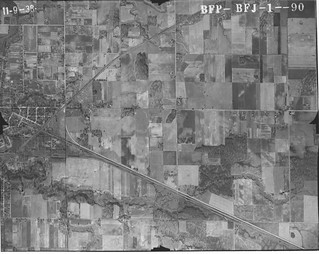
However, to return to history, here's a 1938 aerial view of that general area. It includes an oval line in the fields that could be a racetrack, in what seems to me about right for the location of the McAuliffe land.

BFJ-01-090 Hobart motorcycle racetrack
(Click on image to enlarge)
Image courtesy of the Indiana Geological Survey.


Here, I'll do my label thing.

Hobart motorcycle racetrack detail
(Click on image to enlarge)

So? Whaddaya think?

Wednesday, April 10, 2013

Oh, Nothing; Just Another Airplane

Airplanes are old hat
(Click on image to enlarge)
From the Hobart News of June 24, 1920.


If you want people to look at your airplane these days (1920), you have to involve it in a death-defying stunt.

Airplane stunt at racetrack
(Click on image to enlarge)
From the Hobart Gazette of July 9, 1920.

Sunday, March 3, 2013

Racing News, and the Boys with the Yellow Paint

Motorcycle Race ad

The Hobart Motorcycle Club was confident enough to place this ad in the News ten days before the scheduled race although, according to the Gazette, its members were still working to get the new track ready — the "low places [were] being tiled and the grading [was] progressing."

Three days before the race, the News reported that the work was nearly done: all topsoil had been removed, the curves were banked properly, and the three-quarter-mile track would indeed be ready for the races on Decoration Day, 1920.

The town's memorial ceremony was scheduled for 1:30 p.m., so the races' 2:30 p.m. starting time would allow people to engage in solemn remembrance and then go have fun.

And indeed they did have fun. The racetrack's opening day was a great success.

Motorcycle Race
(Click on image to enlarge)
It's not that I think you're interested in all the details of the race, Dear Reader; I just wanted an excuse to include that totally irrelevant story about the murderous farmhand.


♦    ♦    ♦

The News of May 20, 1920, which carried the ad shown above, also carried a small and mystifying item in its social column: "It is said that the boys with the yellow paint were at work again one night this week."

That the "boys" had no names and were working at night leads me to speculate that this was a case of vandalism, similar to the events of the autumn of 1918. But if this vandalism was likewise in protest — then in protest of what, I wonder? The war was over, and so were its gasless Sundays and rabid anti-German paranoia; thus there was no excuse, anymore, for denouncing "slackers" or persons of German origin. I wonder if perhaps this time the "boys" were trying to denounce Prohibition-flouters?


Sources:
♦ Advertisement. Hobart News 20 May 1920.
♦ "Hobart's New Speedway Will Be Opened Sunday Afternoon." Hobart News 27 May 1920.
♦ "Local and Personal." Hobart News 20 May 1920.
♦ "Motorcycle Races Well Attended." Hobart Gazette 4 June 1920.
♦ "Motorcycle Races Will be Held at 2:30 Sunday, May 30." Hobart News 20 May 1920.
♦ "Motorcycle Races." Hobart Gazette 21 May 1920.
♦ "Nearly 5,000 See Motorcycle Races Sunday Afternoon." Hobart News 3 June 1920.

Friday, February 15, 2013

Hobart's Own Motorcycle Racetrack

The Hobart Motorcycle Club had been organized in the summer of 1919. For its first racing season, its members had to content themselves with racing in other towns, such as Crown Point and Valparaiso ; but they had plans for Hobart.

By the spring of 1920 those plans were coming to fruition. In early May, the club announced that it had secured a lease of several years* on 30 acres owned by Jerry McAuliffe. The News described the leased parcel as "just east of town out Cleveland avenue on the Hobart-Valpo road," so I think we're talking about some part of this land:

McAuliffe land 1926
(Click on image to enlarge)
This shows land owned by Jerry McAuliffe, and his father, T. McAuliffe, in 1926.


The members of the motorcycle club set about preparing a three-quarter-mile race track. The Powers-Thompson Construction Co., which was then at work paving some of Hobart's streets, allowed the club to use its "router machine," and Lloyd Arnold donated his steam tractor engine. The club planned to hold its first race on May 30.

_____________________
*Six years according to the News, while the Gazette says three.

Sources:
♦ 1910 Census.
♦ 1920 Census.
♦ 1926 Plat Book.
♦ "First Motorcycle Races To Be Held Here May 30th." Hobart News 6 May 1920.
♦ "Motorcycle Race Track Started." Hobart Gazette 7 May 1920.