Showing posts with label Smith. Show all posts

Monday, June 1, 2026

Sale on the Howard Smith Farm

For some reason I thought this notice about a sale on Howard Smith's farm in February 1924 was interesting enough to retrieve from the microfilm. Maybe because Howard Smith was dead, and dead people are my favorite people. Anyway, I'm going to slap this up here, because I'm still too busy to do any kind of post that requires research.

2026-06-01. 1924-01-31 News, Administrator's Sale - Howard Smith
(Click on image to enlarge)
Hobart News, 31 Jan. 1924.


The last time we saw Melvin Guernsey, it was 1920 and he was planning to leave for Florida. If he did go, he was obviously back, and farming again. Melvin was not planning on quitting farming (unlike Barney Rhoda in the notice below his): he was just moving to the "Wm. Bixenman farm three miles east of Crown Point."[1]

The notice names "M. Hurlburt" as the administrator of Howard Smith's estate. That would be Milan Hurlburt, who was Howard's uncle.

♦    ♦    ♦

I did not realize when I was getting this page from the microfilm that the story in the left-hand column quotes Charles Chester of Ainsworth. If only I had! — I would have gotten the whole story, so we could have found out what Charles Chester of Ainsworth said about Calumet Electric company's proposal. Now we'll never know. But at least we now know that in 1924, the Chester farm was getting electricity from its own generating system.

_______________
[1] "Local and Personal," Hobart News, 31 Jan. 1924.

Friday, December 20, 2024

Daddy's First Church, and Daddy's Subsequent Career

After my recent post about the Deep River church history, I decided to dig out a postcard that I have been ignoring ever since I bought it a couple years ago because dealing with it would require research, and I'm lazy.

Here it is:

2024-12-20. 1918 Deep River - Moody Inst 01
(Click on image to enlarge)

2024-12-20. 1918 Deep River - Moody Inst 02

I thought it would take a long time to identify pastors of the Deep River church, especially a neophyte who served there circa 1918 as his first church. I was wrong.

Just a little bit of searching in the on-line newspapers turned up a Deep River pastor who apparently started at that church around May 1916 (at least, that was the first mention of him I could find):

2024-12-20. 1916-05-17 Valparaiso-Porter-County-Vidette, Driftwood from Deepriver (Gerald Smith) p-5
(Click on image to enlarge)
Porter County Vidette (Valparaiso, Ind.), 17 May 1916.


And that was not a one-time appearance. The local social columns in the Porter County Vidette continued throughout 1916 and into the spring of 1917 to report the Rev. Gerald Smith preaching at the Deep River church and being entertained at local homes.[1]

In this March 1917 account of a church-related box social, we learn that the Rev. Smith's mother lived in Viroqua, Wisconsin:

2024-12-20. 1917-03-14 Valparaiso-Porter-County-Vidette, Successful Box Social, p-8
(Click on image to enlarge)
Porter County Vidette (Valparaiso, Ind.), 14 Mar. 1917.


In mid-May of 1917, the Rev. Smith gave notice that he was resigning as pastor of the Deep River church …

2024-12-20. 1917-05-16 Valparaiso-Porter-County-Vidette, Southeast Ross, p-8
(Click on image to enlarge)
Porter County Vidette (Valparaiso, Ind.), 16 May 1917.


… but he continued to act in that capacity for a few more weeks, at least:

2024-12-20. 1917-06-13, Valparaiso-Porter-County-Vidette, County Church Meeting at Deepriver, p-2
(Click on image to enlarge)
Porter County Vidette (Valparaiso, Ind.), 13 June 1917.


So I, in my innocence, typed "Gerald L.K. Smith" into my Google search and … oh, dear. How is it that I never heard of him before?

A brief biography appears on Wikipedia. An Indiana website mentions Deep River among his earliest preaching experiences; apparently it was, in fact, "Daddy's first church." He has written books and had books written about him, some still available to buy on Amazon.com.

He died in 1976. Here is one of many obituaries that were printed in newspapers across the U.S.:

2024-12-20. 1976-04-17 The Miami Herald, Gerald L.K. Smith obit
(Click on image to enlarge)
Miami Herald, 17 Apr. 1976.
(The year of his marriage it wrong: it was actually 1922.)


♦    ♦    ♦

Photographs of Gerald L.K. Smith abound on the internet, mostly from later in his career. The earliest I could find was this, from 1926, when he served as pastor of an Indianapolis church:

2024-12-20. Gerald L.K. Smith 1926
Image from the Indiana Album, Joan Hostetler Collection.

Here is a later photo (undated).

2024-12-20. Gerald L.K. Smith date unknown
Image from https://www.4029tv.com/article/arkansas-presidential-candidates/43698269.

Let us go back to the postcard above and take a better look at the young man standing at the left end of the back row:

2024-12-20. unknown 1918 Deep River - Moody Inst postcard detail
(Click on image to enlarge)

Is that the same person as in the two photos above? I don't know. I have run these photos through three free on-line facial comparison programs; two said these photos are all the same person, a third said they are not.

♦    ♦    ♦

And now let's look at the notes on the back of the postcard.

"Daddy's first church" was written during the ballpoint-pen era — that is, after World War II. The handwriting looks, to me, like a woman's.

The notes in red pencil may be the Rev. Smith's own writing, but I have failed to locate an on-line specimen to compare. I think these notes were written some time after the photo was taken. I imagine that Gerald Smith and his wife, Elna, were going through some of his old things and making notes for the benefit of posterity.[2] Thus, Gerald Sr.'s memory might have been a little off about the year.[3]

I had heard, of course, about the Moody Bible Institute and Moody Church of Chicago; what I did not know of, prior to researching this postcard, was the Moody connection to Cedar Lake, Indiana. In the timeframe of this postcard, one or both of those institutions held classes and events at Cedar Lake, eventually purchasing the former Monon Park for that purpose.

Here is a sampling of local articles about Moody events at Cedar Lake from 1916 to 1919:

2024-12-20. 1916-01-24, Lake County Times (Hammond, Ind.), p-2 (Cedar Lake)
(Click on image to enlarge)
Lake County Times (Hammond, Ind.), 24 Jan. 1916.


2024-12-20. 1917-06-28 Lowell, Lake County Times (Hammond, Ind.), p-9 (Cedar Lake)
(Click on image to enlarge)
"Lowell," Lake County Times (Hammond, Ind.), 28 June 1917.


2024-12-20. 1919-06-27, Lake County Times (Hammond, Ind.), p-1 (Cedar Lake)
2024-12-20. 1919-06-27 Cedar Lake, Mecca For Bible Students, Lake County Times (Hammond, Ind.), p-11
(Click on images to enlarge)
Lake County Times (Hammond, Ind.), 27 June 1919.


The point of this Cedar-Lake discursion is that I suspect our postcard photo was taken at a Moody event there. The group in the photo is standing in wooded grounds, and the autos behind them suggest they drove there (as opposed to taking a train, as they might have for a Chicago event). While I have failed to turn up, in the on-line newspapers, any specific mention of Deep River church members attending such an event with the Rev. Gerald Smith, they may have done it without publicity.

That would have been a bit unusual, though, wouldn't it? I think the Rev. Smith himself was responsible for so many items about the Deep River Church making their way into the local papers — after he left, the church seems to have dropped from the columns of the on-line papers to such an extent that I can't even find out who succeeded him as pastor there.


But at this point my laziness kicks in again. I'm pretty sure I have identified who "Daddy" was, and I've come up with a plausible hypothesis about the photo on the postcard. Anyone who wants more research done can do it themselves.

_______________
[1] For example, the "Driftwood from Deepriver" columns of 24 May 1916, 21 June 1916, 12 July 1916, 16 Aug. 1916; and the "Southeast Ross" columns of 8 Nov. 1916, 22 Nov. 1916, 17 Jan. 1917, 11 Apr. 1917.
[2] They had one child, an adopted son named Gerald Jr., but as far as I have been able to find out Gerald Jr. left no surviving children.
[3] Nothing about either the fashions or the automobiles says exclusively 1918 or later.

Monday, September 18, 2023

The Harpers, the Other Harpers, and the Other Other Harpers

I thought I would just quickly research Calvin and Mary (Underwood) Harper of the brick house beside the Deep River, and figure out what (if any) relation they had to Ainsworth's other Harpers (Benjamin; Middleton; Robert; and Robert's aunt, Ellen, who married Cyrus E. Smith). I did research them, but it wasn't quick.

So first let me just get the basic facts about Calvin and Mary Harper, who built the brick house.

Calvin was born in Ohio on September 24, 1819, to William and Deborah (Thompson) Harper. William was a native of New York, Deborah of Vermont, but they had moved to Ohio by the time of their marriage in 1818.

Calvin married Mary Underwood in September of 1843, in Ashtabula County, Ohio. Mary had been born in 1822[1] to Harmon and Mary (Mather) Underwood, in New York. The family must have moved to Ohio by the 1840s, although I can't find them in the census. By 1850 Harmon, Mary, and several of their children had gone to Lake County, Illinois.

But their daughter Mary, now a Harper, did not go with them. Here we see her and Calvin, with their only child, Mayvorite, in Ashtabula County, Ohio, in the 1850 Census:

2023-09-18. 1850 Census - Harper, Calvin and Mary
(Click on image to enlarge)
Image from Ancestry.com.


You will note that their neighbors include Harpers and Thompsons, any of whom may have been relatives. The family of Benjamin and Ruth Harper is particularly interesting. Ruth was Mary's sister, who married Benjamin Harper in 1842 (in Ashtabula County). But what was Benjamin to Calvin? — per a family tree I've found on Ancestry.com, Benjamin was Calvin's uncle, but that tree doesn't cite any definitive sources.

In my earlier post about the land now occupied by Southlake Mall, I noted its purchase in October 1852 by Daniel Underwood. He must have been some a relation to Mary (Underwood) Harper — brother, probably, or uncle. According to Early Land Sales, Lake County, in that same month and year, her father, Harmon Underwood, bought at least 160 acres in Ross Township.

Calvin and Mary Harper came to Ross Township in 1850, according to her 1916 obituary;[2] if so, that must have happened after July 1850 when the census was taken. The land they eventually owned was purchased by James Halsted in June 1852. The 1860 Census records Calvin and Mary in Ross Township. While (as we know) early censuses don't give addresses, the Harpers appear as neighbors (on the census, at least) to Carter and Charlotte Castle, who owned land adjacent to James Halsted's 1852 purchase. This suggests that the Harpers were already on their farm on what is now Grand Boulevard, living in a predecessor to the brick house.

In 1868, Mayvorite Harper married Admiral[3] Rodney Castle. He was the son of Lysander and Maria Castle, born in Ohio in 1841 (Indiana Death Certificates). Lysander had died in 1851[4], and his widow married Samuel Lathrop. The 1860 census and the 1874 Plat Map show the Lathrop-Castle blended family as neighbors of the Harpers.

As for Benjamin and Ruth Harper, they were still in Ohio in 1860, but within the decade they also came to Ross Township, where the 1870 Census found them. According to the 1874 Plat Map, they owned a good chunk of land at the tiny village of Hickory Top (later Ainsworth). They probably lived in, and may have built, the house at 6305 Ainsworth Road, built in 1869 per the county records.

The children of Benjamin and Ruth were Mary, Ellen, and Frank.

Ellen married Cyrus Smith in 1861 in Erie County, Pennsylvania;[5] in 1863[6] they moved to the farm in Ross Township where they would settle permanently.

Ellen's brother, Frank Harper, married Ella Hopkins in 1878, here in Lake County, and they had two children: Cassie and Robert. Thus, Robert was Ellen Smith's nephew.


When it comes to Middleton Harper, things get murky. From his obituary and his grave marker, we know he was born in Montgomery County, Indiana, on December 10, 1850. Per his death certificate, his father was John Harper, born in Tippecanoe County, Indiana, and his mother was Sarah Frazier, born in "East Tenn." or maybe "East Penn."

Middleton first appears as a nine-year-old boy in the 1860 Census of Tippecanoe County. The household consists of his grandfather (I'm guessing), Middleton, born circa 1795 in Maryland, and his 27-year-old mother, who is described as widowed. (She has several children besides Middleton, and there is a 21-year-old William who may be her brother-in-law.)

The next glimpse I catch of Middleton Harper is not the 1870 Census — I can't find him in it — but the Indiana Marriage Collection, which shows him in Lake County, Indiana, marrying Anna Goodrich in 1872. You'd expect to find them in the 1880 Census, but you'd be disappointed.

We do find Anna Harper in the 1900 Census. By then she was widowed. We also find her in 1910 and 1920, living with her married daughters.

But that doesn't help us figure out if Middleton Harper was any relation to all these other Harpers. I just don't know.

♦    ♦    ♦

All of this was put together with online sources. If I ever get the time to go through microfilm and other offline sources, I may find out more.


_______________
[1] Indiana Death Certificates.
[2] "Descendant of Cotton Mather Dies at Miller," Porter County Vidette (Valparaiso, Ind.), 19 Apr. 1916.
[3] Yes, that was his given first name.
[4] He is buried on the south bank of the Deep River west of State Road 51; according to legend (as noted in the NWIGS's Ross Township Cemeteries), at the time of his funeral and even after two days' wait, the river was too swollen to carry his coffin across to the cemetery up the road in Hobart Township.
[5] This is according to his obituary ("Death of a Ross Township Citizen," Hobart Gazette, 8 Oct. 1915); I can't find a record of their marriage on Ancestry.com. I do wonder if this means that Ellen's family spent some time in Pennsylvania, between the time they left Ohio and the time they came to Indiana.
[6] Also from Cyrus' obituary.

Tuesday, June 20, 2023

Fannie Wheeler Smith

I have been meaning to post this ever since I wrote about Frank and B.E. Smith.

This is the obituary of their mother, Fannie Wheeler Smith.

2023-06-20. Fannie Wheeler Smith obit, Hobart Gazette, 9-22-1899
(Click on image to enlarge)
Hobart Gazette, 22 Sept. 1899.


I never cease to marvel at how much people traveled in the days when traveling was hard, slow, and miserable.

Fannie's husband, Henry, may have been fairly comfortable financially, if he handled his mill earnings and his Gold Rush money wisely, so perhaps when he died in 1856, he did not leave her in dire financial straits with four young children (or three children and a pregnancy). Nonetheless, the 1860 Census shows her working as a seamstress. By the summer of 1866, as we learn from B.B. Bale's obituary, she and her eldest surviving son, Frank, were operating a hotel together (although the article about the Bales' 60th wedding anniversary describes it as a "small boarding house").

The 1870 Census lists Fannie's occupation as "keeping house." She had only one minor child still at home, but also her 23-year-old daughter, Mariam Brock — who may have been widowed by then — and a little granddaughter. Still, it seems she no longer felt the need to earn money.

As I've mentioned before, I can't find her in the 1880 Census.

I do not know Fannie's middle name. If it began with E., her grave in Hobart Cemetery is marked. If not, then, apparently, it isn't.

Incidentally, Fannie's surviving sister, Mrs. M.H. Earle of Pasadena, was the divorced first wife of John Earle (George's son). They had been married in Lake County on April 12, 1854. I do not know when they were divorced.

♦    ♦    ♦

While I'm at it, here is the obituary of Mariam Smith Brock from the Hobart Gazette of November 6, 1909.

2023-06-20. Mariam Smith Brock obituary, Hobart Gazette, 6 Nov. 1909
(Click on image to enlarge)

Subtract 37 from 1909 and you get 1872 as the year her husband died; however, the writer did say "about thirty-seven years," so it's possible she was widowed when the 1870 Census recorded her living with her mother. I haven't been able to locate any record of John Brock's death.

Mariam was laid to rest beside her mother, says the article, and the NWIGS' book of Hobart Township cemetery listings records M.N. Brock next to F.E. Smith in row W4 of Hobart Cemetery. Neither stone has any information about birth or death or anything else.

♦    ♦    ♦

7/5/2023 update — Thanks to Suzi at the Hobart Historical Society for finding Fannie and Mariam in the 1880 census:

2023-06-20. 1880 Census - Fannie Smith, Mariam Brock
(Click on image to enlarge)
Image from Ancestry.com.


Fannie kept house, while Mariam worked as a dressmaker. Mariam now has a seven-year-old son as well as a daughter, so perhaps I was wrong in guessing that she had been widowed by 1870.

Thursday, January 5, 2023

Letters to Fonso

It's 1897, and B.E. Smith has left Hobart to work as a teamster in Chicago. His older brother, Frank, remains in Hobart, dealing in groceries and writing business-like letters to B.E.

2023-01-05. Smith, Frank J. to B.E. Smith 1897 1
(Click on images to enlarge)

2023-01-05. Smith, Frank J. to B.E. Smith 1897 2

The first is dated January 2th, 1897.

Fonso I shiped you 27 bush & 30 lbs at 22 per bush. You can get it Thursday & be shure & send the bags rite back & you speak a bout sum Potatoes if they are good you can send a Baral & I would like a barel of good onions & a baral box of good celery if good & cheap but don't want no frosen stock but if you can't send them as well as not let them go but if you can send them send them rite a way & if you want more corn send sacks & I will try & get sum more
Yours Resp[ectfully] F. Smith
If you could send Bbl of parsnips
The second is undated, but seems to involve the same 27 bushels, along with some advice about how B.E. should feed his horses:
Fonso I Paid the freight 144 [illegible scrawl]
If you ar feading oates be carfal in changing fead a little corn with the oate & salt well un till they get youst to the corn
Now if you can get me sum Potatos & sum good onions & sum good celer[y] jest as well as not & [illegible] or Rhodab Rhudabages they are jest the same to me
27 B 30# at 22 X  604
freight                    144
                                 748

That make the corn stand you a bout 27 per Bushul then let me no what it is worth then [or "there"?] is there ena [any?] saven [or "sance"?] in it
Cr BE S. 3.50
I will try to interpret these: Frank has sent Fonso 27 bushels plus 30 pounds of corn at 22 cents per bushel. He has shipped the corn in sacks and wants his sacks back right away. At least some of the corn is for Fonso's horses (he's a teamster, remember?); Frank is concerned that if Fonso has been feeding his horses oats, the sudden switch to corn will upset their stomachs, so he advises mixing the corn gradually into the oats.

Apparently Fonso, up in Chicago, is able to scout out good produce in the various wholesale markets, so Frank wants him to send a barrel of potatoes, a barrel of onions, and a box of celery, so long as it's not frozen (which was a possibility in January[1]). Oh, and a barrel of parsnips. Also, some [illegible] or some rutabagas; Frank doesn't care, [illegible] and rutabagas are just the same as far as he's concerned. (Part of the [illegible] looks like "bananas" to me, but in what universe are rutabagas and bananas just the same to anyone?)

All these barrels of potatoes, etc., would be resold in Hobart, I'm guessing.

The "and Son" part of this business was probably Frank's son, Henry Sylvester (born ca. 1879 and named for his grandfather).

♦    ♦    ♦

Frank's obituary, printed in the Hobart Gazette of January 21, 1927, gives some of the family history going back to Hobart's earliest days.

2023-01-05. Death of Hobart's Oldest Pioneer, Gazette, 01-21-1927
(Click on image to enlarge)

This part about Frank's father is interesting:
Henry S. and Fannie (Wheeler) Smith, natives of Pennsylvania, … emigrated to Ohio and later to Michigan in pioneer days. Mr. Smith visited City West as early as 1838, where he became a great friend of the Indians and learned their language, ways, customs and desires. The Smiths and the Wheelers came to Hobart together and were active in its early growth. This pioneer Smith built the first sawmill for the late George Earle and also the first gristmill which gave service to the community in those early days. When the Mexican War broke out, Mr. Smith became an Indian interpreter for the government and was with Gen. Freemont [sic] in the west. He later entered the gold rush to California but soon returned to Hobart where he died Aug. 5, 1856.
Henry Sylvester Smith is buried in the Old Settlers Cemetery.

It's also interesting that Frank's older brother, Charlie, was probably the first fatality of the Hobart sawmill. That accident would have occurred in 1846 if Frank was then two years old. I do not know where young Charlie is buried.

Nor do I know where Frank's three wives are buried. We know from the obituary that Clara Loague Smith died in 1913 and her death certificate states that she was buried in Hobart, but I can't find a record of her grave. Harriet Ferrin Smith died of tuberculosis on February 6, 1887, [2] but again I can't find a grave. In the case of the first wife, Rosana Eastwood Smith, I don't even know when she died.

As a Civil War veteran, Frank lies beneath a military marker that has nothing to say about his birth or death, only his service.

I've identified only five of the seven children that the obituary attributes to Frank. One was Almantha Smith Bullock, born ca. 1882. The others are Henry Sylvester (b. ca. 1879, as mentioned above), Eugene (ca. 1884), Charles (ca. 1897), and Loleta Smith Havrilla (ca. 1901).

_______________
[1] To be perfectly honest, I don't know how they would prevent freezing during winter shipping in 1897. I'm profoundly ignorant of how wholesale produce was handled in Chicago in 1897.
[2] "Hobart Items," Crown Point Register, 10 Feb. 1887.


Tuesday, November 29, 2022

Alphonso Smith by Any Other Name

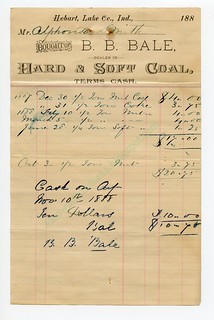
Let's take another look at those statements of account from my last post.

2022-11-04 Bale coal merchant papers 3a

(Reverse of the above:)

2022-11-04 Bale coal merchant papers 3b (verso)

2022-11-04 Bale coal merchant papers 4

Who (you might ask) was that Alphonso Smith guy who bought all that coal from B.B. Bale?

Searching on that name in that place on Ancestry.com brings up only one record: the 1870 Census, where he's a boy of 14 living in the household of Fanny Smith, in Hobart.

2022-11-29. 1870 census - Alphonso Smith
(Click on image to enlarge)
Image from Ancestry.com.


This census did not record how household members were related to each other. It didn't take me long to find out that Mariam Brock was Fannie's daughter, and Carrie Brock her granddaughter. But no other records places Alphonso and Fannie together in one household.

However, in the 1860 Census, Fannie's household includes a boy named Bernett who was then four years old — born the same year as the 1870 Alphonso. Once we assume they are the one and the same, it becomes easier to find this coal-purchasing guy. He was Bernett Elfonso Smith — and yes, it seems he spelled his middle name with an E; only when other people are writing it does the A appear.[1]

I think it was he who signed that promissory note to B.B. Bale:

2022-11-04 Bale coal merchant papers 2

Part of the signature was lost, but you can see the E plainly enough.

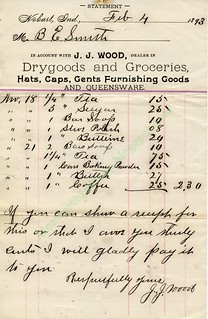
Bernett Elfonso was born to Henry and Fanny (Wheeler) Smith circa 1856. That was probably the same year his father died. His parents were in Porter County for the 1850 Census, but by 1860, as we've seen, the family moved to Hobart. There the widowed Fanny raised her children and spent the rest of her life. Although I can't find the family in the 1880 Census,[2] the Bale coal accounts place him there in the late 1880s, and the promissory note in 1892. And here we have another receipt placing him in Hobart in 1893 — buying some groceries and household goods from John Wood.

2022-11-29. J.J. Wood receipt to B.E. Smith 1893
(Click on image to enlarge)

Notwithstanding these appearances in Hobart, it seems that Bernett Elfonso also spent time in Illinois, probably Chicago: in 1888 he married Helen Brown in Cook County, and by 1900 they were living in Chicago with their young daughter, Sarah. At that time B.E. worked as a teamster.

But sometime after 1900 the family moved to California. The 1910 Census shows them in Pasadena (B.E. working as an "investigator" for a gas and electric company), and the 1920 Census shows B.E. and his wife farming in Fresno County (their daughter having moved out of the house and married). On May 30, 1929, B.E. Smith died in Fresno.[3]

2022-11-29. Smith, B.E. - death notice - The_Fresno_Morning_Republican_1929_06_03_page_3
(Click on image to enlarge)
Fresno Morning Republican, 3 June 1929.


♦    ♦    ♦

Having found that last death notice, I thought I had settled the whole life of Bernett Elfonso Smith, so you can imagine my confusion when I came across this obituary in the Hobart Gazette of October 29, 1942:

2022-11-29. Rites for B.E. Smith Held Tuesday, Hobart Gazette, 10-29-1942
(Click on image to enlarge)

Could there possibly be two Bernett Elfonso Smiths in Hobart's history? Unlikely as it seems, the answer is yes. The one who died in 1942 was the nephew of the one who died in 1929: the son of his elder brother, George.


_______________
[1] In the Union Sunday School record book that begins in 1868, a scholar named "Burnett" and one named "Alphonso" are (or is) recorded, although the actual dates of attendance are unclear.
[2] The 1880 census of Hobart is very hard to read, so the name could easily be mistranscribed; but I have looked through all 30 pages of it on Ancestry.com without being able to find Fannie or Bernett Elfonso — only her son/his brother, Frank Smith.
[3] The commercial papers in this post and my previous post about B.B. Bale (as well as another post to come) all came from a seller in Fresno.

Friday, November 4, 2022

Hobart's First Coal Merchant, and the Last of His Name

I recently bought a little packet of commercial papers, held together with a straight pin (because what else do you use when paper clips and staplers haven't been invented yet?).

2022-11-04 Bale coal merchant papers 1 in situ
(Click on images to enlarge)

Upon taking out the rusty straight pin and getting a good look at the individual papers, we find that they concern sales of coal in 1887 and 1888 by Hobart's own Bell Benjamin Bale.

2022-11-04 Bale coal merchant papers 3a

This is on the reverse of the above:

2022-11-04 Bale coal merchant papers 3b (verso)

2022-11-04 Bale coal merchant papers 4

2022-11-04 Bale coal merchant papers 2

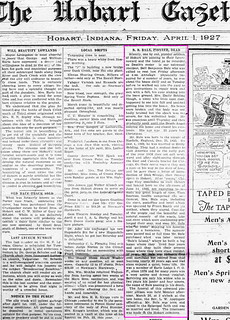
From the obituaries written up in the local papers following his death on March 25, 1927, we learn that he was Hobart's first coal merchant and established the first coal yard in town. We learn a good deal more, too, for B.B. Bale had been a Hobart resident for some 60 years, known to all, and so his death, and his life, received much attention.

2022-11-04 1927-04-01 Gazette, B.B. Bale, Pioneer, Dead
(Click on image to enlarge)
Hobart Gazette, 1 Apr. 1927.


2022-11-04 1927-03-31 News, B.B. Bale obit
(Click on image to enlarge)
Hobart News, 31 Mar. 1927


More details come from this write-up of his sixtieth wedding anniversary, which fell on December 1, 1922. (The text of the article comes from a photocopy of a typewritten manuscript in the Bale file at the Hobart Historical Society Museum, which has no date or source; while it reads like a newspaper article, it's not from the Gazette, and the issues of the News where it might have appeared are missing from the microfilm.)
Mr. and Mrs. Bale Observe 60th Wedding Anniversary

Mr. and Mrs. B.B. Bale, among Hobart's oldest and highly esteemed citizens, on Friday last passed the sixtieth anniversary of their wedded lives, the day being observed by no outward celebration but rather remembered quietly in their home together in keeping with their unostentatious lives.

Mrs. Bale, whose maiden name was Emily Turner Belding, was the daughter of George and Emily Belding and was born December 8, 1837, in the County of Norfolk, England, where her parents owned a large estate.

Mr. Bale, son of John and Mary Bale, also residents of Norfolk County, was born December 25, 1835. At the time of his marriage, December 1, 1862, which was celebrated in the Episcopal church of which both Mr. and Mrs. Bale have been life-long members, he operated one of the large farms of Mr. Belding's estate. Four years after their marriage Mr. and Mrs. Bale decided they would come to America, arriving in this country June 14, 1866. They came through to New York and soon thereafter to Hobart, then scarcely more than a wilderness with perhaps about a dozen and a half scattered homes.

They stayed at a little boarding house, located where the Kramer block now stands, for a few weeks after their arrival, while their own log cabin was being constructed on the beautiful little isle long since known as "Bale's Island." Traces yet remain there of what was once their home and its pleasant surroundings.

During the first year or two of their residence on the island they had no near neighbors, but later the Parks family located on the farm across the creek, [1] then quite a stream, and still later the Daniel Lightner family moved near on the place now owned by his grandson, Dick Johnston, and family. Four years, Mr. and Mrs. Bale lived on the island, then built their present home where they have resided for the past 52 years. At the time of their moving there, their own home and that of the Wettengel family and a little house occupied by the Decourcy family, located near where the Swedish Lutheran church now stands, were all the houses then built on the east side of the bridge over Duck creek.

"In town," Black's store was the center of business and the post-office. Andrew Wall, Sr., and family lived in a little house near Black's. Ernest Passow, a brother of the late Christian Passow, Sr., conducted a grocery and shoe shop in a little building located on the corner of Third and Main streets in the space now occupied by the Central Drug Store. Mr. and Mrs. John Mathews, both now passed away, had a home near what is now the Community building. The brick building on School Street at the rear of the M.E. Church, now remodeled and occupied as a dwelling by Mrs. Margaret Rohwedder, was once the public school building where also were conducted Sunday School and church services, a traveling preacher occasionally coming to officiate. Here Mrs. Bale, assisted by Mrs. Wedge, Mrs. DeCourcy, Mrs. Nixon and Alfred French as its superintendent, established the first Sunday school in Hobart, known as the "Union Sunday School." Their music was assisted by a little melodion which Mr. French carried to and from the building each Sunday.

Mr. Bale operated the first coal yard in Hobart. Some thirty years ago he was attacked with grip which settled in his hips leaving him a sufferer and partial invalid for life which caused him to retire from active business.

Mr. and Mrs. Bale have known Hobart through all its years of changes and development and, through their association with its interests, have contributed much to the upbuilding of the town.

May coming years be measured full of life's choice blessings is the wish prompted by the steadfast friendships they have won.
Emily Bale was interviewed in 1937 on the occasion of her 100th birthday.

2022-11-04 1937-12-12, Chicago Tribune, 100 Years Rest Gently on Lady of Old Norfolk

While the handwritten notes on this photocopy give the source as the Chicago Tribune of December 12, 1937, I have not been able to find this article in that issue online, or any other online paper.


I haven't finished with the Bales, or with this little collection of papers regarding coal sales, either, but this is all I have time for today.

_______________
[1] I believe the reference is to Duck Creek.

Wednesday, August 24, 2022

Series Finale: The Harms 73rd Ave. Farm History

And now we come to the waning days of 1896 — December 28, to be exact — and William Notter is selling his 79.5 acres to Henry and Annie (born Johanna Springman) Harms, who were living on and farming their old homestead to the northeast of this property. The Harmses were to pay $3,180 for the land (about $112,000 in today's money) in installments.

2022-08-24. 1896-12-28 Notter to Harms -- Harms 73rd Ave farm history
(Click on images to enlarge)
Images courtesy of the Eldon Harms family.


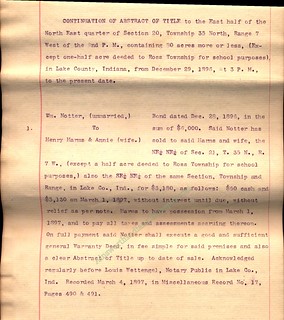
The transaction included an action to quiet title, a review of the property's owners — not all of them, in this case, as you can see. I'm guessing the action named only the ones who might conceivably have some claim to the land.

2022-08-24. 1896-12-28 Notter to Harms -- quiet title 1

2022-08-24. 1896-12-28 Notter to Harms -- quiet title 2

2022-08-24. 1896-12-28 Notter to Harms -- quiet title 3

The only new information we get from this concerns Emma Smith, daughter of Luther and Sarah: in 1881 she married William J. Hatch in Chicago; they had five children, and then Emma died in 1893. None of the surviving Hatches turned up to contest the title to the farm.

This is the title bond that William Notter gave to Henry and Annie Harms on December 28, 1896, promising to deliver title to the land and "a clear abstract of title" upon payment of the full purchase price, without interest.

2022-08-24. 1896-12-28 Notter to Harms title bond - Harms 73rd Ave farm history

On the outside of the title bond, William Notter jotted down a payment by the Harmses of $300 on the "noat" in January 1897. Below that, someone with more polished handwriting (Louis Wettengel, probably) recorded a larger payment, and William signed his name.

2022-08-24. 1896-12-28 Notter to Harms -- title bond verso 1 - Harms 73rd Ave farm history

And this, also from the verso of the title bond, is why I think the person with the polished handwriting was Louis Wettengel.

2022-08-24. 1896-12-28 Notter to Harms title bond verso 2 - Harms 73rd Ave farm

Louis was a resident of Hobart, who appeared in the 1870 Census as a saloonkeeper, but by the 1880 Census had made a lawyer of himself. He and his wife, Emmeline (Shearer), had many children, lived out their lives in Hobart and are now buried in Hobart Cemetery.

By October 16, 1897, Henry and Annie Harms had paid off the purchase price of the land, and William Notter gave them the deed.

2022-08-24. 1897-10-16 Notter to Harms - warranty deed - Harms 73rd Ave farm

2022-08-24. 1897-10-16 Notter to Harms - warranty deed verso 1 - Harms 73rd Ave farm

2022-08-24. 1897-10-16 Notter to Harms - warranty deed verso 2 - Harms 73rd Ave farm

And so we come to the end — not of the history of the farm, but of this abstract. I'm afraid I've already given away an episode of the sequel, when Henry and Annie sold 9 acres of the land to Herman and Minnie Harms in 1938. From a comparison of the 1939 Plat Book to the 1950 Plat Book, we can see that a lot more dividing and selling of the land went on over the course of that decade. I shall see if I come across any details in the future.

Sunday, July 3, 2022

Ross Township School Report Card, 1875 (cont'd)

Having covered Alfred Winslow and the Brown's Point school last time, I shall now look at the other Ross Township schools described by the county superintendent of schools in 1875.

2022-06-21. REPORT ON SCHOOLS Crown-Point-Register-Feb-11-1875-p-2

(Click on image to enlarge)
Crown Point Register, 11 Feb. 1875.


The superintendent was not impressed by District No. 13. The school building was sparsely equipped, and the pupils and their parents seemed unenthusiastic. Based on the fact that the teacher here was Mary Underwood, I'm guessing that this was the one-room Underwood school. Mary was probably the 19-year-old daughter of Daniel and Sybil Underwood. (Three years after this report, she would marry Jackson Castle.)

District No. 1 was being taught by Asa Bullock. He was about 20 years old, the son of Moses and Amanda Bullock, and in 1875 probably still living where he was recorded in the 1870 Census, on the Bullock farm along 73rd Avenue. If he taught at the nearest school to his home, that would be the one-room Adams school on the northeast corner of Colorado and 69th. In spite of poor equipment, the superintendent says, "The teacher is quite thorough and is doing good work." As we learned from his obituary, Asa had formal training at a normal school and taught for some eleven years, before going into the practice of law. At his death, some of his former pupils still remembered him as "a good teacher."

Next we have District No. 2, which was especially bad. The (few) students' textbooks were "wholly unfit" while their seats were "a complete wreck, all broken and cut up." The teacher was Cyrus Smith, and since his farm, as we know, lay just west of the intersection of (present-day) Green and 73rd, I'm guessing he taught at the Ainsworth school, which in 1875 still had only one room. Cyrus' 1915 obituary said, "In his earlier days in Ross township, he taught school for eight years during the winter months." (During the other months, of course, he farmed.) The superintendent says nothing about how well the students were doing. Unless I'm reading too much into that silence, that suggests they weren't doing particularly well. Perhaps Cyrus — while evidently competent, since he kept getting re-hired — was not the sort of extraordinarily gifted enough teacher who could inspire the undersupplied students in their dilapidated school.

Moving on, we find that the "Merrillville Graded School" was large enough to need two teachers. Again, no maps or charts, but otherwise the report was favorable: "Order good; pupils pretty well advanced; good interest, and good attendance. Teacher quite thorough and doing good work." The teacher in this case, I believe, was Orsemus H. Spencer, whom we've met before only in passing (as the brother-in-law of Harriet Hanks Chester, and the brother of Charles Spencer). Mrs. Spencer, whose department the superintendent did not have time to examine, was the former Emma Gearhart, whom Orsemus married in 1871 (Indiana Marriage Collection). She was his third wife.

His first wife was Esther A. Tree, a native of Canada, who shows up in the 1850 Census in Porter County. Her father's name is illegible, but elsewhere[1] is given as Bradford; her mother's name is Lucinda; and Esther has a sister, Marilla, who eventually married Charles Spencer — so two sisters married two brothers. As for the Spencer family, originally from Ohio where Orsemus had been born in 1836, by 1850 they had settled in Hobart. As early as 1855 Orsemus began appearing in the Hobart Township Trustee's ledger as a teacher.

In 1856 Orsemus and Esther eloped (I'm guessing) to marry in Berrien County, Michigan. The 1860 Census shows the young couple, with their two small boys, farming in Porter County. In August 1862, Orsemus joined the 73rd Regiment, Indiana Infantry. Apparently he was taken as a prisoner of war, then paroled, and discharged from the Army in July 1863 for health reasons, suffering from "heart disease and rheumatism from exposure while in prison."[2]

Probably in April 1866, Esther died.[3] On May 20, 1867, Orsemus married Lucy Hanks. He and Lucy, with the sons from his first marriage, were recorded in Hobart in the 1870 Census, he giving his occupation as schoolteacher. Lucy died sometime in 1870 or 1871, though I can't determine exactly when.[4]

On August 18, 1871, Orsemus married Emma Gearhart. As late as June 1879 I find both of them in the Hobart Township Trustee's records, receiving pay as teachers. Perhaps it was that summer that they left for Kansas, where the 1880 Census found them, and where they lived out the rest of their lives. Orsemus died there in 1896. When Emma died in 1907, her body was brought back to Indiana for burial.

♦    ♦    ♦

This 1875 report does not cover all the schools in Ross Township. I would have liked to hear about the Green, Deep River, Hurlburt, and Vincent schools, all of which show up on the 1874 Plat Map in eastern Ross Township, as well as several others in the more westerly part of the township.

_______________
[1] In the 1900 death certificate of Esther's sister, Marilla Tree Spencer.
[2] Ancestry.com. Kansas, U.S., Enrollment of Civil War Veterans, 1889 [database on-line]. Provo, UT, USA: Ancestry.com Operations, Inc., 2013. Original data: Enrollment of Ex-Soldiers and Sailors, their Widows and Orphans, 1889. Unit ID #190462, 69 volumes. Records of the Adjutant General’s Office. Kansas State Historical Society, Topeka, Kansas.
[3] Per a family tree on Ancestry.com that does not cite a source for this information.
[4] I find information in the Crown Point Register, in the "From Hobart" columns of June 9, 1870, and June 23, 1870, about the illness and death of Mrs. O.A. Spencer, but if that is a misprint for O.H., then how could Lucy be recorded in the census on July 19, 1870? The same family tree mentioned in footnote 3 above gives June 3, 1870, as the date of Lucy's death but does not cite a source, and again, what about the census?

Friday, October 29, 2021

Mr. and Mrs. Johann Christian Traugott Erfurth, Just Passing Through

Now let's get back to the northern 40 acres of the Harms 73rd Avenue farm. We left off in 1870, at which time ownership of those 40 acres was transferred from Charles Smith to Albert Van Doozer. Charles' parents, Jacob and Hannah, may or may not have still been leasing the land and farming it themselves.

Five years later, it appears that the elder Smiths had no further want of the land, for whatever reason that may have been. On New Year's Day, 1875, Albert and Emma Van Doozer sold the land to someone named Johann Christian Traugott Erfourth.

2021-10-29. 1875-01-01 Van Doozer to Erfourth - Harms Abstract of Title 018
(Click on images to enlarge)
Images courtesy of the Eldon Harms family.


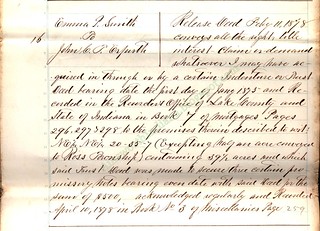
Johann aka John, and his wife, Eliza Rosalia, borrowed the money to purchase the land from one Emma P. Smith …

2021-10-29. 1875-01-01 Mortgage - Erfourth to Smith - Harms Abstract of Title 019

… who was, I'm guessing, the daughter of Luther and Sarah Smith. If my guess is correct, Emma was about 20 years old (born circa 1855 per the 1860 Census). I do not know where a 20-year-old would get $500 to lend out, unless she inherited it from her mother, or perhaps a grandparent (we know that both her grandparents were dead by September 1877). I have not been able to find out anything about Emma's life after her father's estate was distributed, beyond the fact that she became an orphan in 1871.

The surname of the purchasers has already appeared in two different spellings: Erfourth and Erfurth. Later it shows up as Ehrfurth. Even with all those options I cannot identify Johann and Eliza in any other record, such as a census, that would give us details about them.

A lien search two years later (when the Erfurths were selling the land) showed that Johann had been active enough, during the previous ten years, to be involved in a couple of lawsuits:

2021-10-29. 1877-09-12 lien search Harms Abstract of Title 021

That first lawsuit, Ehrfurth v. Kline, might have involved an Ainsworth-area Kleine/Kline, but without a first name we can't know.

The second lawsuit, Steinfeld v. Ehrfurth & Bommerschein, tells us that the Erfurths were in business with a Martin Bommerschein — but I can't find any information about him, either. Nor can I identify this Steinfeld person who sued them.

So this episode in the history of the Harms 73rd Avenue farm is a big "I don't know."

Finally, in 1878 — several months after the Erfurths had sold the land — Emma Smith released the mortgage on it.

2021-10-29. 1878-02-11 Release - Harms Abstract of Title 022


I just have to add that I think "Traugott" is an interesting name. It means "trust in God."