Showing posts with label Waldeck. Show all posts

Monday, March 23, 2026

Darn Lucky Kids of Ainsworth

This photo was (somewhat crudely) printed on a postcard …

2026-03-23. 1909-04-29 Playhouse (unidentified) Ainsworth to Deepriver 01
(Click on images to enlarge)

… and mailed on April 29, 1909, from Ainsworth to the 13-year-old Phillip Waldeck in Deepriver (by someone who didn't know how to spell Phillip):

2026-03-23. 1909-04-29 Playhouse (unidentified) Ainsworth to Deepriver 02

These lucky kids are unidentified. I think their parents memorialized this awesome playhouse by taking the photo and having it printed on at least one postcard. So many nice things! — kid-sized rocking chairs, two dolls, a teddy bear loading up a toy train, and curtains in the window.

What do you want to bet these kids were some of Philly's many Maybaum cousins? I'm just taking a wild guess.

Friday, December 13, 2024

A Very Short History of the Deep River Church

I came across this article in the May 14, 1975 issue of the Hobart Gazette about the Christian Church of Deep River, whose original building is now the Deep River County Park visitors' center.

2024-12-13. 1975-05-14 Gazette, Deep River Church Has Historical Past
(Click on image to enlarge)

It's interesting that the old-timers of 1975 did not remember Contractor Abel, unless he was one of the volunteers mentioned. But I believe he and his family belonged to the German Lutheran Church in Hobart, so it isn't likely that he was volunteering his services to the Deep River church.

The article does me a favor by explaining the "Willing Workers," as I was unclear about its origin. I have seen that ladies' aid society mentioned numerous times in the early 20th-century newspapers (for example, a 1922 social column previously posted announced their fund-raising sale and supper). The earliest such mention I can find in my notes was in June 1906,[1] so I guess the 1975 old-timers' memories were off by just one year. Which is remarkably good.

I only wish the article were clearer about the location of the dance hall! [6/24/2026 update parsonage/dance hall identified]


The photo of the Sunday School class includes some familiar names as well as some I have scarcely looked into.

Mrs. Flora Maxwell, presumably the Sunday-School teacher, had been born into an old Ross Township family, the Sturtevants, and had married Douglas Maxwell. Thus Olive Maxwell, in the first row, was her stepdaughter.

We already know of Philip Waldeck and his untimely death. Through his mother, he was a cousin of Clarence Maybaum ("Maybawm" is a mistake).

George Casbon, born in 1897, was a child of Thomas and Ella Casbon[2] and lived in a brick house on the north side of what is now 73rd Avenue (later owned by the Buchfuehrers).

Raymond Wood was the son of William and Martha Wood, and a great-grandson of John and Hannah, who founded the village of Deep River. The "Ford agency in town" mentioned in the article was run by William and Raymond.

Floyd Yager was born in 1897 to George and Anna. The extended Yager clan has already furnished considerable material for this blog, from Floyd's eccentric uncle, Fred, to his elegant brother, George Jr., but Floyd himself seems to have led a pretty quiet life. His family's farmhouse on 73rd Avenue is still standing.

Now we get to the less familiar names.

I believe that George Sandburg's father, John, bought Huffman's mill in 1903, and his mother, Lucy, had been a Baker.[3] George remained a Porter County resident through the 1940 Census, but by 1950 had moved with his wife to Tennessee, where he is buried.

Thus far I have indexed the surname Ditlow only in connection with "South of Deepriver" social columns (1921 and 1922). Raymond and Cecil Ditlow were brothers, born into a Union Township farming family. This 1942 article about their parents' 50th wedding anniversary gives a little of the family history …

2024-12-13. 1942-09-21, Vidette-Messenger (Valparaiso, Ind.), Golden Wedding Anniversary (Ditlow), p. 2
(Click on image to enlarge)
"Mr. and Mrs. Abe Ditlow Celebrate Golden Wedding," Vidette-Messenger (Valparaiso, Ind.), 21 Sept. 1942.


.. as does their father's 1947 obituary:

2024-12-13. 1947-03-17, Vidette-Messenger (Valparaiso, Inc.), Death Takes Aged Farmer (Abraham Ditlow)
(Click on image to enlarge)
Vidette-Messenger (Valparaiso, Ind.), 17 Mar. 1947.


Raymond and Cecil are both buried in Mosier Cemetery.

As for the surname Riley, I have found it several times in my notes, in connection with minor social news, and once it got into the blog, but I am confused about the relation of the various Rileys to one another, if any. The Riley in this photo, Marion, was the daughter of Edwin Stanton[4] and Rose (Miller) Riley and was born in 1897. In 1917 she married Reid Peck and lived out the rest of her life in Valparaiso. She, too, is buried in Mosier Cemetery.

_______________
[1] "Thursday, June 21st, from two to four o'clock, there will be a ten-cent Tea served by Mrs. B.H. Wood at Deepriver and by other members of the Willing Workers society on Mrs. W.M. Waldeck's lawn. Everybody invited. Mrs. Casbon, President." "General News Items," Hobart Gazette, 15 June 1906.
[2] Per his entry on Findagrave.com, his middle name was Perry — the maiden name of his grandmother.
[3] The surname appears as both "Sandburg" and "Sandberg." Since George himself used "Sandberg" when he signed his WWI draft card, I will be indexing it that way.
[4] He seems to be variously referred to as "E.S.," "Edwin S.," and "Stanton," which contributes to my confusion.

Tuesday, May 10, 2016

Little Philly Waldeck

A recent acquisition.

img033
(Click on image to enlarge)

The photographer was A.O. Merrill of Hobart. As you can see, someone has written in "Phil." Handwritten notes on the back specify: "Cousin Phillip Waldeck." I see no reason to doubt the identification; you can already see a resemblance to his high-school portrait, and since Phillip was born in 1896, he looks about the right age here to have been photographed by A.O. Merrill, whose Hobart career ended in late 1902.

Phillip Waldeck's mother was a Maybaum, so he had plenty of cousins on that side. I don't know about his father's side.

This portrait is all the more touching because we know that Phillip's life would be cut short.

Monday, February 10, 2014

Master Horseshoers

Walter Veal, Gust Lindborg, and William Waldeck — master horseshoers!

Master Horseshoers
(Click on image to enlarge)
From the Hobart News 7 Apr. 1921.


Over a hundred such representatives attended the convention, according to the Gazette.

(And no, the Mr. and Mrs. Joseph Daley who visited the Raschkas were not the future mayor's parents.)


Sources:
♦ 1920 Census.
♦ "Local and Personal." Hobart News 7 Apr. 1921.
♦ "Local Drifts." Hobart Gazette 8 Apr. 1921.

Tuesday, May 28, 2013

South of Deepriver

Next best thing to an Ainsworth social column.

South of Deepriver column
(Click on image to enlarge)
From the Hobart News of August 19, 1920.


I don't know what ailed our old friend Otis Guernsey.

But we do know what ailed poor William Waldeck, don't we? Ouch.

Saturday, May 18, 2013

On Second Thought, Don't "Trade in Hobart"

Burt Thompson, Sr. and Jr., had been operating the ten-cent store on Third Street for nine years when they decided, in late July 1920, to close their Hobart location and concentrate on their Crown Point store. The Gazette, reporting on their departure, couldn't resist mentioning their past Hobart boosterism.

Thompson store closes
(Click on image to enlarge)

… Also, tidbits of news about some acquaintances.

William Waldeck, the village blacksmith of Deep River, was selling a cow. The 1920 Census shows his wife, Augusta, at home with him, so apparently she had recovered from her health problems.

While the report of George Severance, Jr.'s accident doesn't say what kind of machinery was involved, I'd like to think it was aviation-related — if the poor guy had to have his fingers mangled, I mean — rather than some mundane factory equipment.


Sources:
♦ "10¢ Store Quits Hobart." Hobart Gazette 6 Aug. 1920.
♦ "All kinds of Wants." Hobart Gazette 6 Aug. 1920.
♦ "Local and Personal." Hobart News 5 Aug. 1920.
♦ "Local Drifts." Hobart Gazette 6 Aug. 1920.

Wednesday, January 5, 2011

Seeking Asylum from Grief

Early in May 1917 Augusta Waldeck returned to Longcliff Hospital in Logansport, Indiana.

We know she undergone treatment there starting in June 1904 for mental illness that was attributed — in a rather strained medical diagnosis — to terminal cancer of the abdomen (which turned out not to be terminal).

This time there was no need to look so far for a cause, and the Hobart News gave what was probably the medical as well as the layman's opinion when it explained that Augusta's mind had "become unbalanced, it is thought, on account of the death of her son, who was killed last fall at the Ainsworth railroad crossing."

A few days after seeing his wife put into the hospital, William Waldeck left for Illinois to attend his mother's funeral.


Source: Untitled social column. Hobart News 10 May 1917.

Friday, December 10, 2010

How Could This Have Happened?

Ainsworthcrossing315pm
The modern view toward the east as you approach the Ainsworth crossing from the north, just after 3 o'clock on a December afternoon. Trees that now line the tracks were not there in 1916. The small depot stood approximately even with that yellow left-curve warning sign, but closer to the tracks.
(Click on image to enlarge)


Ninety-four years later, a note of perplexity still echoes in the newspaper accounts of the accident — how could this have happened? Eastward of the Grand Trunk crossing at Ainsworth, the track ran straight and level for almost a mile, through open, treeless fields. With no obstruction to the view other than a small depot set well back from the road, anyone approaching the tracks from the north on the Hobart-Ainsworth road (State Road 51) could see a westbound train well before it reached the crossing. Especially on a clear afternoon.

And yet on the afternoon of December 12, 1916, a southbound Ford automobile drove onto the tracks just as a speeding westbound train entered the crossing. The resulting collision killed two young men. And no one had been near enough, had seen enough to understand why it had happened. "The exact cause leading to the accident will never be known," the Gazette said, "and conditions that might have caused it are problematical. Results are sufficiently horrifying."

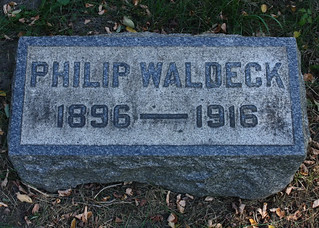
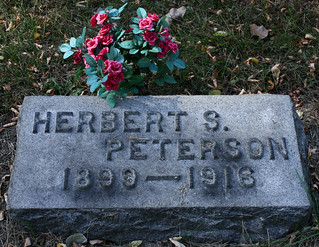
The two young men killed were Philip Waldeck, 20, and Herbert Peterson, 17. It was Herbert's Ford, and he had been at the wheel. He was the eldest son of Frank and Mabel Peterson, who lived and farmed south of Ainsworth — one of their five children, and a grandson of William Smith. Philip, as we know, was the only child of William and Augusta Waldeck of Deep River.

Herbert and Philip had driven up to Hobart to do some shopping that day. They started home around 3:00, going south on State Road 51. The Grand Trunk express train due through Ainsworth at 2:15 was running about an hour late, and, according to some witnesses, speeding to make up for lost time.

Someone who saw the accident from a distance said that Herbert's Ford was moving south on State Road 51 at a leisurely enough pace, but seemed to speed up as it approached the Grand Trunk tracks. At the same time, the train was flying toward the crossing. When they met, the train caught the car squarely in the middle and carried it about a hundred feet before it fell away to the side. The train took a mile to stop. Dr. C.C. Brink of Hobart was sent for, but there was nothing he could do. Both young men had been killed instantly.

There was nothing anyone else could do, either, but look at each other and helplessly ask: How could this have happened? The theory that the boys had tried to beat the train was supported by the witness who thought Herbert had sped up near the crossing. On the other hand, they would not have been expecting a train — there was none scheduled at that time. A moment's lapse of attention, maybe, or of judgment … just a moment's lapse, but it cost the Peterson family dearly, and it cost the Waldecks their all.

The double funeral was held in the Hobart High School auditorium the afternoon of Friday, December 15. Crowds of mourners filed in, family and friends, young and old, faculty and students. Herbert had attended Hobart High until the middle of his junior year; Philip had graduated the previous spring, and had been planning to attend an alumni party that evening. The girls' quartet from his graduating class sang at the funeral service. The pallbearers were all classmates; among Herbert's was Will Wollenberg, Jr., and among Philip's, Ed Wollenberg and another Ainsworth-area boy, Will Buchfuehrer.

Philip and Herbert were laid to rest in adjacent rows in Crown Hill Cemetery.

WaldeckPhilip
(Click on images to enlarge)

PetersonHerbert

Three months before his death, Herbert Peterson had bought a life insurance policy through John A. McDaniel, local agent for Farmers' National of Indiana. The policy carried a double-indemnity clause in case of accident.


Sources:
♦ "Card of Thanks." Hobart Gazette 22 Dec. 1916.
♦ "Funeral of Herbert Peterson and Philip Waldeck Largely Attended." Hobart News 21 Dec. 1916.
♦ "Herbert Peterson and Philip Waldeck Instantly Killed." Hobart News 14 Dec. 1916.
♦ "Local Drifts." Hobart Gazette 15 Dec. 1916.
♦ "Train Kills Two Young Men." Hobart Gazette 15 Dec. 1916.

Wednesday, December 8, 2010

The Athletic Will Jr.

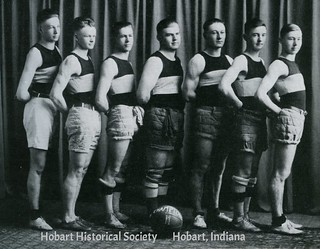
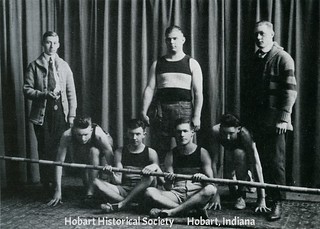
Will Wollenberg, Jr.'s talents were not confined to drama and music — he was also an athlete. During the 1915-16 school year, he was on the Hobart High basketball and track teams.

12-8-2010 Basketball team 1916
(Click on image to enlarge. Image courtesy of the Hobart Historical Society.)
The Hobart High School basketball team. Will Wollenberg, Jr., is at center, with the ball at his feet. (In front of him is Philip Waldeck.)


12-8-2010 Track team 1916
(Click on image to enlarge. Image courtesy of the Hobart Historical Society.)
The Hobart High School track team. Once again, Will is at center. Is that a discus in his hand?

Saturday, November 6, 2010

Hobart High School Class of 1916: Philip Waldeck

PhilipWaldeck
(Click on image to enlarge)
Image courtesy of the Hobart Historical Society.


Just thought I'd stray over into Deep River, as I sometimes do, and mention Philip Waldeck. After all, he was the Secretary of the Class of 1916! "Mac" was the only child of the Deep River village blacksmith, William Waldeck, and his wife, Augusta.

So he drove a Ford, according to that caption — he had driven one for years, I gather, since as early as September 1911 he earned a mention in the paper for running his Ford into another car at the Lake County Fair (no one hurt). In those days he was called "Fillie." Just a few weeks later, he was driving home from Uncle August Maybaum's when he swerved around some cows in the road and skidded into a ditch; it took two hours to get his car out.

When Philip was eight or nine years old, his mother became seriously ill. It was her mental condition that first caused alarm to her husband and friends, and it deteriorated to the point where she was adjudged insane and in June 1904 taken to an asylum at Logansport, Indiana (probably Longcliff Hospital). From there came the alarming report that she had been diagnosed with terminal cancer of the abdomen, which was supposed to have caused her insanity. …And then we hear no more of her (or, strictly speaking, I find nothing in my notes) until June 1906, when suddenly we find her back home in Deep River, in good enough health to host a "ten-cent tea" on her lawn to raise funds for the Willing Workers (a charitable club formed by women in the Deep River area). So I don't know quite what to make of that whole episode, but it likely was frightening enough to young Philip and his father when it happened.

Anyway, we're now in 1916, the family is back together, all apparently in good health and spirits, and Philip is a proud graduate of Hobart High School.

Waldeckblacksmithshop
(Click on image to enlarge)
William Waldeck's blacksmith shop in Deep River, Indiana, date unknown (but probably between 1903 and 1912). Image courtesy of the Merrillville-Ross Township Historical Society.


Sources:
♦ "Charles Maybaum Killed by Falling Tree Thursday." 11 Sept. 1913.
♦ "General News Items." Hobart Gazette 17 June 1904; 1 July 1904; 29 July 1904; 15 June 1906.
♦ Hobart High School Aurora yearbook 1916.
♦ "Ross Township Notes." Hobart Gazette 1 Sept. 1911; 22 Sept. 1911.
♦ "School Closes Next Week." Hobart Gazette 12 May 1916.


P.S. to Bonnie — Please see the new comment on the August 4 entry; someone is asking for your help.

Thursday, July 29, 2010

Trees: Falling and Family

As I said, I'm at a point in time where an Ainsworth person has to die or be born in order to get into the paper. Charles Maybaum made it onto the front page of the Hobart News of September 11, 1913, by being killed by a falling tree. And it took that obituary to inform me just how instrumental he and his wife, Caroline, had been in populating the area. Just look at the list of surviving (adult) children:

In Ainsworth:
  • Albert Maybaum
  • Edward Maybaum
  • Charles Maybaum
  • August Maybaum (in Ross Township, outside the village of Ainsworth)
  • Mrs. Lena Barney
  • Mrs. Martha Miller
  • Mrs. Hattie Sizelove
In Deep River: Mrs. Gusta Waldeck
In Hobart: Mrs. Jennie Dewell
"Near Hebron": Mrs. Mary Thompson

Honestly, Ainsworth wouldn't have been much of a town without Charles and Caroline Maybaum; now, would it? I mean, even less of a town. Or village.

He was also survived by a brother, Fred Maybaum of Chicago, and just to make things interesting there was an (I believe) unrelated Fred Maybaum in Hobart whose hobby was likewise, apparently, populating the town.

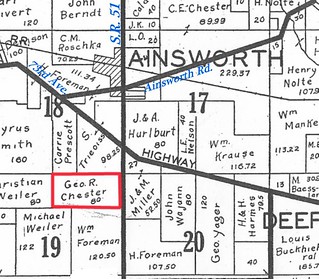
Charles Maybaum was born in Germany in 1840. In 1863 he married Caroline Wagoner, and their two eldest sons, August and Charles junior, were born in Germany. In 1871 the family came to the United States and eventually settled in Ross Township, south of Ainsworth, where they resumed producing children. The 1891 Plat Book shows "Chas. Maibaum & wife" owning the 80-acre parcel that later passed into the hands of George Chester, and where Chester Cemetery is located.

Maybaum
(Click on image to enlarge)
The 80-acre Maybaum parcel is outlined in red. This image is from the 1926 Plat Book, which I use because it's easier to read than the 1891 one, and by that time the land belonged to George Chester.


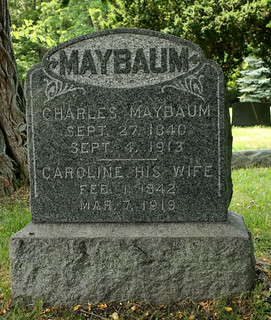
Charles died sometime on the morning of September 4, 1913. He had left the house about 9 a.m., after announcing his intention to go chop down a tree in the woods on his land. No one thought anything of it when he didn't come back for lunch, but as the afternoon wore on and Charles was nowhere to be seen, someone got worried and set out looking for him. His "severely bruised" body — dead for probably several hours — was found near the tree he had cut down.

He is buried in Crown Hill Cemetery.

CharlesandCarolineMaybaum
(Click on image to enlarge)


Sources:
♦ 1891 Plat Book.
♦ 1900 Census.
♦ 1926 Plat Book.
♦ "Chas. Maybaum Killed by Falling Tree Thursday." Hobart News 11 Sept. 1913.