Showing posts with label women's suffrage. Show all posts

Thursday, September 22, 2016

Women Voters and a Woman Pioneer

The mid-term election of 1922 was approaching, which may be why the Ainsworth League of Women Voters planned a meeting in the W.G. Haan school; but then again, in those days people held meetings for any reason.

2016-9-22. League of Women Voters meeting
(Click on image to enlarge)
"Local and Personal." Hobart News 21 Sept. 1922.


The death of Mrs. J.E. Small, mentioned at the bottom of that column, got a fuller treatment from the next day's Gazette.

2016-9-22. Mary Jane Riley Small obit
(Click on image to enlarge)
Hobart Gazette 22 Sept. 1922.


Her daughter, Mrs. Crisman — christened Elizabeth — was the wife of John Crisman, Sr., and the grandmother of Dorothea.

Mary Hardesty, the daughter with whom Mrs. Small had lived, was a widow (1920 Census), but I'm not sure of her deceased husband's name. It might have been Adolphus (Indiana Marriage Collection).

Mary Jane Riley Small rests in Mosier Cemetery.


In the pages above and elsewhere in old newspapers I have come across references to "Small's Crossing," and thus far nobody I've asked has known exactly where it was. Based on the people whose names came up in connection with Small's Crossing, I gathered it was in Porter County but not far from the village of Deep River. In common parlance around the turn of the 20th century, the name likely referred to a road crossing a railroad line near a piece of land owned by a Small. So, let's take a look at the plat map of Union Township, Porter County, in 1895, by which time all the railroads were in place:

2016-9-22. Small 1895
(Click on image to enlarge)
Image from http://www.inportercounty.org/Data/Maps/1895Plats/Union-1895.jpg, courtesy of Steven R. Shook.


There's a Small farm, there's the Grand Trunk Railroad, there's the road now known as N 725 W crossing the railroad. Just over the county line is the village of Deep River. I think this is a pretty good candidate for Small's Crossing. If you can find a better one, please let me know about it.

Saturday, May 25, 2013

"Women Can Vote"

The Hobart News of August 16, 1920, brought the news of the 19th Amendment's ratification.

Suffrage amendment ratified
(Click on image to enlarge)

♦    ♦    ♦

Register for 1920 election

A reminder to register for the 1920 election, addressed to men and women, appeared in the Hobart News of September 2, 1920.

Wednesday, February 29, 2012

Voting, Drinking, Tipping

Or: What the Indiana General Assembly Was Up to in February 1919

Indiana Legislature news
(Click on image to enlarge)
From the Hobart News of Feb. 20, 1919.


So, among other things, Indiana women got a very limited right to vote, and an attempt to repeal Indiana's state-wide prohibition was defeated.

The anti-tipping bill is amusing, but the item that follows it is a sobering reminder of the war's cost, even to those who survived it. The "insane" soldiers were likely those with severe post-traumatic stress disorder, and those who had suffered head injuries with brain damage.

Wednesday, March 16, 2011

Two Defeats

Back in 1902, while living in Ross Township, our friend William Raschka had successfully run for justice of the peace. In the autumn of 1917, as a Hobart resident, he decided to dabble in politics again. He announced his candidacy for first ward trustee of the town of Hobart. He was running against William C. Jahnke, the incumbent, and Hugo Zobjeck, a local soda bottler and saloon owner.
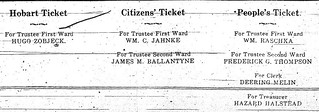
3-16-2011 News 10-25-1917
(Click on image to enlarge)

Concerning his candidacy, the News remarked: "Mr. Raschka has been a resident of this vicinity for a number of years, being an extensive dealer in hay and grain, and has been a resident of Hobart for the past couple of years. He has been very successful in his business, and he no doubt would conduct the town's business in the same progressive and conservative way if elected to the position."

I don't know how Carrie Raschka felt about this. I notice she got out of town for a week in the latter part of October, going with Charles and Constance Chester as they took yet another road trip (this time a comparatively short one through eastern Indiana and southern Michigan).

Anyway, Carrie did not have long to worry about her husband's involvement in politics. On November 6 the voters of Hobart elected Hugo Zobjeck as first ward trustee by a considerable margin.

In the second ward, the incumbent James Ballantyne lost to Frederick Thompson (son of Alexander Thompson and a former Ainsworthite). The town Treasurer and Clerk — Hazard Halstead and Deering Melin, respectively — had run unopposed and thus could hardly avoid being re-elected.

♦    ♦    ♦

Hobart women could not vote in this election. No Hoosier woman could vote in any election. The Indiana supreme court had so ruled, and its decision was final.

The challenge had begun with a lawsuit filed by an Indianapolis businessman, William W. Knight, against the Indianapolis board of election commissioners.* As we know, the Marion County superior court had ruled in Mr. Knight's favor in September 1917. The supreme court heard the appeal during the second week of October. The decision came down two weeks later: it upheld the lower court's ruling.

The Indiana constitution gave the right to vote only to male citizens over the age of 21, said the court; hence the Indiana legislature had exceeded its authority in extending even limited suffrage to women.

The decision was a serious setback. It meant that Hoosier women could win the right to vote only by getting the current constitution amended or a new one adopted. Either process would take at least six years. So the women of Indiana had a long fight ahead of them, unless, of course, they got help from the federal level.

_____________________
*I've not been able to find out any more about Mr. Knight or what his motivations were, aside from one report that among the plaintiff's arguments was the contention that allowing women to vote would cause "great additional expense and much confusion."


Sources:
♦ "Election Day Is One Month Away, Tuesday, Nov. 6th." Hobart News 4 Oct. 1917.
♦ "Election Next Tuesday." Hobart Gazette 2 Nov. 1917.
♦ "Hugo Zobjeck and Frederick Thompson Elected Trustees." Hobart News 8 Nov. 1917.
♦ "Indiana Women's Right to Vote Now Up to Supreme Court." Hobart News 18 Oct. 1917.
♦ "Local and Personal." Hobart News 4 Oct. 1917.
♦ "Local Drifts." Hobart Gazette 26 Oct. 1917.
♦ "Makeup of Tickets For the Coming Town Election." Hobart News 25 Oct. 1917.
♦ "New Trustees Elected." Hobart Gazette 9 Nov. 1917.
♦ "Republicans Victorious." Hobart Gazette 7 Nov. 1902.
♦ "Supreme Court Holds Woman's Suffrage Law Unconstitutional." Hobart News 1 Nov. 1917.
♦ "Women Cannot Vote." Hobart Gazette 2 Nov. 1917.
♦ Year Book of the State of Indiana for the Year 1917. Indianapolis: Wm. B. Burford, 1918.

Thursday, February 10, 2011

A Setback for Suffrage

In September 1917 a Superior Court Judge John J. Rochford of Marion County, Indiana, ruled that the limited women's suffrage bill passed by the Indiana legislature earlier that year was unconstitutional. The essence of his decision was that the legislature did not have the power to grant women the vote because the Indiana constitution "specifies who may have a right to vote, and does not mention women."

Back in Ainsworth, I expect Pearl Ols was annoyed — but not entirely discouraged, for the same News article that reported this decision also said it would shortly be appealed to the Indiana Supreme Court.

Around the state, women continued registering to vote, in the hope that the upcoming appeal would reverse Judge Rochford's ruling.


Sources:
♦ "Judge Holds Woman's Suffrage Bill Unconstitutional." Hobart News 20 Sept. 1917.
♦ Monks, Leander (ed.). Courts and Lawyers of Indiana. Indianapolis: Federal Publishing Co., Inc., 1916. Google books. Web. 1 Dec. 2010.

Tuesday, December 28, 2010

A Partial Victory for Pearl

I'm sure Pearl Ols was happy to read the newspaper reports, late in the winter of 1917, that Indiana women had won a limited right to vote — limited, but less so than in any other state at the time.

A suffrage bill had been introduced at every Indiana legislative session starting in 1907, and at every session had failed. According to a contemporary source, "[m]ost of the [legislators] appeared to regard woman suffrage as a joke with which they were merely to have sport and fun in the 61 days of their sessions." By 1915 attitudes had changed sufficiently that the issue was at least treated as a serious matter, but even that year the suffrage bill did not make it out of committee before the end of the legislative session.

Women's-rights activists took a lesson from that failure and in 1917 got identical bills introduced simultaneously into the house and the senate, to speed the process along.

By going the legislative route, women would have to accept a limited vote, since the right to vote for constitutional offices would require an amendment to the state constitution, a far more complex and time-consuming process, and far less likely to succeed. This pragmatic position was supported by the largest women's-rights group in the state, the Legislative Council of Indiana Women. The Council figured that they could reach their ultimate goal more surely by the indirect route, moving in steps from limited to unlimited voting.

And finally, some congruence of improved tactics and changed attitudes brought about success. The woman suffrage bill (known as the Masten-McKinley bill for the two senators who introduced it) passed the senate and then the house in late February, then went to Governor James Goodrich's desk for signature.

He intended to sign it, but other matters kept diverting his attention, until the morning of February 28, 1917, when his wife, Cora, came into his office and (according to a contemporary source) asked:
"When are you going to sign the woman suffrage bill?"

Governor Goodrich, who has been the busiest man in seventeen states ever since the session of the legislature opened, smiled and remarked that he would sign the bill just as soon as he could get at it.

"This is a good time to sign it, right now," Mrs. Goodrich said.

And the governor thought so, too, for he took his pen in hand and attached his "James P. Goodrich" to give Indiana women their first opportunity to vote at elections.

The governor said afterward that he signed the bill in the presence of the best witness in the world.
Thus Indiana women who met the same requirements as male voters finally won the right to vote for non-constitutional offices — which meant they could not vote for governor, secretary of state, judges of the supreme or circuit courts, county sheriffs, auditors, treasurers and commissioners, etc. There remained, however, a good number of offices for which they could vote, including presidential electors, attorney general, judges of the appellate, superior, criminal, probate and juvenile courts, county council, township trustee, all elective city and town officials, "and for all other elective officers not provided for in the state constitution."


Sources:
♦ Searles, Ellis. "Indiana Women's Victory Sweeping." Hobart News 1 Mar. 1917.
♦ "Signs Suffrage Bill with His Wife as a Witness." Washington Herald (Washington, IN) 1 Mar. 1917. http://www.newspaperarchive.com (accessed 7 Nov. 2010).