Showing posts with label Ainsworth station. Show all posts

Saturday, March 27, 2010

A Trainload of Model Ts

3-27-2010 1919 Unloading Model Ts
(Click on image to enlarge)
From the collection of R.F.


Circa 1919, these Model Ts were unloaded from a Grand Trunk train at Ainsworth (you can see the depot in the background at right). They were probably destined for the Wood Ford dealership at Deep River.

Wednesday, March 24, 2010

Ainsworth Then and Now: Fast Train Approaching

Circa 1910 and 2010

Fast Train Approaching
No Train Approaching
(Click on images to enlarge)
1910 image courtesy of the Hobart Historical Society


Fast train approaching versus no train approaching. What, did you think I was going to play chicken with a freight train out there? They did that sort of thing in 1910. In 2010, we don't, and we also don't get killed by trains as often as they did.

The 1910 photographer was standing east of where Ainsworth Road crossed the tracks — that's the crossing you see in the foreground of the photo. The train looks to be just about to cross State Road 51. Note the milk cans at the left edge of the picture, and the siding behind them. I had to guess where to stand to replicate that photo, since I'm still not sure exactly where the Ainsworth Road crossing was.

My guess that the top image dates to around 1910 is based on the fact that it's from one of several postcards in the Hobart Historical Society's Ainsworth picture file that contain correspondence between Howard Shearer and Elsie Wojahn, and while this particular card is not postmarked, the others are postmarked 1910 (and one 1911). So I'm placing it in the same timeframe. The correspondence on the postcards is not effusive, but I wasn't surprised to learn that Howard and Elsie were later married (on February 12, 1913 per the Indiana Marriage Collection).

Sunday, February 14, 2010

Ainsworth Depot 1930

2-14-2010 1930 Ainsworth Depot
(Click on image to enlarge)
Image courtesy of the Hobart Historical Society.


"Here is pictured the story of Hobart's triumph in the Class B at the National Band Contest," says the caption, and Ainsworth had its own little part to play in that story. It was from the Ainsworth depot that the band departed, and to the Ainsworth depot they returned. A local resident who witnessed the event still recalls the hooplah of that day — the great crowd gathered around the depot to greet the conquering heroes and carry them back to Hobart in triumph.

What amazes me about the lower photo of the depot, with the steam engine, is the emptiness through which the tracks run. Nowadays there are trees all along the tracks, not to mention the Ainsworth Tower.

Thursday, January 28, 2010

Ainsworth Depot 1910

1-28-2010 Grand Trunk RR Ainsworth depot ca. 1910
(Click on image to enlarge)
From the collection of R.F.


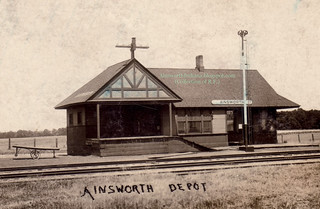
Here at last is the Ainsworth depot on the Grand Trunk Railroad, circa 1910. The person who gave me this photo told me that after this building was demolished, the railroad still maintained a shed in its place, where tools and such were stored. Nothing of either building remains, except possibly the foundation of that signal tower in front of the station — you can still find a concrete block out there by the tracks, with a bit of rusty metal pipe embedded in it.

That's a nice station, more impressive than I thought it would be.

Now I can update my Grand Trunk Western Historical Images map with the most important station of all!

Saturday, September 26, 2009

Station Location

StationLocation
(Click on image to enlarge)

I have confirmed my earlier speculation: the building north of the tracks and east of Grand Boulevard was indeed Ainsworth Station, and it was "reportedly named for a railroad executive."

Sources:
♦ Burns, Bob, "Community of lore: Although never incorporated, Ainsworth has a colorful history," Post-Tribune (IN), Apr. 14, 2002.
♦ ———, "Find Ainsworth and Nob Hill, and you can't miss Hobart," Post-Tribune (IN), Apr. 9, 2006.

Friday, September 18, 2009

Grand Trunk Railroad Employees Timetable 1932

1932 Grand Trunk Western Employees Timetable

I don't know whether in 1880 the Grand Trunk Railroad was double track or single track, but by 1932, as this employees timetable tells us, it was double track except between Sedley and Valparaiso, which would not include Ainsworth.

Westbound passenger trains traveling from Port Huron, Michigan, to Chicago, Illinois, stopped in Ainsworth daily at 5:38 a.m., 7:14 a.m., and 7:07 p.m. Westbound way freight trains stopped (I think, but I don't know exactly how to read this thing) daily, except Sunday, at 10:30 a.m.

Eastbound passenger trains traveling from Chicago to Port Huron stopped in Ainsworth daily at 10:10 a.m., 7:50 p.m. and 12:07 a.m. (12:07 a.m.?? What honest Indiana farmer would be awake at that hour? — lots of them, I suppose, if the whistle was loud enough.) Way freights stopped daily, except Sunday, at 9:10 a.m.

The train order office in Ainsworth was open from 8:30 a.m. to 5:30 p.m. daily except Sunday.

There was no railroad surgeon here. If you got hurt on the train in Ainsworth, you had to go to Valpo. Actually I don't know what a "surgeon" was for purposes of this schedule.

And that's all this schedule has to tell us about Ainsworth.

Thursday, September 17, 2009

Jules Verne Takes Notice of Ainsworth

On page 151 of the Free Ebooks Edition of Jules Verne's Le Testament d'un Excentrique (1899), we encounter this sentence:
En quittant Chicago, après avoir contourné le golfe inférieur du lac Michigan, le train entra dans l'Indiana, limitrophe d l'Illinois, à la station d'Ainsworth et il remonta jusqu'à Michigan City.
My amateur translation:
On leaving Chicago, after having skirted round the lower gulf of Lake Michigan, the train entered into Indiana, bordering Illinois, at the Ainsworth station and it went back up to Michigan City.
The book in this edition is 520 pages long. It makes no further mention of Ainsworth. The story seems to be set in 1897.

Sunday, August 9, 2009

Aerial Photos: 1939 (2 of 3)

BFJ-04-071 enhanced
(Click on image to enlarge)

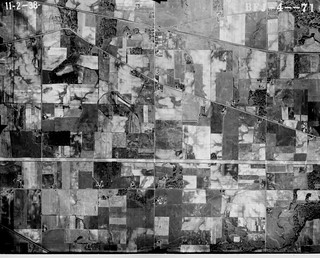
This photo was taken at nearly the same east-west position as the one from the previous post, but here we are positioned further to the south. The Ainsworth Triangle is nearly at the top of the photo, while the double horizontal line of Route 30 appears about a third of the way from the bottom.

The exposure is higher, which makes some features stand out more clearly, such as the building I spoke of earlier — the suspected railroad station — that sits right beside the Grand Trunk Railroad on the north side of the Ainsworth Triangle.

There is absolutely nothing at the junction of Grand Boulevard and Route 30.

On the southeast corner of Grand Boulevard and 73rd Street stands a house that has since been knocked down. Here it looks like a significant farming operation. By the time I moved into the area, it was just a house; out back was a shed where a horse stayed, and further out a rusting farm machine. I was fond of the old farmhouse and the weathered wood of the shed, and of course I liked the horse. Then I read in local newspaper a letter from a reader complaining about the existence of that very shed and horse, and the rusting farm machine. I was simply stunned that anyone could find it offensive.

Saturday, August 8, 2009

Aerial Photos: 1939 (1 of 3)

1939 Aerial Park (BFJ-04-070[2])
(Click on image to enlarge)

This photo is bisected vertically, just to the left of center, by Grand Boulevard, aka State Road 51. Almost at the center of the photo you can see the triangle formed by the intersection of Grand Boulevard, Ainsworth Road and the Grand Trunk Railroad.

Ainsworth Road here appears in its old configuration: it crosses the railroad tracks and connects with Grand Boulevard south of the tracks. These days it veers north to connect with Grand just north of the tracks, never crossing them at all. When I moved out here in 1990, you could still see a line in the pavement of Ainsworth Road that pointed obliquely toward the tracks, marking the road's old path. I don't know exactly when the change was made, but I believe it was post-1973. When they resurfaced Ainsworth Road prior to excavating Big Maple Lake, they covered up the line.

On the north side of the Ainsworth Triangle, you can just make out what appears to be a building right beside the railroad tracks. I suspect that was the railroad station. Two paths have been worn from Grand Boulevard to that building, as if by people coming from the north and from the south.

As you follow Grand Boulevard south, you can clearly see the dark square of the school building, halfway between Ainsworth Road and 73rd Street.

Looking east on Ainsworth Road, you find no trace of Shiloh Ranch or the sheep farm buildings. Once you pass the tiny house and barn at 6720, there is nothing until the collection of buildings that surrounded the house at the western border of what is now Big Maple Lake park. The house still stands today, and as for the outbuildings, you can find their ruins among the trees that have filled up the fields on both sides of the road.

Continuing eastward along Ainsworth Road, you come to a collection of buildings on the north side of the road, just edging the dense vegetation that marks the Deep River.

When I first started taking my dog for walks in the forest around Big Maple Lake, I noticed great blocks of broken concrete piled along the path at the east end of the park. I thought, who would go to all the trouble of driving up this little path to dump their debris in the park? What's wrong with people? and so on. But a little more exploration showed me that the debris hadn't been imported — it was the remains of some mysterious structure that had been built and then demolished on that site. Deep among the trees, among the thickets of poison ivy and the thorns of multiflora rose, I traced the concrete foundation of a long, narrow building. Elsewhere there were remnants of electrical conduit, fencing, gates, truck bumpers, glazed bricks and, further towards the river, what seemed an archeological treasure trove of garbage that people had dumped down the high, sloping bank of the Deep River. Further investigation of the remains and the garbage dump proved it all disappointingly modern, but I was still curious about what the structures had been and who had built them. I haven't found out yet.

Anyway, there they stand, pristine in an open field, in 1939.

Monday, August 3, 2009

Ainsworth Station

I believe it was in Bad Land: An American Romance by Jonathan Rabin (a book I highly recommend) that I read of the establishment of towns along new railroads crossing the Great Plains — towns set up entirely by the agents of the railroad, who were instructed to locate a town every so many miles along the railroad, and who assigned each town a name pulled out of their own whimsy. And so a station would be built, and the town would grow up around it, with no more basis than that the railroad happened to pick that spot.

I don't know in what way Ainsworth existed before the Grand Trunk Railroad was built through Lake County in 1880 and established the "Ainsworth" station. I have a map of Lake County published in 1876 on which Ainsworth does not appear, although such distinguished metropolises as Liverpool, Tollestone and Ross appear, as does Hobart, of course.

On this 1876 map I do see a road resembling Ainsworth Road, and there's a little house icon where Ainsworth Road crosses what seems to be the beginnings of Grand Boulevard. I don't have the whole atlas with its key, so I don't know what the house icon represents.

(By the way, I will start publishing images as soon as my new memory card arrives and I install it. Right now my computer is teetering on the brink of the Chasm of Unremembering and can't handle the scanning of images.)

Then comes 1880, and the Grand Trunk Railroad builds a station with a day telegraph office, somewhere close to the junction of the railroad, Grand Boulevard and Ainsworth Road. I have no idea what induced the railroad to put a station there, whether it was a matter of a station every X number of miles, or a promising junction of roads, or some person(s) with influence.

Trains traveling westward toward Chicago, originating in Ft. Gratiot, Michigan, or Valparaiso, Indiana, stopped in Ainsworth daily at 7:03 AM and 5:08 PM. Eastbound trains, from Chicago to Fort Gratiot or Valparaiso, made the Ainsworth stop at 11:07 AM and 7:21 PM daily, with a Sunday train at 3:17 PM. Local farmers shipped milk from the Ainsworth station to Chicago by the morning trains; evening trains returned the empty milk cans.

By 1882 Ainsworth had a post office (closed 1934); by 1900 the Rev. T.H. Ball described Ainsworth as "quite a shipping point for milk" with "some other business interests, with a population now of about fifty, fourteen families. It has a school house but no church." (Whether the school house referred to is the two-story brick one still standing, I'm not sure. Kenneth J. Schoon gives two dates for the building of an Ainsworth school — 1900 and 1912.)

I don't know the precise location of the station, but I have an idea, based on the 1939 aerial image. More on that later.

Somehow I have the idea that the station ceased operation in 1971, but I don't know where I got that figure.

By the time I moved here in 1990, Ainsworth as a town was imperceptible. The town itself was not incorporated, and no signs on the road bade you welcome to Ainsworth. My first month here, a neighbor who stopped by to talk to the guy pumping out my septic tank said something to me about "us folks here in Ainsworth," and that was the first I heard of such a place. As Hobart's fight to annex the Ainsworth area intensified, I would notice, as I drove around, that some yards had signs reading "Freedom for Ainsworth," or similar slogans. Ainsworth didn't get its freedom, as we know; it disappeared into Hobart. Its only revenge was that the Hobart mayor who had presided over the annexation effort, Robert Malizzo, was voted out of office largely by Ainsworth-area voters.

Sources:
  • Ball, the Rev. Timothy Horton, Northwest Indiana from 1800 to 1900 (1900).
  • Ball, the Rev. Timothy Horton, Encyclopedia of Genealogy and Biography of Lake County, Indiana (1904), as transcribed at Genealogy Trails.
  • Chicago and Grand Trunk Railway Gazette, Vol. 1, No. 1 (September 1883).
  • Schoon, Kenneth J., Calumet Beginnings: Ancient Shorelines and Settlements at the South End of Lake Michigan (2003).