Showing posts with label Johnson. Show all posts

Monday, February 24, 2020

Miss Margaret and the Woodses of Ross Township

I must have been in a bad mood seven years ago when I wrote the post about Samuel B. Woods: I put so little effort into it. Now Sam's youngest child is getting married, so maybe I should take this opportunity to educate myself a bit more.

2020-02-24. Woods, News, 11-1-1923
(Click on image to enlarge)
"Local and Personal," Hobart News, Nov. 1, 1923.


The home of the bride's parents stood, according to A Pictorial History of Merrillville, "on West 57th Avenue, near the intersection of 57th and Cleveland Street (Route 55)." That certainly helps me figure out which of the various parcels owned by the Woodses was where they actually lived.

2020-02-24. Woods 1908
(Click on image to enlarge)
From the 1908 Plat Map.


Samuel Bartlett Woods was born in Ross Township in 1856 to Bartlett and Ann Eliza Woods. Bartlett Woods was among the early settlers of Ross Township and a prominent citizen; you can read more about him in Lake County Encyclopedia. Ann Eliza Sigler, who became Bartlett's wife in 1847 (Indiana Marriage Collection), was the daughter of Samuel and Ann Sigler, early settlers of Hobart Township.

In 1882, Samuel Woods married Mellue Vilmer.[1] They had three children. The first was a son, Harold, who died in 1908. The second was a daughter, Wilma, who married Francis Malmstone in 1915 and lived with him in Griffith. The last was our Miss Margaret.

Now, Chester Clark and his new wife may have spent some of their early married life on his "large farm" at Carthage, Illinois, but we know from the 1930 Census that within seven years they moved back to live on her parents' farm.

♦    ♦    ♦

At the top of the right-hand column on the page above, we find another happy event: at the farm on Cleveland Avenue, Lois Harms turned eight years old. Esther Palm was a neighbor; Ruth and Loretta Schavey were maternal relatives, I'm sure, but I don't know their exact relation.

♦    ♦    ♦

Lower down in that same column, another item that interested me was A. Johnson's public sale "at the old Collver place." I've just barely mentioned the name of Collver and identified the Collver property without understanding precisely where it was …

2015-9-5. Collver 1908
(Click on image to enlarge)
Image from the 1908 Plat Map.


… and now I'm going to try to figure that out. When I wrote the linked post, in 2015, the Lake County Surveyor GIS website may not even have been online — or if it was, my internet connection was not good enough to use it. But now I can use it, and do, and it's very helpful.

Anyway, we can see from the plat map above that the Collver place was bordered on the south by South Side Addition 2. Per the Lake County GIS, South Side Addition 2 is a strip of land running along the north side of 13th Street, from S.R. 51 east to just past Fleming Street (now occupied by a commercial building and several houses). And we have a pretty good idea where the Sapper land was and still is, don't we? So the Collver place was between the Sapper land and South Side Addition 2. Just north of South Side Addition 2 is a cute little house, built in 1919 per the county records, that must have stood on the old Collver place, and was probably occupied by this A. Johnson — maybe even by the Collver family.

And who was the Collver family? The member we're dealing with today — the auctioneer at this public sale — was born Sylvanus Roy Collver in Canada in 1873, but always went by Roy or S.R. He came to the U.S. sometimes around 1890[2], following his father, mother, and brother. In 1900, the family was living in Chicago. Roy was a fruit salesman. In January 1896 Roy had married Margrete Prendergast (Cook County, Illinois, Marriages Index); in June of that year they had a son, whom they christened Sylvanus Albert.

Since Roy was in his early twenties when he married Margrete, that was probably his first marriage. It wasn't his last. I don't know what happened to Margrete, but by 1905 Roy was free to marry Mary M. O'Donnell (Cook County, Illinois, Marriages Index). I think she is the "Mae" who shows up with him the 1910 Census, living in Hobart Township, in their own home. In January 1917, Roy sued Mae for divorce.[3] The divorce must have gone through: in May 1917, Roy married Leah Herman (Indiana Marriage Collection). I can't find them in the 1920 Census, and Roy didn't live to be counted in the 1930 Census. He was still married to Leah when he died in 1927 (Indiana Death Certificates).


I cannot identify the A. Johnson who started all this by having a public sale on the old Collver place.


_______________
[1] I believe that her brother, William E. Vilmer, was a local photographer.
[2] 1893 per the 1900 Census; 1889 per the 1910 Census.
[3] "In the Divorce Courts," Hobart Gazette, January 19, 1917.

Friday, December 1, 2017

Ainsworth Basketball Team, 1941-42

Ainsworth Basketball Team, 1941-42
(Click on image to enlarge)
Image courtesy of the Hobart Historical Society.


This photo comes to us with the following IDs:

Back row, L to R: Young Johnson, Pat Sullivan, unknown, unknown, Donald Tonagel, Ron (last name unknown), Jack Dick, Don Carpenter.

Front row, L to R: Dick Julian, unknown, unknown, Jerry Kuntz, Wayne Johnson, Jack Woodland, Principal George Garland. Little boy in front may be Frankie Foreman.

To the extent I've been able to find these boys in the 1940 Census, they are all around 11-13 years of age, and, I suppose, students at the W.G. Haan School in Ainsworth. Here are my notes on each:

Young Johnson — don't know if "Young" is a first name or an adjective. If it's a first name, I can't find him; but see Wayne Johnson below.

Pat Sullivan — have no evidence that he's related to the Ross Twp. Sullivans; can't really find who is he is related to.

Donald Tonagel — As we learned a long time ago, he was the elder of the two children of Cecil and Ruby Tonagel.

Ron (last name unknown) — can't find any Ron in Ross Twp. who would be the right age.

Jack Dick — his family farmed in southeastern Ross Township. His parents were Sherman and Anna.

Don Carpenter — maybe son of Lawrence and LaRiatha, born 1930 in Ross Township; by 1940 lived in Gary.

Dick Julian — possibly the son of Ralph and Rachael Julian of Hobart Township. Ralph is a described as a "laborer" in a "W.P.A. project."

Jerry Kuntz — Paul Gerald "Jerry" Kuntz, son of William and Iva, who in 1940 were living in Ross Township, somewhere (to judge by their neighbors) along the old Lincoln Highway near S.R. 51. Jerry Kuntz went on to serve in the Korean War and to work with Eldon Harms at NIPSCO.

Wayne Johnson — may be the son of Clarence and Bernice Johnson of Hobart. The 1940 Census confusingly describes him as their daughter; however, the 1930 Census shows him as their one-year-old son. If "Young" Johnson (above) is a description, then that boy might be Wayne's younger brother, Richard.

Jack Woodland — can't find in Ross Township 1940 census. Eldon Harms told me that Jack was a resident of the Cozy Camp (successor to Chester's Camp, situated on the north side of the Old Lincoln Highway just east of DeKalb Street), his family having come down from Kenosha, Wisconsin.

Principal Garland is George Bronson Garland.

The little boy in front holding the basketball is probably Frankie Foreman, youngest son of Otto and Louise Foreman. Between Frankie and his next oldest brother, there were about 10 years. Frankie was a surprise baby, who came at a time when his parents had stopped expecting any more children.

Thursday, May 12, 2016

Too Many Johnsons

A recent post was about Hugo William Kent. Now I'd like to talk just a little about his second wife's family.

If we look at the Kent farm in 1921, we find it owned by a John Johnson.

2016-5-12. Johnson 1921
From http://www.inportercounty.org/Data/Maps/1921Plats/Union-1921.jpg, courtesy of Steven R. Shook.

John was Anna's father. Just south of Joliet Road and east of N 750 W, you see a little square marked "Res. of Theo. Johnson." Theodore was Anna's brother.*

I'm a little hazy on the composition of the family. The Johnsons (or Johannessons) lived a good part of their lives in Sweden, and some of their children were born there; the family came to this country only in 1882, thus missing the 1880 census — and the 1890 census, of course, is lost to us. It doesn't help that Johnson is a common name, and this area was crawling with them in the timeframe we're discussing.

Someone on Ancestry.com has compiled a list of the Johnson family as part of the Krachey Family Tree:

John (Johann Magnus) Johnson (Johannesson) b. 1841 in Sweden
m. Ulrika Ulla Kristina Swanson b. 1849 (in Sweden)
Children:
1. Anna Elisabet (1874-1878)
2. Charles Carl Johan (1876-1945)
3. August Albin (1879-1882)
4. Oscar Emil (1881-1949)
Arrival in New York 1882
5. Theodore Clauss (1886-1955)
6. Anna (1889-1971)**
7. Hulda Josefina (1895-1980)

This almost-but-not-quite matches the listing in John Johnson's 1930 obituary:
John Johnson, aged 89 years, pioneer Porter county resident, passed away at the family homestead, where he had resided for the past 37 years, now the home of his daughter, Mrs. Hugo Kent, and family, one mile east of Deepriver, on Friday, Jan. 3, the cause of death being heart trouble.

Mr. Johnson's birthplace was in Sweden, and he was born on March 11, 1840. He was united in marriage to Ulricka Swanson in 1872. To this union was born eight children, two dying in infancy. In 1880 he and his family emigrated to this country and settled near Crisman, where they resided for twelve years. They then moved to Deepriver on the place where he had since resided. His wife preceded him in death seventeen years ago.

He leaves to mourn his death, four sons and two daughters — Charles, Oscar, Albin, Theador, Mrs. Anna Kent, all of Porter county, and Mrs. Hulda King of Rockford, Ill., two sisters and twenty-one grandchildren.
This gives us an approximate date for the Johnson family's purchase of the Union Township farm — 1893. The 1895 plat map backs that up. So does Ulrike Swanson Johnson's obituary, which I happened to save, back when I was reading the 1912 microfilm, because it mentioned "a farm near Deep River."

2016-5-12. Ulrike Swanson Johnson obituary
(Click on image to enlarge)

Ulrike and John Johnson are buried in Crown Hill Cemetery, among many other Johnsons.

One day last year, Eldon Harms and I went out driving so he could show me where Huffman's mill had been. As we turned south off Joliet Road onto N 750 W, he pointed to the old farmhouse on that corner and said, "That was Constance Kent's house." I still haven't figured out who Constance was. The Porter County records have 1892 as the construction date of that house … which may mean the Johnsons did not build it themselves. Assuming a little carelessness on the part of the 1921 plat-map maker, that might be the house marked as Theodore Johnson's residence. I gather that after Anna Johnson married Hugo William Kent, it became the Kent home.

_______________
*But I can't find Theodore in Porter County in the 1920 Census.
**Theodore's birthplace is given as Miller, Indiana; Anna's as "Union City," which may be the area in Porter County known as Union Center, today memorialized only by Union Center Elementary School.

Obituary Sources:
♦ "John Johnson, Pioneer of Porter Co., Passes Away." Hobart News 9 Jan. 1930.
♦ "Obituary." Hobart News 26 Dec. 1912.

Sunday, May 8, 2016

The Mayor of Aetna

If there was any local announcement about the family of Hugo William Kent moving to the greater Ainsworth metropolitan area, I missed it. But, as we've seen, by August 1922 they had moved to a farm in Porter County where they would spend the next two decades at least.

Here is the Kent farm in 1928:

2016-5-8. Kent 1928
(Click on image to enlarge)
From http://www.inportercounty.org/Data/Maps/1928Plats/Union-1928.jpg, courtesy of Steven R. Shook.


Hugo was married to a local woman, Anna (née Johnson). She was his second wife. His first marriage had begun in Chicago in 1904, and ended abruptly on September 5, 1916:

2016-5-8. Death of Ida Kent
(Click on image to enlarge)

While the headline of the article gave Hugo the title of "Mayor" of Aetna (now a neighborhood in Gary), the article clarifies that he was president of the town board.

The coroner's investigation resulted in a finding that Ida's death was indeed suicide.

In October 1917 came the second marriage. Hugo and Anna Johnson went to Berrien County, Michigan, to tie the knot, although Hugo lived in Gary and Anna gave her residence as Valparaiso. Thanks to the marriage records, I know Hugo's father's name was Robert, and his mother's maiden name looks like "Schdean." All the same, I can't identify him for certain in any census prior to 1910. He was born in 1883 and so may have been out of his parents' house by 1900.

In 1920, Hugo and Anna had been living in Hammond. Sometime between then and August 1922, they moved to the old Johnson farm; and sometime during the year Anna gave birth to their first child, Norma. A son, James, would follow about four years later. (James went on to start Kent Heating and Air Conditioning, so I have him to thank for my house being warm in winter and cool in summer.)

Hugo died in 1957, Anna in 1971.


Sources:
♦ 1920 Census.
♦ 1930 Census.
♦ 1940 Census.
♦ "A Case of Suicide." Kokomo Daily Tribune 7 Sept. 1916.
♦ Ancestry.com. Michigan, Marriage Records, 1867-1952 [database on-line]. Provo, UT, USA: Ancestry.com Operations, Inc., 2015. Original data: Michigan, Marriage Records, 1867–1952. Michigan Department of Community Health, Division for Vital Records and Health Statistics.
♦ Cook County, Illinois, Marriages Index.
♦ "Deaths." "Hugo William Kent." Vidette-Messenger (Valparaiso, Ind.) 6 Sept. 1957.
♦ "Obituaries." "Mrs. Hugo Kent." Vidette-Messenger (Valparaiso, Ind.) 25 Oct. 1971.
♦ "Probe Death of Aetna Lady." Lake County Times (Hammond, Ind.) 6 Sept. 1916.

Wednesday, May 4, 2016

License

Take a look at this announcement about a marriage license:

2016-5-4. Mae Jeffrey marriage license
(Click on image to enlarge)
Hobart Gazette 11 Aug. 1922


The Hobart News used the same wording, but prefaced with "This item has been handed in to The News for publication," as if to say, "Don't blame us, we just print what we're given."

The lack of enthusiasm and the reference to both of them living in Gary spurred my imagination to a gallop, and it leapt over all the more innocent possibilities, to the conclusion that this item must have been "handed in" to inform local gossips that an irregular situation was about to be regularized.

As you may recall, the James Jeffrey family moved to Ross Township in 1921. May was listed in the 1910 Census as their eldest child, at seven years of age, so she was about 19 in 1922.

♦    ♦    ♦

In the item just above that, we find Mr. and Mrs. Hoken Hazelgreen leaving Lake Station to go live with their daughter in Crisman. I believe these are Elna's parents, Hoken being Mr. Hazelgreen's Swedish name (more commonly spelled Haken), which he often Americanized to Henry (when he wasn't just using his initials, H.S.). On the other hand, if any of their daughters ever married a Pete Nicholson, I haven't been able to document it. Update: There has to be a mistake in this item. By 1922, both Haken and Christine Hazelgreen were dead. The mother of Pete Nicholson, Jr. of Crisman had been a Hazelgreen, or Hasselgren, but whether any relation to Haken I don't know and don't intend to find out. Pete Jr.'s wife's maiden name was Gustafson. Perhaps Pete Jr.'s parents went to live with him, and the Gazette's editor had a moment of confusion (in which I sympathize) preserved for posterity.


Additional Source: "Local and Personal." Hobart News 10 Aug. 1922.

Wednesday, December 16, 2015

Spring Piglets

Early in June of 1922 we find the Nolte brothers selling piglets born on April Fool's Day (or thereabouts); Mrs. Gilbert Robinson (whoever she was) selling her spring chickens; and Fremont B. Price selling a tractor and plows … maybe his insurance business was doing so well that he wasn't going to pretend to be a farmer anymore.

2015-12-16. Selling pigs, spring chickens, farming stuff
(Click on image to enlarge)
Hobart News 8 June 1922.


On June 4 James and Effie (Spencer) Chester attended a Spencer family reunion.

2015-12-16. Spencer family reunion
(Click on image to enlarge)

The guest of honor was the owner of the famous sidesaddle, and the label on that sidesaddle just saved me a lot of snooping around on Ancestry.com.

The late Eleazar Spencer owned a lot of land. On this image from the 1926 Plat Book, I have marked in red his land as it appeared in the 1891 Plat Book (the parcel marked in green belonged to his brother cousin(?), Orsemus):

2015-12-16. Spencer 1891 on 1926
(Click on image to enlarge)

I believe the house at 3194 County Line Road (built in 1882 according to the county records) is the Eleazar Spencer residence.

Mrs. Robert Roper had been born Jessie Spencer circa 1879 (1880 Census) and married Robert Roper in 1899 (Indiana Marriage Collection). Mrs. Duffy DeFrance had been Myrtle Belle Swanson, daughter of Helena (Spencer) Swanson, and mother of Verva (DeFrance) Johnson.

Saturday, September 20, 2014

The McAuliffe Farmhouse

Since we've been talking about the Hobart Speedway, which sat on the McAuliffe farm, it's a good time to begin showing you selections from another collection of photos and other materials recently donated to the Hobart Historical Society by Jocelyn Hahn Johnson. These materials came to her through her father, Edward Hahn.

Timothy Sr. and Catherine (Quinlan) McAuliffe were Irish immigrants. They moved to the Cleveland Avenue farm around 1871. They had three children: Mary, Jerry, and Timothy Jr. The younger McAuliffes would spend the rest of their lives together on that farm. None of them ever married.

I will let Jocelyn explain the relationship of the McAuliffes with the Hahns, in her own words:
Sometimes in the early 1900s Mary [McAuliffe] took in homeless boys in order to help with farm chores, as well as perhaps give extra income. Among those boys were my father Edward Hahn and his 2 older brothers, Arthur Jr., and Hubert. The 2 older boys arrived first, probably in 1911 and Edward in 1912.

(Arthur Hahn Sr., the boys' father, was born in Sydney, Australia — their mother, Lilian, perhaps born in England, later emigrated to Australia. Arthur Sr. was a singer and had been entertaining in Vaudeville in Australia as well as New Zealand. Little is known about Lilian but she may have been an entertainer as well. In 1902 they left that area, along with their 2 boys born in Australia and New Zealand. Eventually they ended up in Chicago where Lilian died in 1906, having given birth to my father sometime earlier there although his birth registration has never been found. After Lilian died, Arthur continued traveling on the Vaudeville circuit; the boys went to orphanages and/or lived with friends of their father's. In 1911 the 2 older boys arrived in Hobart at the McAuliffe farm, but it is unknown to me how Arthur Sr. found this place. Edward later arrived to join his brothers.)

As the boys grew into their teens, Arthur and Hubert left the McAuliffe's in order to find jobs. Occasionally they came back for awhile, but in general did not stay. Arthur Jr. became a stonemason and eventually built at least 3 homes in Hobart which remain standing today; he and his family stayed in the Lake County region all his life, as far as I know. Hubert soon moved to the west coast where he remained until he died.

Edward, however, spent his teen years on the farm and attended Hobart High School. In 1931 when he married Mildred Nelson from Lake Station/East Gary. During these years he and Mary developed a close bond which lasted through the rest of her life (she died in 1945). Edward paid the taxes on the land when she couldn't, helped her with maintenance, and supported her in many other ways. He became the heir to the McAuliffe property since Mary, Tim (junior) and Jerry had no children.

To begin the McAuliffe/Hahn collection, here is the McAuliffe farmhouse, in an undated photo.

2014-9-20. img827
(Click on image to enlarge)
Image courtesy of the Hobart Historical Society and Jocelyn Hahn Johnson.


No one in the photo is identified, but I like to tell myself that the man at left is Timothy McAuliffe, Sr., and the woman standing by the fence with her arms crossed is his wife, Catherine. (We have a photo of Catherine, but this photo is too blurry to make a positive ID.) Perhaps the younger woman at right is their only daughter, Mary.

If that man is Timothy, then the photo must date to before February 23, 1911; if that woman is Catherine, then it must date to before October 26, 1899.

Here is Catherine's obituary, from the Hobart Gazette of Nov. 4, 1899:

2014-9-20. Catherine McAuliffe obituary
(Click on image to enlarge)

And here is Timothy Sr.'s, from the Hobart Gazette of March 3, 1911:

2014-9-20. Timothy McAuliffe Sr. obituary
(Click on image to enlarge)

Friday, May 30, 2014

Cement for the Lincoln Highway

"Truck loads of cement are being hauled via Hobart to Ainsworth for the Lincoln Highway," said the Gazette, early in April 1921. "This would indicate that cement work will soon start." This was welcome news to motorists (especially those driving oil trucks).

Just a few days later, Ainsworth became the center of cement activity.

5-30-2014 Cement
(Click on image to enlarge)

I believe "the Will Smith corner" refers to a long-time resident who died in 1919; he had once owned 50 acres on the south side of the Lincoln Highway where it meets Ainsworth Road* — he hadn't actually lived there since 1907, and yet the custom of naming this intersection after him persisted.

5-30-2014 W. Smith land 1908
(Click on image to enlarge)
The William Smith farm as it appears on the 1908 Plat Map.


For about a month, bad weather interfered with the Lincoln Highway work.

5-30-2014 Weather delay
(Click on image to enlarge)

Also, a "South of Deepriver" column, which tells us that Esther Guernsey was back after teaching a school year in South Dakota. And a revival at the Deep River church.

_______________________
*Called Greene Street from that intersection as it moves northeast to a gentle curve where it imperceptibly becomes Ainsworth Road; but as far as I'm concerned it's all Ainsworth Road.


Sources:
♦ "Additional Local News." Hobart Gazette 8 Apr. 1921.
♦ "Pouring Cement." Hobart Gazette 15 Apr. 1921.
♦ "Rainy Weather Retards Work on the Lincoln Highway." Hobart News 5 May 1921.
♦ "South of Deepriver." Hobart News 5 May 1921.

Monday, August 26, 2013

C as in Cyrus

Until a few days ago I had held intact the perfect ignorance of Calvin C. Shearer's middle name with which I began this blog. Now I know what the "C." stood for, but I'm no longer sure it was his middle name. Cast your eyes upon the page below, which appears to have been cut out of a family Bible and placed in the Shearer genealogy file at the Hobart Historical Society museum:

Births (front)
(Click on images to enlarge)
Images courtesy of the Hobart Historical Society.


Who wrote that, and what does it mean? — that he went around calling himself "Calvin C." just because if he used "C. Calvin" people would forever be asking, "Hey, why don't you use your first name?" Or did the writer, overpowered by the weirdness of spelling out "Cyrus," simply make a mistake? I don't know.

I also don't think I ever knew before that Calvin and Huldah had a little girl, Flossie (or "Flausy"), who died in infancy.

A few more pages from the same source:

Deaths (back of births)

Marriage certificate (front)

Marriage records (back of certificate)

There was also a "Family Temperance Pledge," but nobody signed it.


Flossie M. Shearer grave marker
(Click on image to enlarge)

Little Flossie's grave marker in Hobart Cemetery, next to her parents'.

Calvin and Huldah Shearer grave marker

Friday, August 16, 2013

Abbie, Irene and I

From Mildred Lindborg's photo album.

34a Abbie & I
(Click on images to enlarge)
Images courtesy of E.H.

Abbie & I

"I" was Mildred Lindborg, of course. Abbie's last name is lost to memory. The 1920 Census shows an Abbie Johnson, born around 1906 of Swedish-immigrant parents, living in Gary — seems a good candidate to be Mildred's friend, but I just don't know.

34b Irene & Abbie
Irene & Abbie

All we know about Irene is her last name, Hanson. We find an Irene Hanson just a year older than Mildred, in Miller in the 1910 Census and Gary in the 1920 Census; that's a possibility.*

Judging by the shadows in the road, the photographer is wearing a dress.

In the background is downtown Ainsworth. In both pictures we can see the Raschka (later Shearer) warehouse; in the second picture, to the left of Abbie's upper arm, "W. Raschka" is legible on the side of the warehouse. At the right of both pictures, we catch a glimpse of the general store. The second picture also takes in the former saloon building, now (1920s) serving as — what? a little grocery? On the telephone pole next to it are signs reading "Gasoline Filling Station" and "Fisk Tires," but perhaps the gas and tires were being sold from Gust Lindborg's shop.

______________________
*Irene had a brother, Curtis, which leads me to wonder about the unidentified Hanson boy we've previously seen (#7 in this Labor Day group photo).

Tuesday, September 25, 2012

Overrun with Hunters and Dogs

Notice to Hunters
(Click on image to enlarge)

This inhospitable notice, published on the front page of both local papers, was provoked by the area's growing population, as the News explained:
Farmers in this locality have become tired and disgusted with having their farms overrun with hunting parties with dogs, and have decided to put a stop to the practice. As the Calumet region grows, the hunters naturally increase until they have become a nuisance. A number of names appear in this issue of The News warning hunters to keep off their farms. It may be well for hunters to heed this notice or someone will pay a heavy fine.
♦    ♦    ♦

The "Births" column below the warning to hunters reports good news for some old friends, Charles and Amelia Gernenz — a new addition to the family. It's reported as a son, but later censuses seem to indicate it was in fact a daughter, Bertha.


Sources:
♦ 1920 Census.
♦ 1930 Census.
♦ "Births." Hobart Gazette 14 Nov. 1919.
♦ "Local and Personal." Hobart News 13 Nov. 1919.
♦ "Notice." Hobart News 13 Nov. 1919.
♦ "Warning to Hunters." Hobart Gazette 14 Nov. 1919.

Thursday, March 8, 2012

Restless George Settles Down

The first hint that George Sauter had plans for settling down came in mid-February 1919, when the Gazette reported that he had bought "the Epps house and lot on Third street."

The owners had been his sister Lizzie and her second husband, Alfred Epps, now living in Grand Rapids, Michigan. The News described the house's location as "the corner of Third and New Street," but did not say which corner. (The Gazette added that the house had been occupied by the Messick family, which probably included the budding artist, Dalia.)

At the time, George was still managing the grocery department at the Tittle Bros. store on Broadway in Gary. That soon changed: not two weeks after he bought the house, he also bought the Carstensen-Anders market in Hobart. (Around the same time, George's former business partner, Armin Mackeldey, sold the market they had once operated together to H.J. and W.B. Anderson.)

Announcements of George's most recent purchase noted that he expected to take over the market's management on March 10. Why he did not do so immediately became clear with the first newspapers of March. On Wednesday, March 5, George married Mabel Johnson.

Mabel was the daughter of John and Clara Johnson of Hobart. She was 24 years old and had been earning wages for several years at various Hobart businesses — among them the Sauter & Mackeldey market, where she had worked as bookkeeper.

The wedding, held in Mabel's home on Center Street, was small and quiet. Only close relatives attended. The fact that George was described by both papers as the son of Mrs. John Fiester, with no mention of Edward Sauter, Sr., suggests that Edward did not come to town for his eldest son's wedding.

After the ceremony, the party sat down to a three-course dinner, and then the newlyweds left for Grand Rapids. They would spend much of their honeymoon visiting Lizzie and Alfred Epps — a short honeymoon, for George was due back at his new business on Monday. Though it seems he was ready, at the age of 28, to give up his wandering, he wasn't ready to give up his workaholic ways.

♦    ♦    ♦

I believe the Carstensen-Anders market was already in the location where George ended up operating his store. It had originally been in the Roper/ATS building, for the Carstensens had bought out James Roper's market around 1904. After Conrad Carstensen died in 1911, his widow ran the market herself. When the American Trust and Savings Bank moved into the Roper building in 1912, Emma Carstensen had the market's new home built at 413 Main. In 1915 she remarried, and lived in the flat over the market with her new husband, Emerson Anders. They intended to continue living their after George Sauter took possession of the store.

I may never know for certain, but now I suspect that Mabel Johnson was one of the young women in the photo with Fred Rose, Jr. and George Sauter in uniform — probably the one second from the right.


Sources:
♦ 1910 Census.
♦ "A. Mackeldey Sells Out." Hobart Gazette 28 Feb. 1919.
♦ Christianson, Elin B. Hobart's Historic Buildings. Hobart: Hobart Historical Society, 2002.
♦ Cook County, Illinois, Marriages Index.
♦ "George Sauter Buys A. Carstensen-Anders Store." Hobart News 27 Feb. 1919.
♦ Indiana WPA Death Records Index.
♦ "Local Drifts." Hobart Gazette 14 Feb. 1919.
♦ "Sauter-Johnson Marriage." Hobart Gazette 7 Mar. 1919.
♦ "Sauter-Johnson." Hobart News 6 Mar. 1919.
♦ "The Carstensen Market Sold." Hobart Gazette 28 Feb. 1919.

Tuesday, March 16, 2010

Ainsworth School: Interior

Ainsworthclasscirca1900
(Click on images to enlarge)
Images in this post courtesy of the Hobart Historical Society.


The caption says this is circa 1900.

What are those birds on the blackboard holding the "Roll of Honor" banner? — sandhill cranes?

"The Hunter and the Woodman" is one of Aesop's fables.

Here's another exterior shot of the schoolhouse. No date is given and the photo is not clear enough for me to tell whether the schoolhouse has one room or two at this point.

AinsworthSchool2

Saturday, March 13, 2010

Tuberculosis Again

ScottsEmulsion
(Click on image to enlarge)
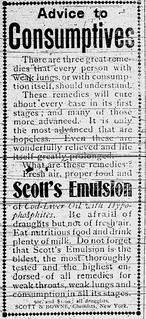
An 1898 advertisement for a quack tuberculosis remedy, from the Hobart Gazette.


I've been paying particular attention to tuberculosis since I came across stories from 1908 about the new governmental anti-tuberculosis regulations that had dairy farmers around Ainsworth in an uproar. Since I live in a time and a place where I'm very unlikely to get tuberculosis, it's hard for me to get a feeling for how real and threatening it was to my neighbors a century ago.

In 2005, tuberculosis caused just 0.2 deaths per 100,000 people in the United States. In 1900, it caused 194.4 deaths per 100,000 — only slightly fewer than influenza and pneumonia combined — while major cardiovascular disease caused 345.2 deaths per 100,000, and cancer 64.0. In 1904, nearly five thousand people in Indiana died of tuberculosis.

On the personal level, we've already seen how it devastated the Nolte family. In 1901 the Gazette reported on a Hobart family profoundly affected by it: Mr. and Mrs. J.P. Johnson, both infected with TB, had become so ill and weak that their 13-year-old daughter had to take on full responsibility for the care of her four little sisters, the youngest being only a few weeks old.

Other local deaths from tuberculosis:
  • Charles Niles, 30, died at his home in Deep River on May 30, 1900. Funeral services had to be held in the house because his wife was too weak to go to the church.
  • In September 1900 a 32-year-old railroad employee, David Hartland — working in spite of his tuberculosis — collapsed on the job near Deep River and died the same day.
  • In Lake Station, Miss Jennie Ringberg died in 1902 at the age of 21.
  • Also in 1902, Randolph Guernsey, who had gone to Colorado to try for a cure, died there at the age of 29, leaving a wife and two sons.
  • In 1905, Mrs. Amanda Bullock died at age 23.
From these reports I get the impression that tuberculosis liked to take people in the prime of their lives.

By the early twentieth century, the bacterium that causes tuberculosis had been identified, and with the new X-ray technology doctors could better diagnose the disease and track its progress in a patient; but there was no medical cure. TB sufferers were advised to get plenty of rest, fresh air and good nutrition, and to the extent such treatment strengthened the body's own immune system it could help in fighting off the infection. There were many sanatoria that offered this treatment (with the added benefit to the general population of isolating infected people), but patients had to be able to bear the financial burden involved — not only the fees charged by the sanatorium, but also the loss of work during the patient's stay there, which often stretched into months or even years. It was not until 1944, when the antibiotic streptomycin became available for use in humans, that doctors could actively cure tuberculosis.

Sources:
♦ "A Sorrowful Sight." Hobart Gazette 24 May 1901.
♦ "Advice to Consumptives" (advertisement). Hobart Gazette 9 December 1898.
♦ Dunne, Mike. "Former TB sanatorium in Placer County awash in poignant history." Sacramento Bee 7 Jan. 2010. http://www.sacbee.com/2010/01/07/2442723/former-tb-sanatorium-in-placer.html (accessed 13 March 2010).
♦ "General News Items." Hobart Gazette. 27 Jan. 1905.
♦ "Late Pick-Ups." Hobart Gazette 28 Feb. 1902.
♦ "Local Drifts." Hobart Gazette 28 Sept. 1900.
♦ "Mortuary Record." Hobart Gazette 1 June 1900; 21 March 1902; 3 March 1905.
♦ Pearson Education, Inc. "Death Rates by Cause of Death, 1900–2005." Infoplease 2007 (abstracting U.S. Public Health Service, Vital Statistics of the United States, annual, Vol. I and Vol II). http://www.infoplease.com/ipa/A0922292.html (accessed 12 March 2010).
♦ University of Medicine and Dentistry of New Jersey. Brief History of Tuberculosis. July 23, 1996. http://www.umdnj.edu/~ntbcweb/history.htm (access 13 March 2010).