Showing posts with label Goodrich. Show all posts

Monday, September 18, 2023

The Harpers, the Other Harpers, and the Other Other Harpers

I thought I would just quickly research Calvin and Mary (Underwood) Harper of the brick house beside the Deep River, and figure out what (if any) relation they had to Ainsworth's other Harpers (Benjamin; Middleton; Robert; and Robert's aunt, Ellen, who married Cyrus E. Smith). I did research them, but it wasn't quick.

So first let me just get the basic facts about Calvin and Mary Harper, who built the brick house.

Calvin was born in Ohio on September 24, 1819, to William and Deborah (Thompson) Harper. William was a native of New York, Deborah of Vermont, but they had moved to Ohio by the time of their marriage in 1818.

Calvin married Mary Underwood in September of 1843, in Ashtabula County, Ohio. Mary had been born in 1822[1] to Harmon and Mary (Mather) Underwood, in New York. The family must have moved to Ohio by the 1840s, although I can't find them in the census. By 1850 Harmon, Mary, and several of their children had gone to Lake County, Illinois.

But their daughter Mary, now a Harper, did not go with them. Here we see her and Calvin, with their only child, Mayvorite, in Ashtabula County, Ohio, in the 1850 Census:

2023-09-18. 1850 Census - Harper, Calvin and Mary
(Click on image to enlarge)
Image from Ancestry.com.


You will note that their neighbors include Harpers and Thompsons, any of whom may have been relatives. The family of Benjamin and Ruth Harper is particularly interesting. Ruth was Mary's sister, who married Benjamin Harper in 1842 (in Ashtabula County). But what was Benjamin to Calvin? — per a family tree I've found on Ancestry.com, Benjamin was Calvin's uncle, but that tree doesn't cite any definitive sources.

In my earlier post about the land now occupied by Southlake Mall, I noted its purchase in October 1852 by Daniel Underwood. He must have been some a relation to Mary (Underwood) Harper — brother, probably, or uncle. According to Early Land Sales, Lake County, in that same month and year, her father, Harmon Underwood, bought at least 160 acres in Ross Township.

Calvin and Mary Harper came to Ross Township in 1850, according to her 1916 obituary;[2] if so, that must have happened after July 1850 when the census was taken. The land they eventually owned was purchased by James Halsted in June 1852. The 1860 Census records Calvin and Mary in Ross Township. While (as we know) early censuses don't give addresses, the Harpers appear as neighbors (on the census, at least) to Carter and Charlotte Castle, who owned land adjacent to James Halsted's 1852 purchase. This suggests that the Harpers were already on their farm on what is now Grand Boulevard, living in a predecessor to the brick house.

In 1868, Mayvorite Harper married Admiral[3] Rodney Castle. He was the son of Lysander and Maria Castle, born in Ohio in 1841 (Indiana Death Certificates). Lysander had died in 1851[4], and his widow married Samuel Lathrop. The 1860 census and the 1874 Plat Map show the Lathrop-Castle blended family as neighbors of the Harpers.

As for Benjamin and Ruth Harper, they were still in Ohio in 1860, but within the decade they also came to Ross Township, where the 1870 Census found them. According to the 1874 Plat Map, they owned a good chunk of land at the tiny village of Hickory Top (later Ainsworth). They probably lived in, and may have built, the house at 6305 Ainsworth Road, built in 1869 per the county records.

The children of Benjamin and Ruth were Mary, Ellen, and Frank.

Ellen married Cyrus Smith in 1861 in Erie County, Pennsylvania;[5] in 1863[6] they moved to the farm in Ross Township where they would settle permanently.

Ellen's brother, Frank Harper, married Ella Hopkins in 1878, here in Lake County, and they had two children: Cassie and Robert. Thus, Robert was Ellen Smith's nephew.


When it comes to Middleton Harper, things get murky. From his obituary and his grave marker, we know he was born in Montgomery County, Indiana, on December 10, 1850. Per his death certificate, his father was John Harper, born in Tippecanoe County, Indiana, and his mother was Sarah Frazier, born in "East Tenn." or maybe "East Penn."

Middleton first appears as a nine-year-old boy in the 1860 Census of Tippecanoe County. The household consists of his grandfather (I'm guessing), Middleton, born circa 1795 in Maryland, and his 27-year-old mother, who is described as widowed. (She has several children besides Middleton, and there is a 21-year-old William who may be her brother-in-law.)

The next glimpse I catch of Middleton Harper is not the 1870 Census — I can't find him in it — but the Indiana Marriage Collection, which shows him in Lake County, Indiana, marrying Anna Goodrich in 1872. You'd expect to find them in the 1880 Census, but you'd be disappointed.

We do find Anna Harper in the 1900 Census. By then she was widowed. We also find her in 1910 and 1920, living with her married daughters.

But that doesn't help us figure out if Middleton Harper was any relation to all these other Harpers. I just don't know.

♦    ♦    ♦

All of this was put together with online sources. If I ever get the time to go through microfilm and other offline sources, I may find out more.


_______________
[1] Indiana Death Certificates.
[2] "Descendant of Cotton Mather Dies at Miller," Porter County Vidette (Valparaiso, Ind.), 19 Apr. 1916.
[3] Yes, that was his given first name.
[4] He is buried on the south bank of the Deep River west of State Road 51; according to legend (as noted in the NWIGS's Ross Township Cemeteries), at the time of his funeral and even after two days' wait, the river was too swollen to carry his coffin across to the cemetery up the road in Hobart Township.
[5] This is according to his obituary ("Death of a Ross Township Citizen," Hobart Gazette, 8 Oct. 1915); I can't find a record of their marriage on Ancestry.com. I do wonder if this means that Ellen's family spent some time in Pennsylvania, between the time they left Ohio and the time they came to Indiana.
[6] Also from Cyrus' obituary.

Friday, March 25, 2016

Walter Bros. Garage circa 1919

We've seen the Walter Bros. Garage before, but here's a slightly different view:

2016-3-25. Walter Bros 1919 a
(Click on images to enlarge)

So that would be the Lincoln Highway passing in front of the garage. It does not appear to be paved. I believe this photo dates to 1919 or earlier, based on the verso evidence:

2016-3-25. Walter Bros 1919 b

We do see "1919" in what appears to be a postmark. But also, the message was written by someone named Paul who is linked somehow to a Lina or Lena, and a little Elmer; and in the 1920 Census, taken in February of that year, we find a nine-month-old boy named Elmer, the son of Paul Bourquin and his wife, Lena, who were farming rented land in Ross Township. (They also have a two-year-old son, Paul.) Paul Sr. and Lena were both natives of Switzerland whose mother tongue was French.

The message is written in German. Now, what little I know of that language, I learned against my will in grade school, so it's not surprising that I would have trouble reading the postcard message. But I think in this case the difficulty is not just my own ignorance — this doesn't seem to be the proper German we learn in school. I have no idea whether Paul is being playful by writing incorrectly, as people sometimes do, or whether this is a regional dialect of German, or whether it's just the sort of German you might expect from a native French speaker.

Anyway, I've attempted a loose translation:
Hello there! (We) have received on Good Friday morning a healthy splendid little boy (Buebchen). Here it is Good Friday morning and we're as sound as turnips. All are doing well, all 4 are healthy and jolly. When you get married we will all quickly come across, so don't keep us waiting. When you get married, get over here right away so we won't be left suffering any longer. Lena wants to get little Elmer baptized. I hope you and all the rest are healthy, and my hearty greetings to all. Paul.
Perhaps some German-speaker will stumble across this post and help me out. [Update: the corrected sentences are from Jon Casbon's comments to this post.]

I can't positively identify Paul in any official records other than the 1920 census. Nor can I find any mention of him in my newspaper notes … until August 1922:

2016-3-25. Bourquin public sale
(Click on image to enlarge)
Hobart News 17 Aug. 1922.


To find a Goodrich farm meeting that description, we have to go all the way back to the 1891 Plat Book, where we find this parcel of land, shown on the 1908 Plat Map as belonging to Eli and Levi Boyd, owned by a Thomas Goodrich.

2016-3-25. Goodrich farm 1891
(Click on image to enlarge)
This image from the 1908 Plat Map shows the Thomas Goodrich farm as shown in the 1891 Plat Book.


Now I have to stop and ask myself who Thomas Goodrich was. Born 1826, died 1891, he was the father of Charles Goodrich, whose family has been mentioned several times already in this blog. I can't find him in Ross Township any earlier than the 1870 Census, where he and his wife, Sarah, with their three children (Anna, Levi P.,* and Charles), are farming in what seems to be roughly the vicinity of the "old Goodrich farm."


But to return to the Bourquins — that 1922 farm sale sounds as if they are getting ready to move, doesn't it? If so, I don't know where they went, any more than I know where they came from.

__________________
*Levi seems to have preferred his middle name, Perry, as evidenced by the census records and various newspaper items. I think Perry may have continued farming the old Goodrich land for some years after his father's death.

Friday, December 11, 2015

Back in '02, When the Vincent School Burned

Here's an interesting little event that I didn't know enough to pay attention to the first time I was reading through the 1902 microfilm.

2015-12-11. Vincent schoolhouse fire
(Click on image to enlarge)
Hobart Gazette 28 Feb. 1902.


So when Gust Lindborg "bought the old Sullivan schoolhouse" in 1912 — assuming "Sullivan" and "Vincent" are two names for the same school — it wasn't really all that old, was it? — nine or ten years.

The property records for the former Vincent schoolhouse still standing at Clay St. and Harms Rd. give a construction date of 1925. If that's correct (and assuming Sullivan = Vincent), why was the Vincent school building available for purchase in 1912? Were they building a new wooden one then? This is getting complicated.

I wish the story had identified "Miss Burge" better. In the 1900 Census, (Winfield) Scott and Mary Burge had six daughters and two sons living at home. I suppose either of the two eldest daughters, May (born circa 1881) and Bertha (born circa 1882), could have become a teacher by 1902, and maybe even the next eldest, Libbie (born ca. 1885). The census shows the Burges owning their own farm; my guess at its location is marked on this image from the 1908 Plat Map, which also shows how conveniently close for the burned-out students the Goodrich house was.

2015-12-11. Goodrich 1908
(Click on image to enlarge)

The yellow X marks the present location of the brick house that used to be the Vincent schoolhouse. This map places the 1908 schoolhouse* on the north side of present-day E. 83rd Ave.

The Goodriches were Charles and Caroline. They had five children of their own who likely attended the Vincent school: Cora, Ida, Arthur, Clarence, and Harold. (The two youngest would later go to war, and Harold would not come home.)

___________________
*Which would be the one that ended up as the Lindborg home on Ainsworth Road, as I currently understand it all.

Tuesday, November 24, 2015

It's a Rich Man's Road and a Poor Man's Tax

These notices to Ross Township taxpayers appeared in April 1922:

2015-11-24. Notice of road improvement bonds
(Click on image to enlarge)
Hobart Gazette 14 Apr. 1922.


In view of recent complaints about the condition of local roads, some road improvements would seem necessary and desirable, even if interest-bearing bonds had to be issued to pay for them.

But by late May the protests of some unnamed "Ross Township farmers" had brought a member of the state board of tax commissioners up to from Indianapolis to look into the proposed work. The general objection was that the costs of construction were inflated. With regard to the Woods road, protesters were suspicious of the fact that the wealthy Gary citizens who used the Gary Country Club (at the site of the present-day Innsbrook Country Club) would benefit from the road while not bearing any of its cost.

2015-11-24. Protest against road improvements
(Click on image to enlarge)
Hobart News 1 June 1922.


Perhaps the awarding of the road-work contract to someone who wasn't local didn't sit well with them either.

I gather from the description in this article that the "Sam B. Woods road" to be improved was only five-eighths of a mile long. My guess at its location is marked in red on this excerpt from the 1926 Plat Book:

2015-11-24. Sam B. Woods road 1926
(Click on image to enlarge)

The "Goodrich road" improvement area was 2.5 miles "running south and west from Ainsworth on the Lincoln highway" … so, some unspecified chunk of the Lincoln Highway between Ainsworth and Merrillville?

2015-11-24. Goodrich Rd 1926
(Click on image to enlarge)

Hey, I just like making these little maps.

Monday, February 18, 2013

Twenty Years to the Day

Twenty years to the day after her husband died, Anna Harper went to join him. She had been a resident of Ross Township for at least half a century, yet her passing prompted only this brief mention in one of the Hobart papers.

Anna Harper death notice
(Click on image to enlarge)

Anna had been born a Goodrich, so the two brothers were Levi and Charles; she married Middleton Harper in 1872. The home "near Merrillville" where she died was, I believe, the farm of her daughter Eva and son-in-law Walter, on the south side of 73rd Avenue west of Ainsworth — part of the old Morgan Blachly land. The land that had once been known as the "Mid Harper farm" was now the Sizelove farm.

Harper, Mid and Annie
(Click on image to enlarge)

I had to go back and look at the 1900 microfilm to find out what kind of a write-up Middleton Harper got upon his death. It was more than Anna had:
Middleton Harper, a farmer near the Adam's school house in Ross township, died Sunday evening, May 6th, 1900, aged 49 years 4 months and 25 days. The deceased was born in Montgomery Co, Ind., but for the last thirty years had been a resident of Lake county. During recent years he had become very fleshy, so much so that he weighed over three hundred pounds, and as a result he became afflicted with fatty degeneration of the heart. The funeral service conducted by Rev. J.L. Greenway took place at the church in Merrillville on Tuesday, a large number of friends being present. The deceased was a good neighbor and was respected by all who knew him. He leaves a mother, wife and three daughters, also two brothers and one sister.

There is no Death! What seems so is transition;
This life of mortal breath
Is but a suburb of the life elysian,
Whose portal we call Death.

And though at times impetuous with emotion
And anguish long suppressed,
The swelling heart heaves moaning like the ocean,
That cannot be at rest,—

We will be patient, and assuage the feeling
We may not wholly stay;
By silence sanctifying, not concealing,
The grief that must have way.
The poetry is an excerpt from Henry Wadsworth Longfellow's "Resignation." I shall have to wait until I retire from blogging and have some free time so I can go and check the Crown Point newspapers of 1920, before I make any remarks about Anna's family not being able to find any poetry for her.


Sources:
♦ 1870 Census.
♦ 1920 Census.
♦ Indiana Marriage Collection.
♦ Indiana WPA Death Records Index.
♦ "Local and Personal." Hobart News 6 May 1920.
♦ "Obituary." Hobart Gazette 11 May 1900.

Tuesday, May 8, 2012

Ross Township Commencement

Ross Township's graduating class of 1919 including two young people from Ainsworth — Robert Chester and Raymond Triebess, as well as three from Deep River.

The page from the Gazette of May 16, 1919, carrying that announcement also gives us an update to our continuing saga, Plumbing Hobart's Secrets. In this episode, George and Helen Rhodes have just returned from Philadelphia, where George had finally concluded his wartime plumbing mission. George was ready to hit the ground running in the service of Hobart's plumbing needs. Meanwhile, George Bruce — perhaps seeing the Lee & Rhodes juggernaut bearing down on him — had started rethinking his career in plumbing.

Ross Twp Commencement
(Click on image to enlarge)

More on Rhodes and Bruce, from the Hobart News of May 15, 1919.

Rhodes, Bruce
(Click on image to enlarge)

Sunday, April 29, 2012

Clarence Goodrich Comes Home

"Clarence Goodrich has landed at Boston," said the Hobart News of April 17, 1919. He was on his way home from "over there."

He arrived back at his parents' farm on Sunday, April 20. That same day, the Merrillville Study Club held a memorial service for the four Ross Township men who died in the war — among them, as we know, Clarence's younger brother, Harold. The memorial service ended with the planting of four trees along the Lincoln Highway, each marked with the name of one of the fallen soldiers.

The report doesn't state whether Clarence attended that ceremony, but as Harold's brother and a veteran of the battlefields himself, he was an object of much attention. The last day of April, the Goodriches hosted an evening reception at their farmhouse in Clarence's honor; some 300 people from Ainsworth and vicinity attended. They were eager to hear about Clarence's experiences, and Clarence was willing enough to talk.

Harold, he told them, had fallen just a few feet from him on that day in July 1918 — killed in the heat of battle, and instantly, Clarence believed. But something about the way Harold had said goodbye the evening before suggested that the young man had a premonition of his own death. As for Clarence himself, he had gone through much fighting without ever being wounded, and through an epidemic without ever getting sick.

The Gazette of May 9 included a brief summary of his military experience:
Clarence was in the service about two years. On April 10, 1917, he enlisted with Co. F, at Gary, and when he went to camp at Hattiesburg he was assigned to Co. F, 151st Inf., but when he later went to France he was transferred to Co. I, 104th Inf., 26th Division. He sailed overseas March 2, 1918, and upon returning to America he was discharged April 19, 1919. He saw considerable service being in the Marne, in the Pas Ferris sector, July 4 to Aug. 1, 1918, and in the Marne offensive from July 18 to Aug. 23, in the St. Mihiel offensive, Sept. 12 to Sept. 15, and the Truyon sector from Sept. 14 to Oct. 5, and the Marne-Argonne offensive, Oct. 10 to the signing of the armistice.
And now he was back on the farm.


Sources:
♦ "Additional Local News." Hobart Gazette 9 May 1919.
♦ "Honor Soldier Boy." Hobart Gazette 2 May 1919.
♦ "Local and Personal." Hobart News 24 Apr. 1919.
♦ "Local Drifts." Hobart Gazette 25 Apr. 1919.
♦ "Memorial to Fallen Heroes." Hobart Gazette 25 Apr. 1919.
♦ "South of Deepriver." Hobart News 17 Apr. 1919.

Thursday, December 22, 2011

A Dreary Holiday Season

As Christmas 1918 approached, the Spanish influenza still lay heavily over Hobart and the surrounding countryside. The Gazette of December 20 was full of influenza news. A report on the continuing epidemic noted that people who had lived through the disease, though they may be able to leave their beds and their houses, remained "very weak." Just lately the disease seemed "to attack the children more than formerly"; but the week's three influenza fatalities had all been adults, in the prime of life.

Anna Flodquist died of pneumonia following influenza on December 18, her 20th birthday; she left a husband and a six-month-old baby. Two days earlier, a 41-year-old bachelor, Joseph Fox, had died of influenza.

And the family of Charles and Caroline Goodrich, still mourning the loss of Harold in France, now were hit with fresh heartbreak. On December 15, Cora Goodrich Fasel died of pneumonia following influenza. She had been born on the Goodrich farm southwest of Ainsworth in 1886; in 1908 she married Charles Fasel; they lived in Ross Township for the next eight years, then moved to Hobart. Besides her husband, parents and siblings, Cora left four children, all under the age of 10.

♦    ♦    ♦

The quarantine was still in full force, with no hope of its being lifted for Christmas. It seems that the churches had not accepted Dr. Clara Faulkner's angry permission "to contribute to the spread of the epidemic" by holding public services; next to the listing of the week's deaths was printed an open letter to the public from a chastened Rev. A.H. Lawrence (pastor of the M.E. Church), who acknowledged no other way of communication, "[t]he churches being closed." After offering sympathy to those who had suffered illness or bereavement, he urged the citizens of Hobart to comply with the quarantine.
We are fighting an enemy of health that is not well known. … We do not know, and until it is discovered just what treatment is best, and what public policy is best, let us be loyal to the requirements and judgment of our health officer. … Not being free to observe Christmas in the churches as usual, let us make this Christmas a home festival long to be remembered. …
He closed by asking to be informed about any family in need of a Christmas tree for their home celebration, and about any evergreen trees that might be donated.


Sources:
♦ "Deaths for the Week." Hobart Gazette 20 Dec. 1918.
♦ "Influenza Claims Three More Victims the Past Week." Hobart News 19 Dec. 1918.
♦ "Influenza Still Rages." Hobart Gazette 20 Dec. 1918.
♦ "To the Citizens of Hobart." Hobart Gazette 20 Dec. 1918.

Friday, September 16, 2011

A Soldier's Letter of Condolence

The Hobart News of September 12, 1918, reprinted a letter of condolence that Charles and Caroline Goodrich received from the commanding officer of their son, Harold.

9-16-2011 Goodrich letter 9-12-1918
(Click on image to enlarge)

Sunday, September 4, 2011

The War Comes Home to Ainsworth

As we've seen, in July 1917, Clarence Goodrich and his younger brother Harold had both volunteered for the Indiana National Guard, which was drafted into the regular army the following month; by December of that year, both young men were at Camp Shelby in Mississippi (where Harold celebrated his 20th birthday), and by the summer of 1918 both were in France. Their parents still had their eldest and youngest sons, Arthur and Howard, living at home with them.

I don't know what became of the divorce proceedings Caroline Goodrich reportedly began against Charles early in 1918, as I've heard no more about it. Perhaps they made up their differences and saved their marriage.

They received several letters that summer from their boys in France. In the middle of June Harold wrote to say that he expected they would see action very soon. In a letter dated July 15, Harold announced that he had been in battle.

That letter reached the Goodriches around August 13 — the day they received a brief telegram from the government: Harold had been killed in action on July 18. No further explanation.

As usual in such cases, there could be no funeral, no laying their boy to rest, as his remains were somewhere in France. But no doubt the Gazette spoke truly when it said the family had "the deep sympathy of the community."

And with no news of Clarence, for the moment they could only presume — hope — he was still alive.


Sources:
♦ "Ainsworth Boy Killed and Hobart Boy Injured in War." Hobart News 15 Aug. 1918.
♦ "Harold Goodrich Killed in France." Hobart Gazette 16 Aug. 1918.

Friday, May 27, 2011

To Insure Domestic Tranquility

On the topic of Company K — all was not well with Capt. Charles Allen. Early in 1918, Freda Allen hired R.R. Peddicord to file an action for divorce from Charles, alleging desertion and non-support. They had two small daughters at the time.

Perhaps Charles was spending all his time and money on Company K.

However, by the time the divorce suit got into the newspaper (on Valentine's Day), the Allens had reached a "settlement of their differences." The divorce did not go through, and we find them still married in 1920.

In March, Charles resigned as captain of Company K, to the great regret of its members. The News' explanation seems to suggest that he did it to placate Freda: "Trouble outside of the company affairs came up, which, it is said, caused Mr. Allen's resignation."

Now First Lieutenant Charles W. Reeves automatically became the acting captain of Company K.

♦    ♦    ♦

R.R. Peddicord filed another suit in early 1918: Caroline Goodrich sought divorce from her husband Charles, after 33 years of marriage. Let's hope they make up their differences as well. It's stressful enough to have two sons in a wartime army without adding a divorce on top of that.


Sources:
♦ 1920 Census.
♦ "Capt. Allen Resigns." Hobart Gazette 29 Mar. 1918.
♦ "Capt. Chas. Allen of the Hobart Militia Co. Resigns." Hobart News 28 Mar. 1918.
♦ "Court Notes." Hobart News 14 Feb. 1918.

Wednesday, January 26, 2011

The Slow Process of Mobilization

The July 20 draft had drawn the numbers of 52 men in the Crown Point draft district, which included Ainsworth and Hobart. Of those 52, none was from Ainsworth; six were from Hobart.* Their next step was to present themselves for medical examination in Crown Point on August 3 and 4. If they passed that exam and either did not qualify for or did not request any exemption, they would go home and await the orders that would call them to the local draft board to be put on a train to their cantonment.

The Indiana National Guard was mobilized on August 5, its members becoming part of the regular army, with privates to receive $30 a month in pay, plus board. The Gazette, which had kept its promise to include Clarence and Harold Goodrich on its Roll of Honor, now listed them as "Infantry" instead of "Guardsman."

1-26-2011 Roll of Honor Aug 1917

Otto Sizelove, also a former guardsman, had been a barber in civilian life, employed in Frank Wilder's barber shop; now he was the company barber. Like George Severance, Jr., Otto had served on the Mexican border earlier. As for George, he was now in "Aviation."

All the former guardsmen in Company F remained in Gary awaiting orders to entrain for Fort Harrison at Indianapolis. Later they expected to be shipped to a training camp in Mississippi.

In the little village of Deep River, locals planned an ice cream social for August 17 to raise funds for the Red Cross.

__________________________
*Harry McClaran, Oakley R. Jones; Willard W. Stevens, Donald I. Frace, George Schavey, and George Caldwell.


Sources:
♦ "Additional Local News." Hobart Gazette 3 Aug. 1917.
♦ "Crown Point Draft Division Notified to Appear Aug. 3 and 4." Hobart News 2 Aug. 1917.
♦ "Draft Army Called." Hobart Gazette 17 Aug. 1917.
♦ "Hobart Men Called for Examination." Hobart Gazette 3 Aug. 1917.
♦ "Local and Personal." Hobart News 9 Aug. 1917.
♦ "No More Indiana Guards." Hobart Gazette 10 Aug. 1917.

Sunday, January 23, 2011

The Numbers Are Drawn

By mid-July, cavalryman Fred Bowlby was stationed at Fort Ethan Allen in Vermont; President Wilson had issued an order drafting members of the National Guard and National Guard reserve into the regular army; and across the national, the ten million young men who had registered waited for the first draft to take place.

President Wilson's formal draft order set the goal of a military force totaling 1,262,985 men. The first draft would bring in 687,000 men. Indiana's quota was 17,510. On the morning of July 20, the drawing of numbers began in Washington.

The following week the News printed lists of the draft numbers for Hobart and Ross Township conscripts.

1-23-2011 Hobart Draft
(Click on images to enlarge)

1-23-2011 Ross Draft 1
1-23-2011 Ross Draft 2

The day after this list appeared, the Gazette reported that 21-year-old Clarence Goodrich had volunteered, not waiting to be drafted. So had his 19-year-old brother Harold. Both joined Company F of the Indiana National Guard at Gary. Although these young men came from Ross Township — their family's farm was southwest of Ainsworth — the Gazette promised to include them in the Hobart Roll of Honor.

And as for George Severance, Jr., who had joined the army in March 1916, word now came that since the declaration of war he had spent his time learning the young and dangerous art of aviation, and had been promoted to the rank of corporal in a flying squad.


Sources:
♦ 1891 Plat Book.
♦ 1910 Census.
♦ 1926 Plat Book.
♦ "Additional Local News." Hobart Gazette 27 July 1917; 3 Aug. 1917.
♦ "Draft Great American Army." Hobart Gazette 27 July 1917.
♦ "Formal Draft Orders Issued by President." Hobart News 19 July 1917.
♦ "General News." Hobart Gazette 20 July 1917.
♦ "Hobart and Ross Township Conscripts in the Order in Which They Will Be Called." Hobart News 26 July 1917.
♦ "National Guard Is Ordered Into Federal Service." Hobart News 12 July 1917.
♦ "Selective Draft Drawing Takes Place on Schedule Time." Hobart News 26 July 1917.
♦ Untitled social column. Hobart News 5 July 1917.

Friday, December 24, 2010

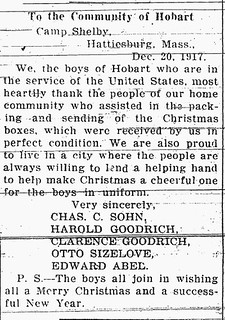
Christmas Greetings from 1917

Christmas1917
(Click on image to enlarge.)
From the Hobart Gazette of December 28, 1917.


I'm jumping ahead in my narrative to bring you this letter from a past Christmas.

They counted themselves among "the boys of Hobart," but Harold and Clarence Goodrich came from a farm southwest of Ainsworth.