
(Click on images to enlarge)
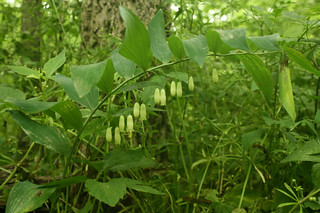
The true Solomon's Seal is finally in bloom. I was expecting something more showy. These shy little blossoms hang upside-down from the underside of the stem. That is supposedly a strategy the plant has developed to keep out rain and to hinder non-bee insects from getting at the nectar. It didn't work too well in this case.
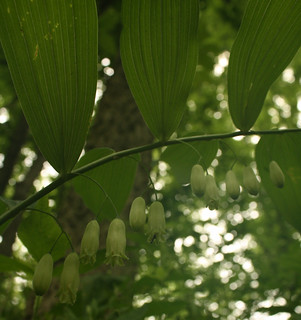
Hi, ant! Enjoying your lunch?
The source of the name is much-debated. Jack Sanders reports various explanations: the rootstock bears indentations, formed each year as the plant dies back, that resemble the impression of a signet ring — or, in another version, those indentations look like Hebrew letters "set in the rootstock by King Solomon as testimony to its medicinal values"; or perhaps it was named after the shape revealed when you transversely slice the root — once again, a Hebrew letter, King Solomon's seal of approval. Yet another theory posits that early Christians gave the plant its name after noting the resemblance between the six-pointed flower and the six-pointed Star of David — also known as Solomon's seal.
Its scientific name is Polygonatum biflorum: the first word is Greek for "many kneed," which describes the zig-zagging, jointed stem, and the second word refers to the way the flowers hang from the stem in pairs, as you can see above.
Found along a trail in Deep River County Park.


No comments:
Post a Comment