Sunday, September 8, 2013

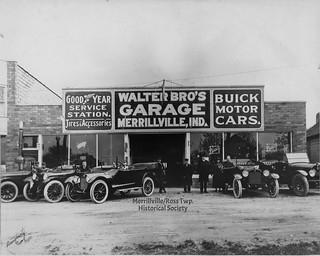
Merrillville Then and Now: Walter Bros./Brugos Automotive

Late 1910s and August 2013.

Walter Bros
Brugos Automotive
(Click on images to enlarge)
Top image courtesy of the Merrillville/Ross Township Historical Society.


We are on the south side of W. 73rd Avenue, just west of Madison Street. So that dirt road in front of the Walter Bros. Garage is the Lincoln Highway.

No one in the photo is identified. Naturally, you'd expect the Walter brothers to be in it, but I don't know which they are.

The 1920 Census lists the three garage operators as Howard (25), Leslie (23) and Clarance (22). They live in the household of their parents, Earnest and Louesa. Last on the list is daughter-in-law Maud, née Shearer, who married Leslie in June 1919.

Saturday, September 7, 2013

And One on the Way

From Mildred Lindborg's photo album.

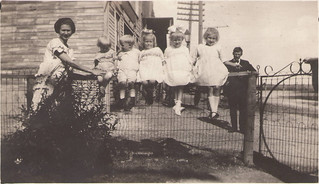
37 A fence full
(Click on image to enlarge)
Image courtesy of N.B.


Mildred captioned this, "A fence full." The woman on the left looks as if she were going to produce another little fence-sitter soon.

None of the people are identified. They are standing where Maud and Edith stood in the front yard of the Lindborg home in Ainsworth. It's possible both photos were taken the same day; the shrub is very similar in both pictures, and the broken-wheeled wagon sits out in front of the blacksmith shop in the same position.

Friday, September 6, 2013

Diphtheria

The early autumn of 1920 saw an outbreak of diphtheria in Hobart. At that time, treatment relied mainly on an antitoxin, developed in the 1890s, to neutralize the effects of the toxin secreted by the diphtheria bacteria; but with effective and widespread vaccination still a few years in the future, and no antibiotics to treat the main infection, the only way to fight the spread of the disease was quarantine. Among the first houses to be quarantined was the Springman home on Lake Street, where the widowed Hattie lived with three sons between 12 and 20 years of age.

Diphtheria was particularly dangerous for young children. The mortality rate for patients under five years of age was about 20%, and for those five years or older, 5-10%.* The first fatality in this outbreak seems to have been Leslie Carlson, the five-year-old son of Albert and Hannah Carlson of Michigan Avenue, who died October 23.

By early November the disease was in Joryville. Eugene Hill, 50 years old, was infected and his house quarantined, as was the home of James and Hulda Shearer, whose only child, the 10-year-old Clara, was sick. Nearby in the Frank and Christina Popp home, an (unnamed) young daughter had caught the same disease. By the time the this report came out, Eugene was already on the mend; Clara would pull through, as would the Popp girl. But on Fleming Street, diphtheria took the life of three-year-old Theresia Peas.

On November 18, the News declared: "The diphtheria epidemic is well under control. All suspicious symptoms are treated with rigid care. … No new cases are reported." As you might expect, the next week brought another reported quarantine — the home of Melvin and Marian Parker, though it isn't clear how many were sick in that household, which included four children under 11, and Melvin's 70-year-old father.

After that, however, diphtheria faded from the news for what remained of 1920.

♦    ♦    ♦

On a related note, for a good read I recommend The Cruelest Miles by Gay Salisbury and Laney Salisbury (2003). It centers on a diphtheria epidemic that broke out in Nome, Alaska, in the winter of 1925. The city was unreachable by boat or airplane; the only way to transport fresh antitoxin from Seward, 1000 miles away, was by dogsled. The Cruelest Miles tells the story of that life-and-death dogsled race.


________________________
*The mortality rate for adults over 40 was 20%, but more of the adult population could be expected to have the immunity that usually resulted from surviving a childhood infection.


Sources:
♦ "Diphtheria." History of Vaccines. College of Physicians of Philadelphia, n.d. http://www.historyofvaccines.org/content/articles/diphtheria. Accessed 28 Aug. 2013.
♦ 1920 Census.
♦ "Local and Personal." Hobart News 11 Nov. 1920; 18 Nov. 1920.
♦ "Local Drifts." Hobart Gazette 15 Oct. 1920; 29 Oct. 1920; 12 Nov. 1920; 26 Nov. 1920.
♦ Steven, Doerr, MD. "Medical Dictionary." EMedicineHealth. WebMD, Inc., n.d. http://www.emedicinehealth.com/diphtheria/article_em.htm. Accessed 28 Aug. 2013.

Thursday, September 5, 2013

Hobart Then and Now: Shearer House on Lincoln

1a Shearer home 8th and Lincoln
Shearer house 2013
(Click on images to enlarge)
Top image courtesy of E.H.


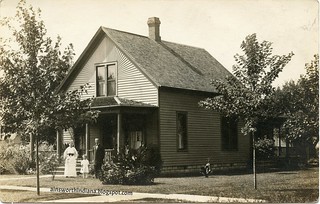
The steamer trunk included this photo postcard of the home of James and Hulda Shearer, at the corner of 8th and Lincoln.

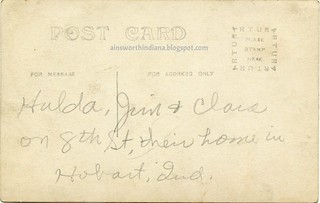
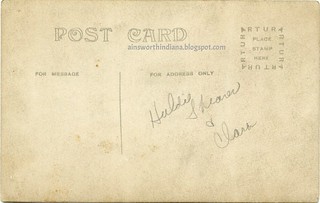
There is nothing on the back of the postcard except the identification:

1b Shearer home verso

The little girl between Hulda and Jim is their daughter, Clara. She was born in 1910. Here she looks to be about six years old, which would date the photo to circa 1916.

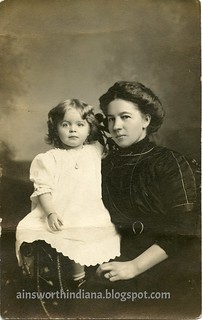
From the same source we have a photo of Clara and Hulda, about three years earlier.

21a Hulda and Clara Shearer

21b H & C Shearer verso

The 1940 Census shows Clara, married, living with her parents. Her surname was Stolp; I think her husband's first name was Willard and she married him circa 1929 (if I've found the right people in the 1930 Census).

Wednesday, September 4, 2013

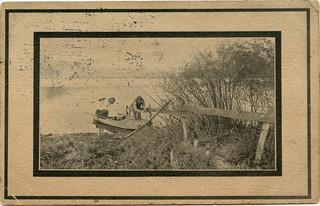
Two Cards from the Chicago Kid

From the steamer trunk.

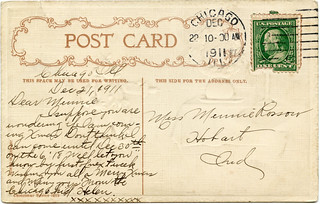
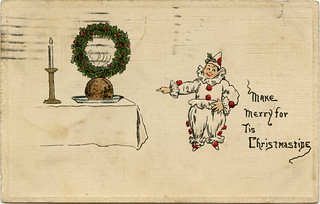
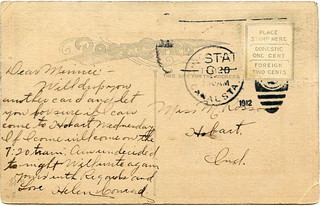
I don't know who Helen Conrad was, but Minnie kept two postcards from her, both talking about intended visits to the Rossow home, so I gather they were good friends.

The first was mailed December 22, 1911:

1911-12-22-b
(Click on images to enlarge)
Images courtesy of E.H.


1911-12-22-a

The exact date of the second isn't clear, but the year is 1912:

1912-4b Helen Conrad

1912-4a Helen Conrad

(There is nothing to indicate what body of water that is.)

The 1910 Census shows a Helen Conrad of Minnie's age living at 5254 S. Ashland Ave. in Chicago — a possibility, but I don't know for sure.

Tuesday, September 3, 2013

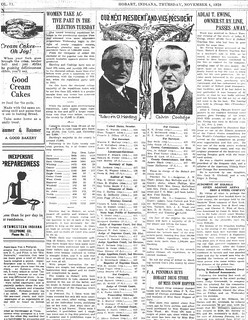
Our New President and Vice President

Harding and Coolidge elected
(Click on images to enlarge)
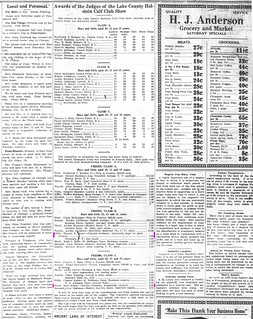
From the Hobart News of Nov. 4, 1920.


The obituary of the streetcar-line owner suggests that Hobartites were less than happy with the line's service.

More bad news from the same issue's summary of "Town Board Doings": "A report by the state board of health showed the town water polluted and unfit for domestic use."

A couple more cheerful items, one from the "Local and Personal" column: "Mr. and Mrs. Wm. Raschka, Mr. and Mrs. Chas. Chester and Mrs. Lovisa Nelson motored to Fort Wayne Saturday and visited at the home of Mrs. Olson, returning Monday."

This is the other:

Goldman's sweaters

Sweaters from Ainsworth! … OK, it's not as exciting as a trip to Purdue or a camera, but it's better than a roll of roofing paper or a manure fork.

Sunday, September 1, 2013

Happy Labor Day!

Herman Harms planting
(Click on image to enlarge)
Image courtesy of E.H.


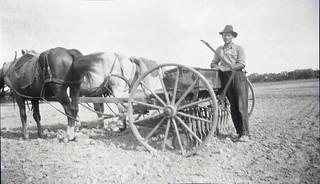
This photo from the steamer trunk shows Herman Harms pausing from his work in his field.

That's a Hoosier grain drill, which could plant 14 rows at a time (so I'm told, though I can see only about 12 funnels in the picture). The discs cut furrows into the earth, the seeds (wheat, oats, soybeans) dropped into the furrows through the funnels behind the discs, and then cast-iron rings dragging behind pulled dirt over the seeds.

No date on this photo. My guess is the 1920s or 1930s, and I can't get more specific than that.