Friday, July 25, 2025

Epaphras!

This item from the estate papers of Jeremiah Wiggins shows him buying 50 pounds of flour on May 10, 1838, from E.P. Butler:

2025-07-25. Wiggins estate 27c
(Click on image to enlarge)
Image courtesy of Alice Flora Smedstad.


My transcription:
Lake County Ia.

The Estate of Jeremiah Wiggins, De'd

To E.P. Butler, Dr.

For 50 lbs. of Flour, furnished said Wiggins in his life time, to wit, on the 10th day of May, 1838 at $4.00 per 100 lbs _________ $2.00
In his discussion of the earliest Lake County settlers, T.H. Ball mentions an encampment of U.S. surveyors during the summer of 1834, and goes on to say:
After the surveyors came the claim seekers. There is evidence that either before or soon after that week of encampment just mentioned, one Wm. Butler was on this ground before Solon Robinson came, and made four claims, for himself, for his brother E.P. Butler, for George Wells, and for Theodore Wells. He also erected cabins and departed. I find the existence of three cabins recognized by those who are called Lake county's earliest settlers. I think they were the Butler cabins. (Lake County 1834-1872 at 21.)
The E.P. Butler mentioned by Ball was probably the same one in our document. The 1840 Census lists E.P. Butler as the head of a household in Lake County.

The first clue I came across as to his first name was a mention of one Epaphrous P. Butler as a non-resident taxpayer of North Township in 1839 (Porter and Lake Counties (Goodspeed-Blanchard) at 533). Early Land Sales, Lake County has more variations on that name: Epaphenas P. Butler, in 1843, purchased 160 acres west of Merrillville[1]; in 1855, Ephrain P. Butler bought nearly 80 acres northwest of Merrillville.[2]

The 1850 Census shows E.P. and his wife, Jane, farming in Ross Township:

2025-07-25. Census, 1850, E.P. Butler
(Click on image to enlarge)
Image from Ancestry.com.


Jane died sometime in 1856 (information from Findagrave.com is filling in here where there are no official records or newspaper reports). On December 31, 1856, E.P. married Saphrona Mears (Indiana Marriage Collection), whose name appears in other places as Myars and Miars.

Based on what we see in the 1860 Census, Saphrona must have been a widow with her own children:

2025-07-25. Census, 1860, E.P. Butler
(Click on image to enlarge)
Image from Ancestry.com.


Judging by the names recorded near them in the census, I believe the Butler farm was in far western Ross Township. Perhaps it was this land that still bore E.P.'s name on the 1874 Plat Map (half of which "Ephrain P. Butler" had purchased in 1855):

2025-07-25. Butler 1874
(Click on image to enlarge)

But E.P. had been dead for some ten years by the time this map was made. He died in 1864 and is buried in Schererville's Pleasant View Cemetery with his first wife, Jane.[3]

♦    ♦    ♦

Thanks to Findagrave.com and family trees on Ancestry.com, I've been able to look into E.P.'s family. He was the second (I believe) child of Jonathan and Elizabeth Butler of Hartford, Connecticut. His siblings were Jonathan, William, Maria, George, Eliza, and Nathan.

So it was only for this second son that his parents pulled a name out of left field — or, to be precise, out of the New Testament, where an otherwise obscure figure in the early church gets a few mentions in Paul's letters. I'm glad E.P.'s parents had that whim, though, because it makes him easier to identify.

Here is his father's will, written in 1853:

2025-07-25. Will of Jonathan Butler
(Click on image to enlarge)
Image from Ancestry.com.


E.P. and William seem to be grouped together in their father's mind, and not exactly as favorite children: each gets only $100, as opposed to the $500 given to Maria. In item #4, we learn that these two, well into their 50s when the will was written, still owed their dad money. But he forgave their debts.

William was by then a Michigan resident. If we go looking for him on Findagrave.com, we see that he did not stay long in Lake County, Indiana, after making those early claims, and that he was drawn to settling in wild places.

_______________
[1] Specifically, the northwest quarter of Section 17, Twp. 35 N., Range 8 West (p. 182).
[2] Two purchases dated December 21, 1855, of the SW quarter of the NW quarter, and then the SW quarter of the SW quarter, Section 6, Twp. 35 N., Range 8 West (p. 175).
[3] His second wife died in 1879 and is buried in Merrillville Cemetery as the widow of William Miars.

Friday, July 18, 2025

How Jeremiah Earned Some Money

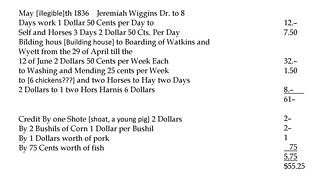
This summary of amounts owed to Jeremiah Wiggins is in the same handwriting (and spelling) as the Charles Sloat note, but, as we shall see, Charles wasn't involved in these transactions, except maybe as the scribe of this summing-up written well after the transactions took place.

2025-07-18. Wiggins estate 27b
(Click on image to enlarge)
Image courtesy of Alice Flora Smedstad.


My attempted transcription:

2025-07-18. Wiggins estate 27b transcription
(Click on image to enlarge)

This document was a challenge: the copy is bad, the spelling non-standard, and the writer did not start a new line for every item. But this is what I have teased out regarding what Jeremiah did or supplied to earn these amounts:
  • eight days' unspecified work by Jeremiah
  • work by Jeremiah and his horses for 3 days to help build a house
  • boarding (i.e., feeding) Watkins and Wyett, whoever they may have been (we'll get to that below), from April 29 to June 12 of — 1835? (the document is being written in May of 1836)
  • washing and mending
  • hay for two horses and (almost illegible but looks like) six chickens
  • one two-horse harness
All of that is reasonable enough except for the washing and mending. "Washing," I suppose, meant laundry. Now, does a tough frontiersman do laundry and mending by the week for other people? Do tough frontiersmen want their laundry done every week? Maybe my notion of tough frontiersmen is wrong. Or maybe Jeremiah subcontracted that work.

The person owing Jeremiah these amounts set off part of his debt by furnishing to Jeremiah one young pig, two bushels of corn, some pork, and some fish.

Here is the description noted on the back of the document by Solon Robinson, the court clerk:

2025-07-18. Wiggins estate 27a
(Click on image to enlarge)
Image courtesy of Alice Flora Smedstad.


My transcription:
No. 1
Wiggins Estate

Barney's a/c.
Balance due 55.25

Filed March 28th 1839
Solon Robinson
Clk. L.P.C.
So, while the body of the document does not name the debtor, the clerk's description supplies a name: Barney.

This may have been Francis Barney, who was in Lake County by 1836 (Lake County 1834-1872 at 55) and is listed in the 1840 census. Around 1842 he married Amanda Strong (Indiana Marriage Collection). The Barney family, with three children, is listed in eastern Ross Township in the 1850 Census. One of their daughters married Austin Thompson in 1863 and raised a family of five children, all of whom went on to raise their own families in Lake and Porter Counties.[1] I have not been able to trace any other Barney family member beyond 1850 (not that I've tried very hard!).

Let's look again at the two people whom Jeremiah boarded: Watkins and Wyett. I have found two possible matches for those names:
  • William Watkins, an early settler of northeast Ross Township, who appears as early as 1837 in records of Hobart merchants, and in the 1840 census
  • Thomas J. Wyatt, an early settler of Liberty Township, Porter County (Porter and Lake Counties (Goodspeed-Blanchard) at 38, 209, 211)
But I simply don't have enough information to identify either man positively. As to why Francis Barney would have owed Jeremiah Wiggins the cost of boarding them or any member of their families, I don't have a clue.

_______________
[1] One of their sons, George, was the father of Eva Thompson.

Friday, July 4, 2025

John G. Forbes and Two Cents

From the estate papers of Jeremiah Wiggins:

2025-07-04. Wiggins estate 06b
(Click on images to enlarge)
Images courtesy of Alice Flora Smedstad.


My transcription:
Solon Robinson Clerk of the Probate Court of Lake County.

Pay the bearer nine dollars and forty eight cents, it being the amount of my account against the estate of Jeremiah Wiggins, allowed at the last term of the Probate Court.

Porter County Dec. 10th 1839.

John G. Forbes

Send 50 change for a $10 bill
The signature appears to be in different handwriting from the everything else. I'm not sure whose preference was being expressed in that last comment, requesting that the $9.48 claim be treated as $9.50.

The microfilm includes two slightly different back descriptions — but both expressing the same essential facts — as if somebody at one time refolded the document differently and thought the new back needed some writing.

2025-07-04. Wiggins estate 06a

2024-07-04. Wiggins estate 10b

♦    ♦    ♦
John G. Forbes settled in Lake County in 1835 (Lake County 1834-1873).

The same year, he was elected as an Overseer of the Poor for Ross Township; he also ran for Justice of the Peace and Constable but was not elected (Porter and Lake Counties (Goodspeed/Blanchard)). In 1836, he was one of three "viewers"[1] of two new roads being constructed through Ross Township.

With county and township lines in the mid-1830s being not being what they are now, it's not completely clear to me whether John moved east to Porter County, or the boundaries changed. He is named among the first settlers of Union Township, Porter County (Porter and Lake Counties (Goodspeed/Blanchard)). He is recorded in Porter County in the 1840 Census.

That is the last local record I can find of him. Since the 1840 census did not record any names beyond the head of the household, and no birth locations, we don't have information that would help to identify the Forbes family in later records. If John's middle name was Gilbert and his wife's name was Elizabeth, then it appears the family moved to Decatur County, Indiana, by 1850, and then by the mid-1850s to Iowa, where John and Elizabeth are both buried.

_______________
[1] As I understand it, a viewer would be responsible for supervising the construction of a road, and its maintenance once constructed.

Tuesday, July 1, 2025

Her Soiled Bedding

Last Sunday at the Merrillville-Ross Township Historical Society museum, we received some items from the estate of the late Jean Halsted. Among them was a book of handwritten probate records recording the settlement of local estates, mostly in the 1920s. Many of the names are familiar to me, from Hobart and from Ross Township. For example, I previously wrote about this young man's accidental death at the Hobart motorcycle racetrack.

2025-07-01. Whisler, E.E. - estate settlement
(Click on image to enlarge)
Image courtesy of the Merrillville-Ross Township Historical Society.
I took this picture with my phone. I hope to get better images if I post any more of these.


I was surprised to see that Mary McAuliffe charged the estate quite a bit of money — $26 would be about $400 in today's terms (CPI Inflation Calculator) — "for bedding soiled by decedent, etc." He had lain in a McAuliffe bed for some 24 hours, until he died the afternoon following the accident[1]. New sheets circa 1919 cost about $2.00 each. This makes me wonder what the "etc." could have been.

Three doctors tried to save him, and failed.

_______________
[1] "Dies as Result of Accident," Hobart Gazette, 27 Aug. 1920; also Indiana Death Certificates.