Friday, July 30, 2021

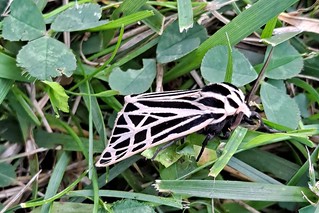
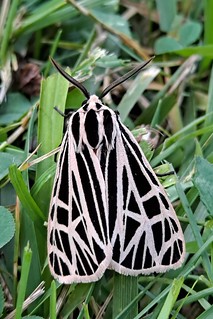
Virgin Tiger Moth

Virgin Tiger Moth 1
(Click on images to enlarge)

Virgin Tiger Moth 2

I wonder how this species propagates itself.

This is yet another moth that I scared up while mowing. It was well over an inch in length. What I could see when it fluttered up, but couldn't catch with my phone camera, is that its hindwings are red.

Nobody seems to know how it got its common name.

Sunday, July 25, 2021

Made in Bohemia

2021-07-25. Soda Bottle
(Click on images to enlarge)

This soda syphon bottle, once used by Zobjeck & Havens of Hobart, Indiana, somehow ended up in Ontario, Canada, whence I bought it on Ebay; but it originally came from Bohemia — at least, the glass part did, according to the legend etched on the bottom and proudly incorporating the lion rampant of the Bohemian coat of arms.

2021-07-25. Made in Bohemia

The detachable syphon at the top was made by the Crown Syphon Bottling Works, which seems to have been a Canadian company according to what Google tells you when you search on that name.

2021-07-25. Crown Syphon Bott. Wks

The firm name, Zobjeck & Havens, is prominently etched on the side and includes an intricate logo joining the owners' initials.

2021-07-25. Logo

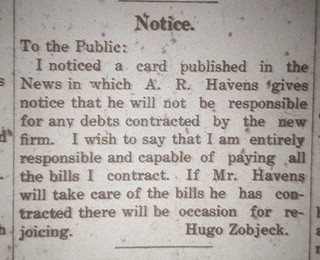
Hugo Zobjeck, Sr., and Albert Roy Havens were in business together in Hobart starting around October 1907[1] and ending sometime in the summer of 1910 — not, perhaps, on the best of terms, as we might infer from this notice that Hugo Zobjeck ran in the Hobart News of September 1, 1910.

2021-07-25. 1910-09-01 Hobart News - Notice


(I spent a ridiculous amount of time trying to come up with a title for this post that involved a pun on Bohemian Rhapsody. I don't think it can be done.)

_______________
[1] "Local Drifts," Hobart Gazette, Oct. 11, 1907.

Sunday, July 18, 2021

"The Pleasure of Motoring, 1928"

… he wrote sarcastically.

2021-07-18. lh086
(Click on images to enlarge)
Images courtesy of Eldon Harms.


"He" being Lester Harms, probably, as this photo came from the Lester Harms collection. I'm posting it now because I just recently came across a relevant newspaper item from the Hobart Gazette of July 6, 1928:
Clarence Harney and Lester Harms were to motor to Yellowstone Park, but they encountered muddy roads in the Black Hills section and gave up going further and returned via Minnesota and Wisconsin, visiting the points of interest enroute. Mr. Harney, who works at the local postoffice, had to return last Saturday at the close of his two-weeks' vacation.
The way Eldon Harms told me the story, they were heading to California. In both stories, they turned back because of the bad roads.

If Yellowstone Park was their destination, I wonder if they traveled on the Yellowstone Trail?

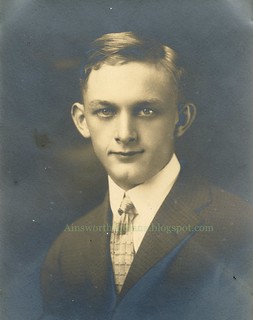
Lester Harms and Clarence Harney were cousins, born in 1904 and 1907, respectively. (Lester's father, John, was a half-brother of Clarence's mother, Mamie.) With the photo being so out-of-focus, it's hard to say which one of them is fixing the flat, but I am inclined to think it's Clarence. Here is his high-school senior portrait from 1925 for comparison:

2021-07-18. lh012

And a photo of Lester from 1932 can be found here.

♦    ♦    ♦

This story got me wondering whether they were in the Black Hills area in hopes of seeing the Mount Rushmore monument, which led me to research how much of the monument there was to see in 1928. As it turns out: very little. The enormous work of carving the mountain had only begun in October 1927. I found some early photos here — if you scroll down, you will find one from about 1928 in which only the rough planes of Washington's face can be distinguished from nature.

Saturday, July 10, 2021

Death and Dollars

When we left off with the Harms 73rd Avenue farm, Charles Chester had just bought those 80 acres.

That was August 1856. Some seven months later, in March 1857, Charles and his wife, Mary, sold the land to Luther and Sarah Smith for $900. The purchase was financed with six promissory notes coming due at intervals over the next six years, their payment secured by a mortgage.

2021-07-10. 1857 Harms Abstract of Title 003 a - Chester sale to L. Smith, mortgage
(Click on image to enlarge)
Image courtesy of the Eldon Harms family.


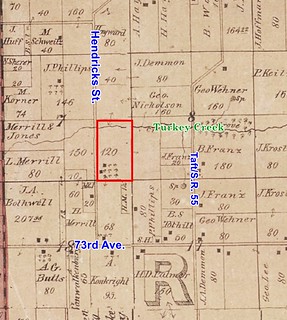
The Smith family and the Chester family had been neighbors for a few years before this sale. If we look at Early Land Sales, Lake County, we find that in May of 1850, Charles and Mary Chester bought the northwest quarter of Section 17. The following year, Jacob and Hannah Smith (Luther's parents) bought the adjacent northwest quarter of the northeast quarter — that is, the land where someday Henry Chester would build his brick farmhouse.

Chester 1850, Smith 1851 on 1874 map
(Click on image to enlarge)
This image is from the 1874 Plat Map.


The Smiths had been in Ross Township early enough to be counted in the 1850 Census: Jacob, 49, a native of Connecticut; his wife, Hannah, also 51, born in New York; and their children, Luther and Charles L. (16 and 13, respectively, and both born in Ohio), plus a 19-year-old woman named Emma Bevins, of Canadian birth. They were recorded with only one intervening entry between them and the Chester family, so perhaps the Smiths were renting farmland nearby.

In 1854, Luther Smith married Sarah Maxwell (Indiana Marriage Collection), who was only about 15 years old.[1]

Then in 1857 comes this sale to Luther and Sarah of the Chester 80 acres along Randolph Street. And that is where the 1860 Census finds them, with their children, Emma (5), Albert (2), and Sarah (10 months). Also in the home were Luther's parents, Jacob and Hannah.[2]

The mortgage on the land was cancelled in 1861, a year before the final promissory note was due. It may have been paid off early with money raised through what happened in 1859: Luther gave his parents a life-long lease on the land, for which they paid him $600.

2021-07-10. 1859 lease
(Click on images to enlarge)
This image and the images below courtesy of the Eldon Harms family.


In January 1865, Luther enlisted in the Union Army. By August of that year he was at home (not discharged yet, so perhaps on leave, possibly due to poor health). On August 10, he died.

He had made no will, and it seems that for a few years, his survivors went on farming that land together peaceably, not even seeking to have Luther's estate probated. But in 1868, something began to stir, and that's when the county court finally appointed an estate administrator.

2021-07-10. 1868 estate administrator
(Click on image to enlarge)
Image courtesy of the Eldon Harms family.


And in 1869 Jacob and Hannah sued the estate for the return of the $600 they had paid Luther ten years earlier.
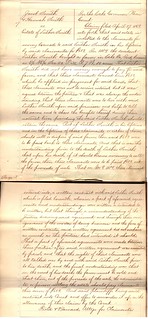
2021-07-10. 1869 suit

The 1859 transaction between them and their son, they said, wasn't just a lease for $600. It was a promise of a home: "these claimants were to live with said Luther Smith upon said premises and help to till the same and to share the benefits thereof throughout their natural lives," and if ever Luther sold the farm out from under them, Jacob and Hannah would get their $600 back. But that provision was not included in the lease "through a misunderstanding of the Justice [of the Peace] drawing said agreement, and through their own ignorance of the modes of doing business and the force of written contracts."

Reading between the lines of the last paragraph, it sounds as if, in August of 1865, Luther did not expect to recover from his sickness — he and his parents "talked over" these arrangements, "and the final understanding was that in the event of his death the farm must be sold." He did die, as we know, but the farm wasn't sold, and his parents went on without their $600 for several years.

I wonder if Sarah — still a young woman — was getting restless around 1868, wanting to sell the farm, take her share of the money, and move on with her life somewhere else.

A sympathetic court decided that the lease of the farm should be cancelled, and the $600 returned to Jacob and Hannah.

2021-07-10. 1869 ruling

The estate administrator then petitioned the court to be allowed to sell the farm, and summarized the estate:

2021-07-10. 1869 summary

After the required publications to advise potential buyers, the sale went forward. And Jacob and Hannah bought the farm.

2021-07-10. 1869 report of sale

Luther's widow and four minor children received a total of $506.22 from the estate (about $10,000 in today's money).

2021-07-10. 1869 summary

The estate administrator duly conveyed the land to the elder Smiths.

2021-07-10. 1869 transfer of title

Sarah may have moved on with her life, but unfortunately she did not have much life left. According to the penciled note in the bottom margin of page 6 of the abstract, above, "Sarah P. Smith died Aug 9th 71." Perhaps that was written circa 1896, when Henry and Johanna Harms were buying the land. But a statement from 1878 says approximately the same thing:

2021-07-10. 1878 statement re Sarah Smith

By 1877, Jacob and Hannah had died too.

2021-07-10. 1877 statement re Jacob and Hannah Smith

Concerning the four minor heirs of Luther's estate, someone jotted notes on the abstract, again probably circa 1896: Emma, Elbert, and Ambrose were dead; Adna was living in Denver (where he is now buried). The little Sarah from the 1860 census is unaccounted for; she may have died in infancy. The rest of Luther's survivors named in the abstract are a mystery to me — their lives, their deaths, their final resting places.

Luther Smith himself is buried in the Woodvale Cemetery, but he is not alone. His and Sarah's son rests there too — a two-month-old infant, named Jacob for his grandfather.

_______________
[1] I don't know much about Sarah's family of origin. Her marriage is the earliest record I can find of her locally.
[2] The other son, Charles L., was not in the household and in fact I can't find him in 1860, but we will hear from him again.

Wednesday, June 30, 2021

Jeremiah's Estate Administrator and His Evaluating Assistants

Following up on my earlier post about the contents of Jeremiah Wiggins' estate — I wanted to research the other names that came up on those inventory pages.

2021-06-21. Wiggins estate 19d
(Click on images to enlarge)
Image above and image below courtesy of Alice Flora Smedstad.


2021-06-21. Wiggins estate 15

The administrator, James H. Cassady, is a mystery. The estate papers tell us that in addition to his administrator duties, he was a justice of the peace, so he must have been a fairly prominent citizen. But beyond these papers, I can find no evidence that he ever lived in Lake County, Indiana, though he did own land here: Early Land Sales, Lake County shows him, in 1839, buying some 120 acres in Township 36 N., Range 9 W., Section 18 — i.e., what is now south Hammond. Still, I can't find him in any census or other record. He's not mentioned in any of my usual local history books, nor does he show up in any of the Hobart-area ledgers I've indexed thus far.

But he's all over these papers, and apparently was a friend of George Earle: this page, from the Wiggins papers, records that James Cassady and George Earle posted $400 bond to ensure that they "truly & faithfully discharge the duties" of administrator of Jeremiah's estate.

2021-06-30. Wiggins estate 30
(Click on image to enlarge)
Image courtesy of Alice Flora Smedstad.


Note how James uses the old-fashioned long s. And below that, we see George Earle's familiar signature.


The first of James' assistants is Charles Walton. We have met him before, under sad circumstances. I still can't find him anywhere except the 1840 Census of Lake County, which doesn't tell us much about him, and the indexed ledgers, where he shows up only in 1839 and 1840.


Next we have Levi D. Jones. According to the Hobart ledgers, he was in this area by the summer of 1840, but I can't find him in the 1840 Census. He does show up in 1850 and 1860, farming in Ross Township. In the 1850 Census he is married to Elizabeth (Vanvolkenburg), whom he married in 1847 per the Indiana Marriage Collection. There are two children in the household, one of whom, a seven-year-old boy named Homer, could not be a child of this marriage. The other is a year-old girl named Louisa. In 1856 Levi D. Jones is recorded marrying Lucy Sly in Lake County; if that is our Levi, I wonder what happened to Elizabeth? When the 1860 Census comes around, we find Levi D. Jones farming in Ross Township, living with an 11-year-old girl, Mary L., whose relation to him is not described, while Homer Jones is now living in the household of Abram Vanvolkenburg. Elizabeth, Louisa,[1] and Lucy are nowhere to be found. And that is as far as I can trace any of them.


The third assistant, David Fowler, shows up in the Hobart-area ledgers as early as October 1836, and makes appearances through 1841 (at this point in my indexing). The 1840 Census also records him, in a household of 11 people, in what appears to be western Ross Township — the same area where he, circa 1843, purchased 80 acres of land.

2021-06-30. Fowler, David 1874
(Click on image to enlarge)
From the 1874 Plat Map. By that time, David Fowler's land was owned by George Nicholson.


The Indiana Marriage Collection records David Fowler marrying Rebeca Deyo (or Dezo) in 1840, and the 1850 Census places them, with two children, in Cedar Creek Township, where apparently David died in 1860.


The last of these assistants is Michael "Stieckelman," but we will use the spelling on his grave marker in the Merrillville Cemetery: Steichelman. He was born in Germany in 1800, and there married and began a family. According to a findagrave.com biography of his daughter, the family came to the U.S. circa 1835 and to Indiana about 1837. It was a relatively small family for those days: just Michael, his wife Margaret, and their two children, Mary and John. The 1840 Census shows five people in the household, so one is unidentified.

Here is a page from an unknown Hobart-area merchant's ledger showing Michael purchasing nails and thread in 1840.

2021-06-30. Steichelman, Michael - DayB1840 66, 67
(Click on image to enlarge)
Image courtesy of the Hobart Historical Society.


If he ever bought land here, I have not found a record of it. That record may be hidden by some creative spelling of his name; I have seen many variations.

By the 1850 Census the family had moved to Illinois. So I don't know why, when Michael died in 1851, his remains were brought back here for burial. According to a note on the findagrave.com entry for Michael's wife, Margaret, she died in 1880 and was buried in the Merrillville Cemetery, but later her remains were moved to the cemetery in Iowa where their daughter is buried. The only other Steichelman in the Merrillville Cemetery is a little girl, Hattie, born to Michael and Margaret's son, John. He had married Mary Towl in 1855. After John was killed in the Civil War, Mary remarried and is now buried in Kansas.


Well, it was interesting to look into these names, but I didn't learn a whole lot. How these people flitted through our early local history, leaving so few traces! They didn't know, apparently, that the purpose of their lives was to furnish material for amateur historians' blogs.


_______________
[1] [Jan. 2026 update: Now that I think about it a little more, I bet that Louisa from the 1850 census and Mary L. from the 1860 census are the same person. But I still don't know what happened to her after 1860.]

Monday, June 21, 2021

Inside Jeremiah's Cabin

The estate administrator drew up an inventory of the late Jeremiah Wiggins' property, along with an appraisal of each item's value. This inventory lets us see into Jeremiah's home, and gives us an idea of his day-to-day living.

2021-06-21. Wiggins estate 19d
(Click on images to enlarge)
Images courtesy of Alice Flora Smedstad.


Here is my attempt to decipher this list:
1 Pair cotton sheets 1 pair rose[1] blankets
1 old coverlid
1 straw tick and pillow
1 barrel with some pork[2]
8 old bags
1 tea kittle 1 dish kettle 1 frying pan 1 axe
all right to his house and improvements
a lot of logs
It's interesting to note what's not recorded: for example, a table and chairs. Pioneer homes sometimes lacked these luxuries; when people wanted to sit, they sat on beds or trunks. But Jeremiah didn't have a trunk either, it seems. No bedstead is listed, but you'd think he'd come up with something to avoid sleeping on the floor: he had an axe, and there were plenty of trees around. He might have stuck poles into the walls of his log cabin to fashion a crude platform for his straw tick.

No clothing is mentioned. Perhaps he was buried in his only suit, but surely he had a coat, at least, for cold weather, and a hat, and gloves or mittens.

No decorative items. No books. But no liquor, either.

Other property, of a more outdoor nature, was recorded on another sheet.

2021-06-21. Wiggins estate 15

This one is even more difficult to read; here's my attempt:
1 Breaking Plough
1 Cast do[3]
1 set whippletrees & neck yoke
1 spade
1 Axe
1 Waggon [illegible]
1 Broad Axe
1 Bay horse(?)
1 " do " do[4]
1 old harness without bridling(??)
1 Rifle
1000 Rails at $1.50 per hundred
It all added up to a value of $115.87 ½ — much more than the domestic inventory.

Other items may not have made it onto these two lists — but not many, I suspect. Jeremiah had the basics of transportation, of farming, of building a shelter, and of cooking enough food to stay alive. That was all he needed, and perhaps all he wanted.

I'd like to look into the people involved in this inventory, but that will have to wait for another post.


_______________
[1] I am not 100% sure I'm reading "rose" correctly. A "rose blanket" was a blanket, usually of wool, with an embroidered medallion on each corner.
[2] I expect this was salt pork.
[3] I got the word "Cast" from another paper in the set; "do" is a 19th-century abbreviation for "ditto." So the item is a cast [iron] plough.
[4] I.e., another bay horse.

Tuesday, June 15, 2021

Sawyer Beetle

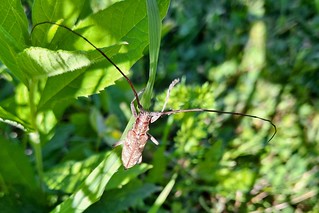
I think this is some kind of Sawyer Beetle.

2021-06-15. sawyer beetle 1
(Click on images to enlarge)

2021-06-15. sawyer beetle 2

2021-06-15. sawyer beetle 3

It flies like it's drunk.

Body about one inch long. Antennae a whole lot longer.

This concludes today's nature lesson.