Wednesday, September 14, 2022

Unidentified Young Man, But I Have a Theory

The seller on Ebay described this item as "Carte de Visite Gentleman Crazy Eyes." The subject of the photo was not identified, but the photographer was — Blackhall of Hobart — and that got my attention. As we know, John Blackhall was one of Hobart's earliest professional photographers. A photo by him would date prior to the mid-1890s, and perhaps as early as 1873.

2022-09-14. Unidentified young man by Blackhall 01
(Click on image to enlarge)

The young man does have a piercing gaze, doesn't he? — although I wouldn't go so far as to call it "crazy." I can't even guess as to the year of the photo — men's fashions are so much harder to date than women's. This photo could have been taken anytime during Blackhall's career.

2022-09-14. Unidentified young man by Blackhall 02

Once I received the original photo and started studying it, I began to feel that there was something familiar about this man. And then I began thinking about Fred Rose, Sr.

Fred Sr.'s presence in Hobart coincided with the later years of Blackhall's photography business. According to the earliest census records we have of Fred, he came to this country from Germany in 1882,[1] and his 1942 obituary states that he arrived in Hobart that same year,[2] at which time he was about 16 years of age.

Here is our unidentified young man side-by-side with a circa-1921 portrait of Fred Rose, Sr. (which I'm using because both photos were taken from nearly the same angle).

2022-09-14. Unidentified and Fred Rose Sr.
(Click on image to enlarge)
Image on the right courtesy of the Hobart Historical Society.


Here I've taken a colorized copy of the young man and superimposed it on the Chief of Police:

2022-09-14. Unidentified young man superimposed over Fred Rose Sr.

There are remarkable similarities about the nose and mouth. There are also remarkable dissimilarities about the crown of the head, the eyes and the ears. I am aware that different cameras can produce surprising differences in a subject's face, but could that, or a 30-year time lapse, explain the differences we see here?

In an earlier photo of Fred, taken circa 1891, his eyes look more like the unidentified subject's.

2022-09-14. Fred Rose Sr. 1891
(Click on image to enlarge)
Image courtesy of the Hobart Historical Society.


The crown of the head is hidden in this one. But the ears! How can I explain away those ears?

So, as fond as I am of my theory that the unidentified subject could be a young Fred Rose, Sr., I have to admit that there's good evidence that it's wrong. Perhaps what we're seeing here is a general family resemblance, in some relative of Fred's who came to visit him in Hobart and sat for a photograph by John Blackhall.

♦    ♦    ♦

[9/17/2022 update] Hobart historian Suzi sends me this photo of Fred Rose, Sr. to show me that my theory is totally off the rails.

2022-09-14. Fred Rose Sr. by Showman's Gallery
(Sorry, it doesn't get any bigger than this)

Since the photo was taken at Showman's Gallery, it would date between 1893 and 1899. (The descendants' faces were a later addition to the image, I'm sure.)

_______________
[1] The 1900 Census and the 1910 Census record 1882 as his year of immigration; the 1920 Census says 1885, the 1930 Census 1883; and the 1940 Census does not include that information.
[2] "Last Rites Held for Hobart's Fire Chief, F. Rose Sr.," Gazette, 26 Mar. 1942.

Saturday, September 10, 2022

Yet Another View of the Hobart Township School

I don't think I've posted this exact image before.

2022-09-10. High School from west001
(Click on images to enlarge)

The verso doesn't help us date the photo.

2022-09-10. High School from west002

No postmark, message or addressee, and the stamp box doesn't tell us anything except that the postcard is probably pre-1920. From the style of the postcard, we know was manufactured after March 1907. I have another digital copy of this image that I got in 2007, which is sitting on my computer and identified as being from 1914, although I did not note down my basis for assigning it that date. However, 1914 sounds reasonable.

I like this image because it captures a couple of the homes on New Street, which used to run along the east side of the old high school, southward almost to Duck Creek. This detail from a 1922 Sanborn map shows the two houses in the photo — the first two south of Fourth Street — as well as five other houses to the south.

2022-09-10. 6781113236_83dd8c33a0_o

I don't know when the last of those houses were demolished. I have previously posted this 1954 aerial view showing some kind of structures on the sites, but it's not clear enough to be sure those are the same houses:

Hobart 1954 Aerial-1
(Click on image to enlarge)

Friday, September 2, 2022

"My Dearest Sweetheart"

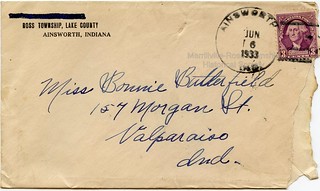
It was 9:00 PM on Monday, June 5, 1933, when the 24-year-old Walter Sievert picked up his fountain pen, grabbed a couple sheets of his father's official Ross Township Trustee stationery, and wrote this letter to the young woman he loved.

2022-09-02. Sievert096
(Click on images to enlarge)
Images courtesy of the Merrillville-Ross Township Historical Society.


2022-09-02. Sievert097

2022-09-02. Sievert095

I haven't seen anything this sweet since the courtship correspondence between Minnie Rossow and Herman Harms. And that young couple couldn't pour out their hearts to the same extent because, of course, they were sending postcards, which could be read by any nosy person in the post office and at the recipient's home.

Walter and Bonnie were married on July 24, 1933, as reported in the Valparaiso Vidette-Messenger of August 1.

2022-09-02. Vidette_Messenger_of_Porter_County_Tue__Aug_1__1933_


I feel that I've neglected the Sievert family of Ainsworth, although I have mentioned Walter's mother and sister. But I'm going to be talking more about them in the near future, because the Merrillville-Ross Township Historical Society has recently been given a treasure-trove of Sievert items, mostly photographs and papers, one of which was the letter above.

Wednesday, August 24, 2022

Series Finale: The Harms 73rd Ave. Farm History

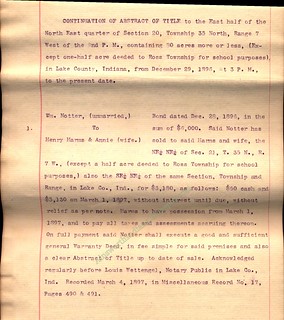
And now we come to the waning days of 1896 — December 28, to be exact — and William Notter is selling his 79.5 acres to Henry and Annie (born Johanna Springman) Harms, who were living on and farming their old homestead to the northeast of this property. The Harmses were to pay $3,180 for the land (about $112,000 in today's money) in installments.

2022-08-24. 1896-12-28 Notter to Harms -- Harms 73rd Ave farm history
(Click on images to enlarge)
Images courtesy of the Eldon Harms family.


The transaction included an action to quiet title, a review of the property's owners — not all of them, in this case, as you can see. I'm guessing the action named only the ones who might conceivably have some claim to the land.

2022-08-24. 1896-12-28 Notter to Harms -- quiet title 1

2022-08-24. 1896-12-28 Notter to Harms -- quiet title 2

2022-08-24. 1896-12-28 Notter to Harms -- quiet title 3

The only new information we get from this concerns Emma Smith, daughter of Luther and Sarah: in 1881 she married William J. Hatch in Chicago; they had five children, and then Emma died in 1893. None of the surviving Hatches turned up to contest the title to the farm.

This is the title bond that William Notter gave to Henry and Annie Harms on December 28, 1896, promising to deliver title to the land and "a clear abstract of title" upon payment of the full purchase price, without interest.

2022-08-24. 1896-12-28 Notter to Harms title bond - Harms 73rd Ave farm history

On the outside of the title bond, William Notter jotted down a payment by the Harmses of $300 on the "noat" in January 1897. Below that, someone with more polished handwriting (Louis Wettengel, probably) recorded a larger payment, and William signed his name.

2022-08-24. 1896-12-28 Notter to Harms -- title bond verso 1 - Harms 73rd Ave farm history

And this, also from the verso of the title bond, is why I think the person with the polished handwriting was Louis Wettengel.

2022-08-24. 1896-12-28 Notter to Harms title bond verso 2 - Harms 73rd Ave farm

Louis was a resident of Hobart, who appeared in the 1870 Census as a saloonkeeper, but by the 1880 Census had made a lawyer of himself. He and his wife, Emmeline (Shearer), had many children, lived out their lives in Hobart and are now buried in Hobart Cemetery.

By October 16, 1897, Henry and Annie Harms had paid off the purchase price of the land, and William Notter gave them the deed.

2022-08-24. 1897-10-16 Notter to Harms - warranty deed - Harms 73rd Ave farm

2022-08-24. 1897-10-16 Notter to Harms - warranty deed verso 1 - Harms 73rd Ave farm

2022-08-24. 1897-10-16 Notter to Harms - warranty deed verso 2 - Harms 73rd Ave farm

And so we come to the end — not of the history of the farm, but of this abstract. I'm afraid I've already given away an episode of the sequel, when Henry and Annie sold 9 acres of the land to Herman and Minnie Harms in 1938. From a comparison of the 1939 Plat Book to the 1950 Plat Book, we can see that a lot more dividing and selling of the land went on over the course of that decade. I shall see if I come across any details in the future.

Thursday, August 18, 2022

Anna and Norma Lindborg in Sweden, 1938

The Hobart Index-Commonwealth of May 26, 1938, carried this article on the front page:
Ainsworth Ladies Embark Saturday For Visit In Sweden With Relatives

Planning to embark on the "S.S. Gripsholm" from New York City this Saturday, for a trip to Sweden and other European countries, Mrs. Gust Lindborg and daughter, Norma, and Miss Bernice Taber, left Wednesday morning for the east. They will be accompanied on their motor trip as far as New York City by Mrs. Lindborg's son, Raymond, daughter, Gladys, and Miss Evelyn Wolf,[1] who plan to return home in about a week, after a motor trip through the eastern states.

Mrs. Lindborg expects to visit until the latter part of August with her aged parents, brothers, and sisters and also with her husband's brothers and sisters, who all reside in the southern part of Sweden in and near the city of Malmo. This will be the first time she has seen any of them in 38 years, since she came to America from her homeland, when she was a young girl.

After a short visit with Miss Lindborg's relatives in Sweden, she and Miss Taber will continue their tour through Sweden, Holland, Norway, Denmark, Germany, and England. The two young ladies plan to return to the United States about August fifth by way of Montreal, Canada.

Mrs. Lindborg will spend all of her time in and near Malmo returning home the latter part of August on a different boat.

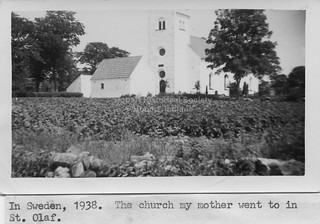
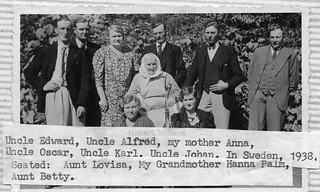
The Hobart Historical Society recently received a donation of a scrapbook/photo album put together by Mildred Lindborg Lute, Anna Lindborg's eldest daughter. It included photos from that trip to Sweden in 1938. We know that thanks to Mildred's happy penchant for identifying her photos — otherwise, we'd just be looking at the photos and saying, "Doesn't that look like Anna Palm Lindborg? But where on earth were these taken?"

The first photo shows Anna and her mother, Hanna Palm.[2]

2022-08-18. Sweden 01 Anna Lindborg, Hanna Palm
(Click on images to enlarge)
Images courtesy of the Hobart Historical Society, Hobart, Indiana.


The photo below shows both Anna and her daughter, Norma, with some relatives. (The fact that Mildred referred to her sister as Norma Berg means she was typing up these captions sometime after Norma's marriage in April 1949.)

2022-08-18. Sweden 03 Uncle Edward, Aunt Lovisa et al

For the rest of the photos, I will let Mildred's captions speak for themselves.

2022-08-18. Sweden 02 church in St. Olaf

2022-08-18. Sweden 04 Aunt Lovisa, Anna and Norma Lindborg etc

2022-08-18. Sweden 05 Bror, Svea, Aunt Betty et al

2022-08-18. Sweden 06 Uncle Edward, Uncle Alfred, et al

2022-08-18. Sweden 07 Harry and Gretha Palm

2022-08-18. Sweden 08 Uncle Johan, wife and daughter

♦    ♦    ♦

The August 11, 1938 Index-Commonwealth reported:
Miss Bernice Taber and Miss Norma Lindborg, both of Ainsworth, returned recently from a three months tour of Europe. The girls motored, together with Mrs. Gust Lindborg, to New York where they embarked on the ship, Gripsholm of the Swedish-American lines. Landing in Sweden they took a trip up the Goda Canal to Stockholm, which is one of the most beautiful cities in the world. From there they went to Oslo, Norway, and through the fjords. The water in the fjords, Miss Taber reports, is a very clear, marked green, but the air has a definite bluish cast and gives the surrounding scenery a hazy look, which even accents its beauty. From Norway, the travelers journeyed to Copenhagen, Denmark, and from thence through Germany by way of the Rhine. The Rhine, the girls said, is an exceptionally winding river and makes its many turns through the surrounding Alps. From Brussels, Belgium, they ferried to England across the English Channel, where they visited London, and Oxford University. Mrs. Lindborg, who remained longer to visit her sister in Sweden, sailed this week for the United States. Miss Taber and Miss Lindborg, however, returned two weeks ago by way of Canada, on the ship Express of Britain. Arriving in Canada, they visited Quebec and Montreal and then journeyed on home.
The August 25 Index-Commonwealth noted that Anna Lindborg had finally come home to Ainsworth, saying she'd had "a wonderful trip."

_______________
[1] I have found an Evelyn Wolfe living in Portage Township, Porter County, who was about 17 in 1938, but I'm not sure she's the right person.
[2] Although the newspaper article mentions Anna's "aged parents," none of the photos include her father. I don't have international Ancestry.com to find out if he was still living then.

Tuesday, August 9, 2022

A Naughty Notter

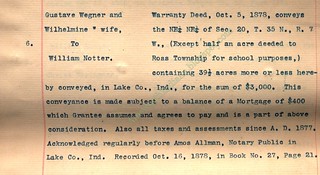
As we saw in our last post, Gustave and Wilhelmine Wegner bought the northern 39.5 acres of the Harms 73rd Avenue farm on April 16, 1878. On October 5 of that year, they sold their land to William and Catharine[1] (known as Kate) Notter …

2022-08-09. 1878-10-05 Wegner to Notter - Harms 73rd Ave farm history
(Click on images to enlarge)
Title abstract images courtesy of the Eldon Harms family.


… who assumed the remainder of the mortgage on the land. By 1880 they had paid it off:

2022-08-09. 1880-12-30 Kenneke-Wegner release of mortgage - Harms 73rd Ave farm history

In 1886 the Notters bought the southern 40 acres of the future Harms farm from Christian and Johanna Beilfuss.
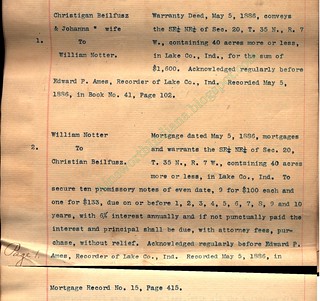
2022-08-09. 1886-05-05 Beilfuss to Notter - Harms 73rd Ave farm history

The day of that sale, the Notters borrowed money from the State of Indiana, mortgaging their northern 40 again.
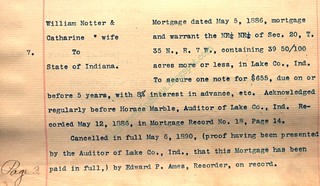
2022-08-09. 1886-05-05 Notter to Indiana - mortgage  - Harms 73rd Ave farm history

In 1890 and 1894, the Notters again borrowed money from the state, securing the debt with mortgages on both the northern and southern halves of their farm. I have no idea what was going on here.
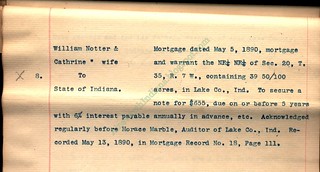
2022-08-09. 1890-05-05 Notter to Indiana - mortgage  - Harms 73rd Ave farm history

2022-08-09. 1894-11-10 Notter to Indiana - mortgage - Harms 73rd Ave farm history

They did pay off their debt to the Beilfusses in 1893.

2022-08-09. 1893-10-23 Beilfuss to Notter  - release - Harms 73rd Ave farm history

♦    ♦    ♦

William Notter was a native of Canada, born circa 1837. He came to the U.S. probably in the early 1860s, since he married an Illinois-born woman, Catharine Golden, before 1864.[2] In the 1870 Census, the Notter[3] family was recorded in Chicago, with three sons: William (born circa 1864), Thomas (1867), and Edward (1869).

As we've seen, in 1878 they bought their first 40 acres and presumably relocated to Ross Township, where the 1880 Census records them. Their eldest son, William, was not accounted for in that census; possibly he had died; it's also possible he left home at 15 or 16 years of age. The Notter children accounted for in 1880 were Thomas and Edward, and a daughter, Fannie, born circa 1875.

In 1891, William and Catharine leased their 79.5 acres in 1891 to Christ Springman:
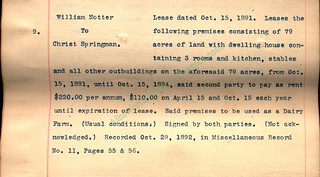
2022-08-09. 1891-10-15 Notter to Springman - lease - Harms 73rd Ave farm history

Since two families had once occupied those 80 acres, perhaps there was a spare house for the Notters to live in while Christ Springman ran the dairy farm. But at some point William bought another 13 acres on the northeast corner of the intersection of Randolph and 73rd, per the 1908 Plat Map.

Sometime before 1900, Catharine died — when and where, I don't know. I can't find any record of the death, or a grave, either here in Ross Township, or in Illinois. The last mention we have of her is the 1894 reference in the title abstract.[4] The 1900 Census shows William, a widower, living alone in Ross Township, farming his own land (probably the 13 acres). The children had grown up and left home.

The "General News Items" of the Hobart Gazette of February 8, 1901, carried an item noting that William Notter "who lives about one-half mile west of Deep River" had sold all his goods and was planning to move to Chicago. But it wasn't until the September 20, 1901 issue that this notice appeared:
"For Sale — My chicken and truck farm one mile west of Deep River, Indiana, comprising 13 acres, a new brick and terra cotta house, frame barn, corn crib and terra cotta chicken house; good water. Will sell for cash or on terms to suit purchaser. Wm. Notter, 396 W. Polk street, Chicago, Ill."
Per the pre-1916 Illinois on-line death records, William died in 1904, but I can't find his grave.

♦    ♦    ♦

The title of this post promised you a naughty Notter. To find him, we must go back to 1896, to the August 21 issue of the Hobart Gazette:
Thomas Notter in Trouble

A special from Crown Point to the Chicago Times-Herald, dated Aug. 19, reads as follows: Thomas Notter was arrested this morning at Deep River, this county, for a clear case of bigamy on complaint of wife No. 1, a resident of Chicago. The bigamist and his wife were taken before Judge Van Winkle this morning. Notter was bound over to the circuit court in the sum of $1,000, and wife No. 2 was held in bonds of $200. In 1892 wife No. 1 was married to Notter at South Omaha, Neb., by Father Thomas. They then moved to Chicago and lived in that city for over three years. During this time three children were born to them. Unknown to Mrs. Notter No. 1, Notter was secretly married to Miss Hock of Laporte, Ind., in December, 1895, by Father Welch of Chicago, and took up quarters in Chicago, and there they remained about two months. They then moved out to Deep River, off a railroad, and located on a farm, where they have remained up to today. Mrs. Notter No. 1 began a search soon after her husband disappeared in Chicago and finally located the couple at Deep River.
This Thomas was the son born to William and Kate circa 1867.

A family tree on Ancestry.com includes the paperwork for a marriage in Omaha, Nebraska in 1889:

2022-08-09. 1889-18-12 Notter, Thomas - Nebraska marriage record
(Click on image to enlarge)
Image from Nebraska, U.S., Select County Marriage Records, 1855-1908 via Ancestry.com.


Was this yet another marriage, or did the article quoted above get the date of the first marriage wrong? (It's unfortunate that the article doesn't give the first wife's name.) The Cook County, Illinois, Marriages Index does indeed show Thomas marrying 21-year-old Frances Hock in December 1895.

I don't know any more about the bigamy case — for example, whether Thomas served time in prison, or paid a fine.

Thomas and his first wife may have kissed and made up after all this mess. In the 1900 Census Thomas is recorded with a wife named Mary. However, as noted by the enumerator, he claimed to have married her only a year prior. I can find no record of that marriage. In the 1910 Census, Thomas was living alone, saying he was a widower. In June of 1913, there's a record of a Thomas Notter marrying an Anna Daley in Cook County; in December 1921, a Thomas Notter married an Anna Powers, same place. One of these (or maybe both) might be our Thomas, whose wife, at the time of his death in 1925 per the Illinois Deaths and Stillbirths Index, was named Anna. But her maiden name is not included in that record.

To top off the story, I will just add that in 1898 Thomas' brother, Edward, married a young lady named Anna Louise Hock, whom I believe to be the sister of Thomas' partner in crime. The 1880 Census shows a Hock family in LaPorte, Indiana, which includes two young girls named Frances and Anna. The girls' ages in that census correspond to their ages in subsequent records: the 1895 marriage record in the case of Frances, and later censuses in the case of Anna.

Edward and Anna were married in Chicago. I can't find them in the 1900 Census, but the 1910 Census shows them living in Ross Township, by which time they had a son, George, and a daughter, Vernet(te). They owned a farm in the vicinity of Deep River (possibly Edward bought his father's 13 acres) and made occasional appearances in the local newspaper social columns. In 1913 Edward sold his farm and relocated to Charlestown, Clark County, Indiana, allegedly "to assist his brother in farming," according to the Gazette[5] — what brother, I'd like to know! Was this the long-lost William, or did Thomas slip out of the city between the 1910 and 1920 censuses, to farm a bit? Or maybe there was another brother I've missed? I can't identify any Notters in that location except for Edward and family, who appear in the 1920 Census (by which time there was another son, Brent). It's possible, of course, that the Gazette got the "brother" part wrong. But if the brother was Thomas, well, all I can say is … awkward.

_______________
[1] Spellings of her name vary. I chose one at random.
[2] I can't find a record of this marriage. I'm going by the age of their eldest child per the census.
[3] The enumerator spelled their surname Knotter.
[4] Someday I have to read the 1890s Hobart and other local newspapers on microfilm. I have only skimmed through them without taking notes, back when when very few names meant much to me.
[5] "Additional Locals News," Hobart Gazette, 14 Mar. 1913.

Sunday, July 31, 2022

Finally Getting Back to the Harms 73rd Ave. Farm

Back in 2021 I started exploring the history of the Harms 73rd Avenue farm. I was making good progress when some shiny object passed before my eyes and I got totally distracted and lost my momentum. I have to go back and try to figure out how to pick up where I left off. This happens to me all the time.

Anyway …

Regarding the northern 40 acres, we left off with the elusive Ehrfurths buying the parcel in 1875.

Over the next few years, other elusive people bought and sold the land.

Even before the Ehrfurths' mortgage was released in February 1878, they turned around the sold their farm to one Henrich Kenneke.

2022-07-31. 1877-09-05 Ehrfurth to Kenneke - Harms 73rd Ave. farm abstract
(Click on images to enlarge)
Images courtesy of the Eldon Harms family.


I can't positively identify Henrich (whom one might also expect to encounter as Heinrich or even Henry). Tax assessment records from the 1860s show Henry Kenneke operating a hotel, selling liquor, and giving public exhibitions in Terre Haute.[1] In 1875, Heinrich Kenneke married a Johanne Bethke in Cook County, Illinois;[2] I think that may be our guy, although I would expect the 1877 sale record above to mention the wife. A wife by that name does get mentioned a year later, when she and Henrich sell the land.

2022-07-31. 1878-04-16 Kenneke to Wegner - Harms 73rd Ave. farm abstract

And that is all I've been able to find out about either of the Kennekes.

The buyers in that sale were Gustave and Wilhelmine Wegner. I may have found them in the 1880 Census, living in Chicago with their two small children. By then they themselves had sold the farm as well. About six months' ownership of 40 acres is all the contact I can find between them and Ross Township.

♦    ♦    ♦

Looking at the southern 40 acres, we pick up in 1882, when Frederick Suhr, a widower of just a few months, sold his farm to Christian Beilfuss.

2022-07-31. 1882-09-14 Suhr to Beilfuss - Harms 73rd Ave. farm history

2022-07-31. Beilfuss - abstract of title for Harms 73rd Ave. farm

Christian was a German immigrant, about 55 years old at the time. He and his wife, Johanna,[3] had both arrived in this country in 1872, the same year they married in Cook County, Illinois.[4] I can't actually place their family in Ross Township, but then I can't find them at all in the 1880 Census. The only other record I can find of them is the 1900 Census, where they are living in Chicago with their son, 19-year-old Louis. The record of their children is a bit mysterious. Per the 1900 census, Johanna had only one child, ever. And yet I've found a death certificate for a Martha Burge, born in 1879, who died in 1963 in Crown Point, and whose parents' names are recorded as Christian Beilfuss and Johanna Orgel. She had married Orrin Burge in Cook County in 1896, and subsequent censuses record them and their growing family in Lake County — farming in Winfield Township through 1930, then moving to Crown Point by 1940. Orrin was the son of Milo Burge and Lucy Sturtevant; thus the Beilfusses would have had a connection to two old local families.

Perhaps the 1900 enumerator made a mistake in noting that Johanna was the mother of only one child. Perhaps Johanna misunderstood the question.

Christian and Johanna Beilfuss sold their Ross Township farm four years after they bought it. As I said, I can't establish that they ever lived on that farm, or anywhere in Lake County, Indiana.

Christian died in Chicago in 1905, Johanna in 1925.[5]

_______________
[1] Ancestry.com, U.S., IRS Tax Assessment Lists, 1862-1918. This hotelkeeper might never have left Terre Haute, where he is buried.
[2] Cook County, Illinois, Marriages Index.
[3] Her maiden name is transcribed various ways, but most commonly "Oergel" or "Orgel."
[4] Cook County, Illinois, Marriages Index.
[5] Someone on findagrave.com has credited them with yet two more children, one of whom (William) might be Christian's son from a previous marriage, and the other of whom (Johanna) I cannot account for.