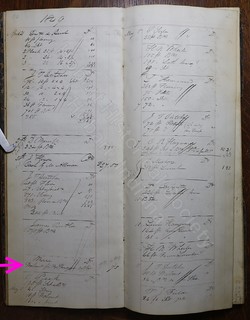
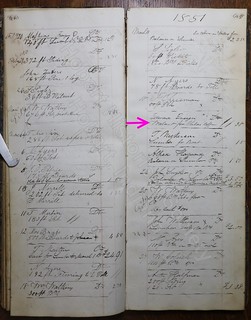
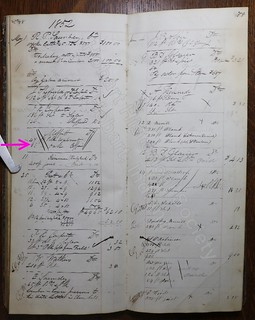
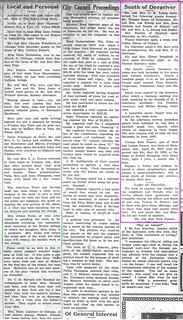
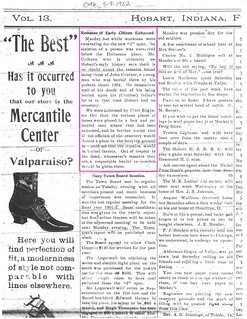
Let's step back to May 1902, when the J spur was being laid from the main EJ&E line through Hobart to the brickyards. That construction work led to an interesting discovery:
 (Click on image to enlarge)
"Mr. Colburn" was, I believe, the 64-year-old Zerah Colburn, who had come to the Hobart area circa 1843 with his parents (
Early Land Sales, Lake County) and lived out the rest of his life here. For
Cruther I think we should read
Carothers — and we have already mentioned that family in connection with the
bridge on the tumbling dam. The young man who died in 1854 must have been John Carothers, Jr.; at that time he would have been about 17 years old.
I have found no follow-up story in later issues of the newspaper, so it is possible that young John's bones still lie in that box along the route of the vanished J spur.
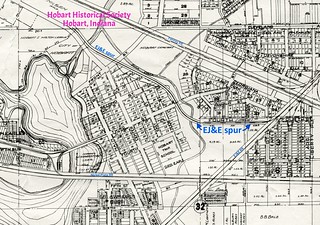
We know the route:
 (Click on image to enlarge)
Image courtesy of the Hobart Historical Society.
The spur actually extended as far as the western Kulage brickyard (see
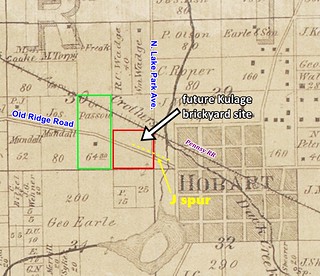
1902 Sanborn map), which I find interesting because that part of the brickyards was on land once owned by the Carothers family. The image below shows that area as it appears on the
1874 Plat Map, with the east half of the southeast quarter of Section 30 owned by "Crothers." In 1846 John Carothers, Sr. had bought the parcel outlined in green, and in 1851 the parcel outlined in red (
Early Land Sales, Lake County). He must have sold the green parcel before 1874.
 (Click on image to enlarge)
However, I doubt that young John's bones lie in that land. Zerah Colburn said John was "buried upon his … father's lot" — which sounds like a (relatively) small lot
in town. In further support of this theory, the "Heitmann place" was likely in town, if we assume it was one of the two Heidtmann households shown in the
1900 Census. That census records one household composed of
Fred and Liddie Heidtmann and their children, and a separate household where Fred's mother,
Sophia, lived with her own elderly mother and an unmarried son. Both homes were within "Hobart Town," but I don't know the exact location of either. The one that included Sophia was probably on Michigan Avenue: it was described that way when Sophia died in 1909
[1], and its being recorded in the
1900 Census next to the Melin home (northeast corner of Michigan and Cleveland) suggests they were neighbors. However, even if that Heidtmann place was on the west side of Michigan Avenue — with a railroad track and a creek between it and the J spur's route, to call the excavation "below the Heitmann place" seems a bit of a stretch.
♦ ♦ ♦
It's odd that Zerah Colburn would say that in 1854 Hobart had no cemetery. I suppose he meant no cemetery within the village. Zerah's own parents are buried in the Old Settlers Cemetery, and both died before John Carothers, Jr.: his father, Allen, in
1843, and his mother, Maria, in
1851. Still, in 1854, small family burial grounds on private property were not so very unusual, although I would expect such grounds to be more rural — a burial in a town lot would be out of the ordinary.
_______________
[1] "Old Citizen Dies," Hobart Gazette, May 14, 1909.