Thursday, May 10, 2018

It Could Go Either Way

The merchant of the 1840 daybook occasionally sold medicine along with the various household goods, hardware and tools, farming implements, cloth and clothing, and footwear he carried. But in the autumn of 1843 he seems to have sold little else besides medicine.

Note the entry for September 24, 1843, where Nicholas Nichols buys medicine … and writes his will.
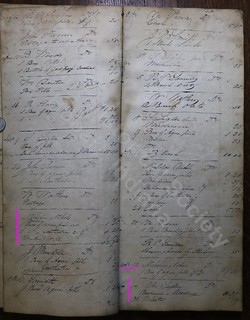
2018-5-10. DayB1840 118, 119
(Click on image to enlarge)
Image courtesy of the Hobart Historical Society.


If the "ague pills" he bought contained quinine, they might actually do some good. The "cathartic pills" — if Nicholas intended to use them to treat fever — were part of the accepted medical standard at the time, and worse than useless. However, from the next page, we see that Nicholas survived at least until November 12, when he bought more ague pills.

Just below that second entry, we find Eli Sigler coming in for other examples of the era's standard medical practice: bleeding and blistering.[1]

I found a rather interesting blog post about such treatments here.

♦    ♦    ♦

Since I haven't been able to find Nicholas Nichols (or Nickels) at all in the census records, I don't know how long he survived beyond 1843.

Eli Sigler was the son of Samuel (Sr.) and Ann Sigler. He survived his bleeding and blistering to reach a ripe old age, and now lies in Hebron Cemetery.


_______________
[1] Long ago I posted a story showing that even in 1904 folk medicine still used a cousin of blistering: namely, the counterirritant of a mustard poultice.

Monday, May 7, 2018

The Historical Hound of Hobart

This photo was taken in the basement of the Hobart Historical Society museum, formerly the library.

2018-5-7. Dog in the basement
(Click on image to enlarge)


This must have happened while the library building was under construction, from 1914 to 1915. The workers had just poured the basement floor when a curious dog came trotting through the site and got into the wet concrete.

Maybe the men didn't notice the pawprints until the concrete was set. Or maybe they looked at the damage, shrugged their shoulders and said, "Eh, it's not worth fussing about."

The basement served as a "social room" where various groups could meet. Over the years, I'm sure, many human feet have walked over these pawprints at the east end of the basement, just outside the kitchen area. But the women preparing food in the kitchen were busy; the men were absorbed in their talk; did anyone ever notice the pawprints? Perhaps they did — and laughed, and said, "That's old Rover."

However it happened, Rover's pawprints have been preserved for posterity.

Friday, May 4, 2018

Arthur Loves Elsie

Just a month after his brother's wedding, Arthur Hahn tied the knot with Elsie Fifield.

2018-5-4. Hahn-Fifield
(Click on image to enlarge)
Hobart News, April 26, 1923


Elsie was the daughter of Zacheus H. and Harrietta Fifield. Her brother, Leo, owned an ice-cream parlor in Hobart, and in October 1920 Elsie had been an attendant at his wedding — she was photographed in the wedding party, standing at the left.


Coincidentally, since we have recently mentioned the Wolf family in the early days of this area — below the Hahn-Fifield announcement, another tells of a wedding on "the Wolf farm east of Hobart in Porter county." Just glancing over the 1921 Portage Township plat map, I see three Wolf farms that seem to have homes on them.

Tuesday, May 1, 2018

Wolf Scalps

Porter and Lake Counties (Goodspeed-Blanchard) mentions that in the early days of this region's European settlement, the government paid bounties for wolf scalps (pp. 49, 53, 421). A page from one of the Hobart Historical Society's daybooks shows William Watkins taking steps to collect such a bounty in November 1841.

2018-5-1. DayB1840 104, 105
(Click on image to enlarge)
Image courtesy of the Hobart Historical Society.


He was also doing business with some of the local Wolfs.

Friday, April 27, 2018

Dance on the Dan Kraft Farm

Here's a good-times post. Let's start off with an ad for a dance to be held on the Dan Kraft farm …

2018-4-27. Kraft
(Click on image to enlarge)
Hobart News, April 29, 1923.


… which naturally leads me to wonder where the Dan Kraft farm was. Of course I thought of that wonderful brick house on the northeast corner of County Line Road and Cleveland/700 N; that's a Kraft house. But looking over the Porter County plat maps, I find that's not the right Kraft house — it belonged to Dan's brother, Fred. Dan's farm was a bit further northeast:

2018-4-27. Dan Kraft Portage-1921
(Click on image to enlarge)
Image from http://www.inportercounty.org/Data/Maps/1921Plats/Portage-1921.jpg.


I am not sure that Dan Kraft actually resided on his farm in 1923. He was about 75 by then, retirement age even in that hard-working era. The 1920 Census seems to have counted him twice: once as a dairy farmer on his farm in Portage Township; and again as a retired resident of Hobart.


Below the Kraft ad in the same column, we learn of a very large party for a 14-year-old. Apparently Louis and Lena Wojahn had moved back to Ainsworth from Hobart since 1917.

I believe this Wojahn house is still standing, but it sits so far from the road that you can't really see it as you drive by.

♦    ♦    ♦

Elsewhere in the same issue, a "South of Deepriver" column …

2018-4-27. SoDR
(Click on image to enlarge)
Hobart News, April 19, 1923.


… with a couple of unfamiliar names — King and Lakotski. I can't identify any of them for certain.

Tuesday, April 24, 2018

Hard Times by the Yard

It's October 1840, and everybody wants hard times.

2018-4-24. DayB1840 070, 071
(Click on images to enlarge)
Images courtesy of the Hobart Historical Society.


Fortunatus Daggett, Jacob Wolf, Jr., and Milton Wolf all bought three yards of hard times. I assume it's some kind of textile.

Lest we think that "hard times" is useful only three yards at a time, in comes Myiel Pierce to buy ten yards of it …

2018-4-24. DayB1840 072, 073

… but on the next page, there's three yards again, going to Philander Sprague.

And just below Philander, a Daggett (Fortunatus?) buys some dog mittens. I'd like to pretend those were mittens for his doggies' paws, but a couple of entries on other pages make it clear that this store sold mittens made from dog hides.

Friday, April 20, 2018

Fast Time

Our friend Fred Rossow lost nearly all his cows in April 1923, as the tuberculosis testing of local herds finished up.

2018-4-20. Fast Time
(Click on image to enlarge)
Hobart Gazette, April 20, 1923.


No one else lost as many in this round of testing, and most of the herds tested clean. "John Harnes" is a misprint for "John Harms."

There is so much material on this page! In the far-left column, Bess Hayward is selling off livestock and farming implements from her parents' estate.

In the next column, just below the cow-testing story, confusion arises from the inconsistent adoption of "fast time" — Daylight Saving Time. (And below that, yet another dance at the Niksches' Deep River Hall.)

In the right-hand column, we find an entertainment planned at the W.G. Haan School.

2018-4-20. brookdale farm synopsis
From Plays of the 19th and 20th Centuries, Volume 27 (1884)

And at the bottom of the column, some Severance-Yager socializing. From the 1920 Census, it would appear that George (Sr.) and Agnes Severance, who always rented the farms they operated, had moved from their previous home, a Ross Township farm west of Hobart,[1] to land in southeastern Hobart Township: their neighbors are Malones, Ensigns and Fasels.

♦    ♦    ♦

I was able to confirm the Harnes/Harms misprint above through the News version of the cow-testing story. That paper also carried a story about Ruby Fisher's marriage to a Hobart chiropractor named Alfred[2] C. Wickham, whom I never heard of before …

2018-4-20. Fisher wedding
(Click on image to enlarge)
Hobart News, April 19, 1923


… or after, either — I can't find them in the 1930 Census.

_______________
[1] "Celebrate Silver Wedding," Hobart Gazette, July 20, 1917.
[2] Indiana Marriage Collection.