Wednesday, April 4, 2018

Capt. John and His 28 Muskrat Skins

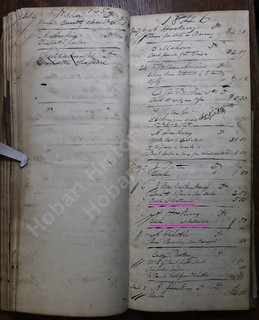
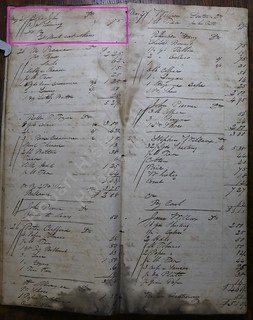
My indexing work has reached the daybook that begins in 1840. On May 25 of that year, a mysterious figure who went by the moniker "Capt. John" appeared in the general store in Liverpool (or wherever it was) and deposited 28 muskrat skins as payment for 3 yards of lining (cloth, I assume) and credit toward future purchases.

2018-4-4. DayB1840 004, 005
(Click on images to enlarge)
Images courtesy of the Hobart Historical Society.


Early in June, Capt. John shows up to make more purchases on his muskrat-skin credit, and this entry suggests he actually has a last name, though I can't read it.
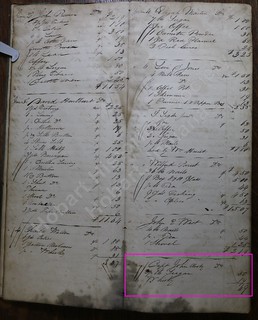
2018-4-4. DayB1840 012, 013

I indexed that name as "Clooky?" — but it's written so small, after that sprawling "Capt. John," that I'm not entirely sure it's a name. Anyway, searching on that name doesn't get me anybody local in the 1840 Census.

About ten days later, Capt. John comes in and buys some lead.

Finally, on June 22 and 23, he makes his last muskrat-skin purchases:
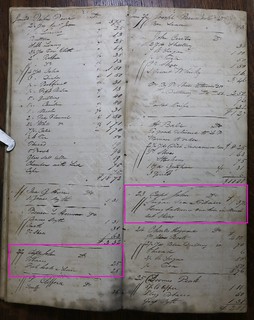
2018-4-4. DayB1840 026, 027

"… being balance due him on musk rat skins," says the June 23 entry. We shall have to wait and see if he gets more muskrat skins.

Letting my imagination go to work on these few hints about Capt. John … I get the impression of one of those eccentric characters who lived by themselves in the wilderness. Oh, that cloth he bought? — he's going to have one of the local farmers' wives sew that up for him in exchange for the fish he'll catch with those hooks he bought. His title of Captain suggests a military background — maybe a veteran of the War of 1812, or the Revolution?

Monday, April 2, 2018

Just Like Old Times

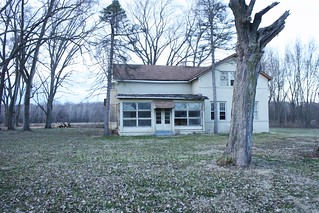
Now that they've cut down the hundreds of trees that had grown up around the Chester house (aka the Wasy house), the landscape looks a bit more the way it did when the first brick was laid.

IMG_9218
(Click on image to enlarge)


I don't know what plans led the park people to cut down those trees, but I took about 40 pictures of the Chester house in case it meets the same fate as the Crisman house.

Sunday, April 1, 2018

Happy Easter!

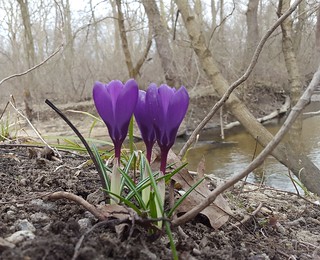
2018-4-1. Easter crocus
(Click on image to enlarge)


A spot of color in the gray woods. I don't know how these crocuses found their way to the banks of the Deep River.

Friday, March 30, 2018

A Heavenly Exclamation Point

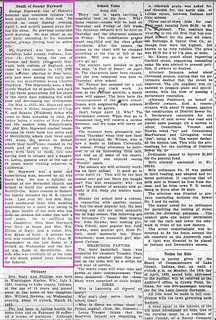
It is simply the natural course of events when an aged man, after a life of useful work, passes quietly to his rest; and so George Hayward's death on April 1, 1923, no doubt saddened but did not greatly surprise those he left behind.

2018-3-30. George Hayward obit
(Click on image to enlarge)
Hobart Gazette, April 6, 1923.


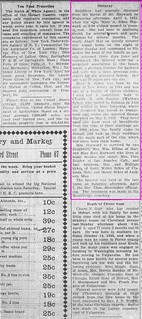
Yes, that last sentence is a little surprising — it is not the usual course of events that the aged man's wife, who (according to another account) was too ill to know that he had died, should follow him out of this world just after his funeral; but thus it was with Mary Sykes Hayward.

2018-3-30. Mary Sykes Hayward obit
(Click on image to enlarge)
Hobart Gazette, April 13, 1923.


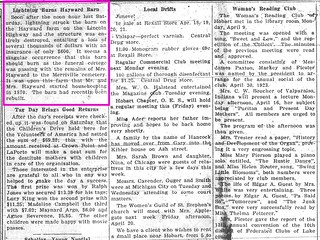
The really astonishing event happened as Mary's funeral cortege left Hobart, heading southeast toward the Merrillville Cemetery.

2018-3-30. Fire
(Click on image to enlarge)
Hobart Gazette, April 13, 1923.


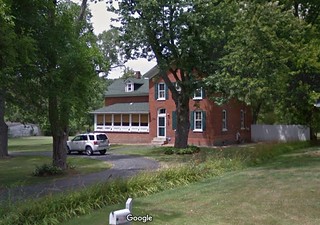
The barn may have been rebuilt again after the fire, but these days there is no barn on the old Hayward place. Still, if you've traveled along the Old Lincoln Highway east of Mississippi Street, you've probably noticed, on the north side of the road, the sturdy brick farmhouse where the Haywards lived and worked and raised their children for three decades.

2018-3-30. Hayward house Google street view
(Click on image to enlarge)
Image from Google street view.


Additional Sources:
♦ "Mr. and Mrs. George Hayward Pass Away," Hobart News, April 5, 1923.
♦ "Mrs. Hayward Passes on," Hobart Gazette, April 6, 1923.

Tuesday, March 27, 2018

"Cash at Centreville"

This ledger page recording transactions during the winter of 1846 reminds us that Merrillville was once Centreville.

2018-3-27. DayB1836 058, 059
(Click on image to enlarge)
Image courtesy of the Hobart Historical Society.


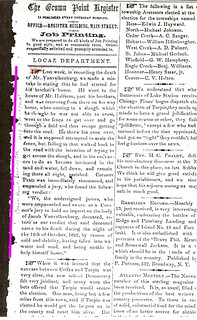
The first marked transaction involves, I believe, Jacob Vanvolkenburg.[1] According to Early Land Sales, Lake County, in 1839 he bought 40 acres in St. John Township, right on its border with Ross Township. He shows up in Lake County in the 1840 Census, and while that census does not specify townships, I see among his neighbors other names that appear in our ledgers. By the 1850 Census he was living in Ross Township, describing himself as a millwright. The 1860 Census shows him still in Ross Township, now farming. His land lay in Section 19, according to the 1874 Plat Map,[2] — but by 1874 poor Jacob himself lay in Merrillville Cemetery, having died (according to the coroner's inquest) a cold and lonely death in October 1862.

2018-3-27. CP Register 1862-10-30
(Click on image to enlarge)
Crown Point Register, Oct. 30, 1862.


As for the second marked transaction, I am not entirely sure who A. Hoskins was: the Hobart area contained both an Alexander and an Ariel old enough to transact business in 1846.

Alexander bought land in Section 5, south of the town of Hobart, as early as 1843 (Early Land Sales, Lake County). He thus lived near Old Settlers Cemetery; and since his wife had been Emma L. Colburn (Indiana Marriage Collection), it would appear that the infant Allen Hoskins whom NWIGS recorded in that cemetery was theirs — "son of A. & E.L."

Ariel, on the other hand, lived slightly northeast of Hobart. Early Land Sales, Lake County records him buying land in Section 28 in 1848. I believe he shows up in my index once as "Rial Hoskins," so perhaps we're better off betting on Alexander as the "A. Hoskins" of the ledger.

Beyond that I know very little about either of them.

_______________

[1] The name shows up in various spellings. I am using the spelling that appears in NWIGS' Ross Township Cemeteries listing.
[2] If I'm reading the plat map correctly, Jacob's land was on the northeast corner of the intersection of U.S. 30 and Whitcomb Street … but I'm not sure I'm reading it correctly.

Saturday, March 24, 2018

Two Drunks and an Idiom

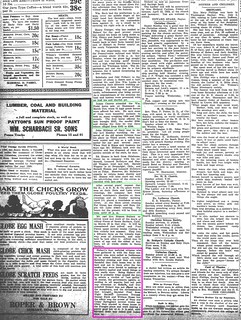
Following the close of the big liquor trial, we get a tidbit of information about the incident involving the Springman brothers — dating back, I suspect, to March 1921 — that somehow led to the parties involved getting mixed up with all those real wrongdoers in Gary.

2018-3-24. Cleaning House
(Click on image to enlarge)
"Local and Personal," Hobart News, April 5, 1923.


I had never before heard the expression "to clean house" being used in this way, meaning … I'm not sure exactly what. To trash the place? To fight?


Elsewhere in the same column, some news of our acquaintances. James Chester went to a horse auction. Ezra Gilpin began standing watch at the Lake Street crossing of the EJ&E Railroad — we have already seen the pictures.

And Alfred Pierce found his final resting place in California.

Wednesday, March 21, 2018

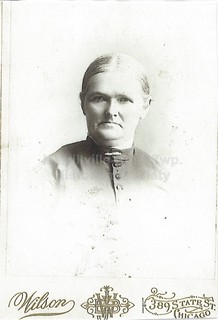
Mary Ellen (Mellon) Halfman

2018-3-21. Mary Ellen (Mellon) Halfman 1
(Click on image to enlarge)
Image courtesy of the Merrillville-Ross Township Historical Society.


About a year before the Civil War broke out, Mary Ellen Mellon became Mrs. Henry Halfman.

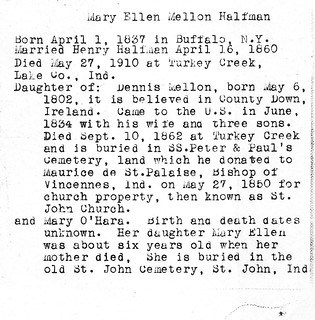
Her descendants compiled some notes to go with this photo, including the interesting fact that the land for what is now St. Peter and Paul Cemetery was donated to the church by her father.

2018-3-21. Mary Ellen (Mellon) Halfman 2
(Click on image to enlarge)
Image courtesy of the Merrillville-Ross Township Historical Society.


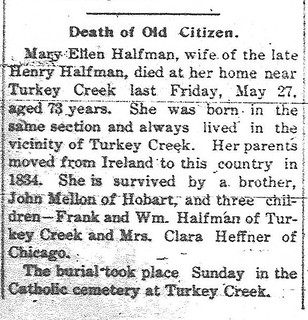
Mary Ellen's obituary had little to add:

2018-3-21. Mary Ellen (Mellon) Halfman obit
(Click on image to enlarge)
Hobart Gazette, June 3, 1910.


The portrait above is undated. Per the Chicago Historical Society's Chicago Photographers 1847 Through 1900 as Listed in Chicago City Directories (1958), John B. Wilson was at 389 State Street from 1887 through 1900 (excluding the year 1890), so Mary Ellen could be anywhere from 50 to 63 years old in that photo.