Monday, December 26, 2022

Bale's Island

At the Hobart Historical Society museum, I asked to be shown, on the Google satellite view of Hobart, where Bale's Island was. Here is my attempt to reproduce what I was shown:

2022-12-26. satellite view - Bale's Island area
(Click on image to enlarge)
Image from Google Maps.


We're looking at an area south of Sixth Street, just east of Gilbert Court.

It wasn't an island, but a swimming hole used by kids such as Elinor Ferren, born in 1911, who grew up in Hobart and told stories to her daughter about swimming there on the girls' days (as opposed to the boys' days).

According to a 1970 Gazette article, Bale's Island was "completely surrounded by water" when B.B. and Emily Bale settled in that area and built their first home, a log cabin, circa 1866.[1] I seem to recall reading elsewhere (if I could only remember where!) that the "island" became an island only on occasions when Duck Creek was running high.

The 1970 article was accompanied by this letter of reminiscences, written by Dorothy Mellon Gant, born in 1912.

2022-12-26. Letter, Gazette, 05-21-1970
(Click on image to enlarge)
Image courtesy of the Hobart Historical Society.


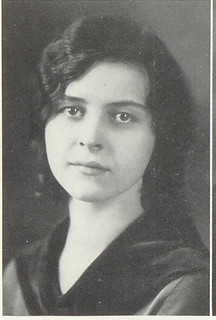
The Mellon family lived at 1001 Georgianna Street (1930 and 1940 censuses). Here is Dorothy Mellon as a senior in high school, from the 1930 Aurora.

2022-12-26. Dorothy Mellon senior portrait
Image from Ancestry.com.


_______________
[1] "Here's Bale's Island," Hobart Gazette, 21 May 1970.

Tuesday, December 20, 2022

"Where Is the Christmas Spirit in Hobart?"

From 77 years ago today, some Christmas unhappiness:

2022-12-20. Where Is the Christmas Spirit, Gazette, 12-20-1945
(Click on images to enlarge)
All images from the Hobart Gazette, 20 Dec. 1945.


OK, back to the usual good cheer.

2022-12-20. Letters to Santa Claus, Gazette, 12-20-1945

2022-12-20. Christmas Greetings from local businesses, Gazette, 12-20-1945

Monday, December 12, 2022

A Stealth Dentist

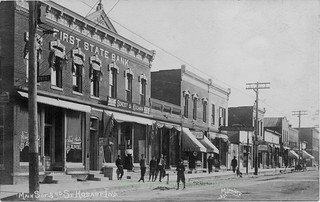
I bought this postcard because I didn't have this exact view of the 300 block of Main Street.

2022-12-12. Main Street 1911-02-01 a
(Click on image to enlarge)

It is the east side of Main Street, looking south from Third Street. The postcard is postmarked February 1, 1911.

We've seen all of these things before. What interests me in particular is the second story of 301-305 Main, where we see several awnings and a sign jutting out, all with the word "Dentist." At street level, under the big sign for the law partnership of Bozarth & Bozarth,[1] there is a small plaque with the nearly illegible name of a dentist.

The 1910 Census shows two dentists in town — Fred Werner and Charles Kenward — and of those two names, I think Kenward looks more likely.

But I never heard of Charles Kenward before. How is it possible that I've read so many issues of Hobart newspapers from this era and never heard of one of the two town dentists?

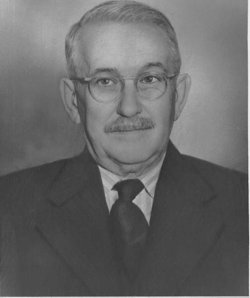
His obituary, from the Hobart Gazette of June 10, 1943, says that he moved to Hobart in 1905 and practiced his profession here until 1918.

2022-12-12. 1943-06-10 Gazette, Dr. Kenward, Former Hobart Dentist, Dies Thursday
(Click on image to enlarge)

2022-12-12. Dr. Charles Franklin Kenward
Image from findagrave.com

♦    ♦    ♦

I already covered most of the other businesses in this photo in another post about a similar postcard, dated the same year, but looking at this side of the 300 block from the other direction.

Notice that the awning of Scheddell's Drug Store reads "The Mackey Drug Store."

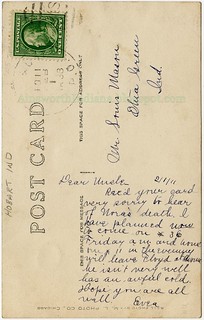
Turning the postcard over, we find it signed "Evea" — I think that's Evea Miller, whom we've met before.

2022-12-12. Main Street 1911-02-01 b

The Floyd with a cold was her toddler-age son. I wonder whom she was planning on leaving him at home with? As for poor Nora, she is a mystery to me.

_______________
[1] I'm not sure who the lawyers were; possibly Nelson and William Bozarth, father and son, who were Valparaiso residents in 1910 but might have had an office in Hobart.

Monday, December 5, 2022

Drug Money in Ainsworth

Today I want to look at the northeastern part of Ross Township as shown on the 1939 Plat Map.

2022-12-05. Schmitt - 1939 Plat Book
(Click on image to enlarge)

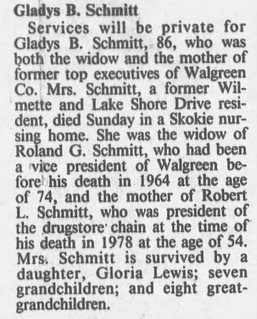
Sometime during the 1930s, Roland G. and Gladys B. Schmitt quietly bought up farmland that had belonged to two of Ainsworth's long-time residents, Charles Chester and Henry Nolte.[1] If I'm reading the plat map correctly, by 1939 the Schmitts owned some 400 acres. Where, during the Great Depression, would the money for that kind of purchase come from? The answer is: drugs. Roland Godfrey Schmitt was an executive with the expanding drugstore chain, Walgreens.

Born in Warsaw, Illinois, in 1890, he had started with Walgreens when he was just 20 years old and the chain itself not quite 10.
Roland G. Schmitt’s path to and through Walgreens would become a well-worn one, and it is still traveled today. The very day he enrolled in the Illinois School of Pharmacy in 1910, he noticed a “help wanted” announcement on a bulletin board at the school for a part-time apprentice at Walgreen’s first store at the corner of Cottage Grove and Bowen avenues. In the same youthful spirit that Walgreen demonstrated when he hopped on a train from Dixon to Chicago 17 years earlier, Schmitt stepped on a streetcar that afternoon, introduced himself to Arthur Thorsen — who was impressed by the young man’s wit and warmth — and accepted Thorsen’s offer of $8 a week (just $3 more than Walgreen earned after he got off the train almost two decades before).

Schmitt worked at the store every morning for an hour and a half, took the same streetcar back to school for a day of classes, then returned to the store to work from 6 P.M. to midnight — then got up and did it again after a few hours of sleep. After graduation, Schmitt became a full-time employee, a store manager, and finally the vice president of store operations — an unusually well-liked man with an easy smile. He retired in 1960, after putting in a very productive half century with Walgreens.[2]
In 1912, Roland married Amanda Schilling. By the 1920 Census — at which time there were 23 stores in the Walgreens Chain[3] — Roland and Amanda were living on Chicago's south side with their one-year-old son, Roland Jr. In September of 1922, Amanda died. Five months later, Roland Sr. married Gladys Forsaith. Together they would have two more children, Robert and Gloria.

The Schmitt family remained Chicago residents, per the 1930 and 1940 censuses. For them and their relatives and friends, I expect the farm was something of a vacation home. It was still a working farm, though. Roland Schmitt turned it into a big chicken-raising operation, producing eggs to sell in Walgreens stored. He hired local people to operate it. Among them, for a few years, was my late friend Eldon Harms. These are my notes from a conversation with Eldon in 2010:
The chicken houses were near the main house,[4] north and west of it on the same side of Ainsworth Road. They had some 2,000 chickens. Eldon worked on weekends, earning enough money to pay for his own textbooks (he was in high school at the time) and one suit of school clothes, and then his parents bought him another so he had a change.

The hens were all in nests along the walls. You had to go collect the eggs a couple times a day; if you left them there they'd be broken when the hens got to fighting over the nests. Eldon also had to clear out the old straw and lay down fresh, and if you want to hear some singing, you should have been there when the hens got the fresh straw. They just loved it.

The eggs had to be carried down into the storeroom in the basement of the house. They had one of those outside entrances, too. Twice a month a big green semi-trailer would come out from Chicago to collect the eggs.

He didn't earn a lot of money, but it was better than nothing.
I'm guessing the Schmitts built the guest house of which the chimney still stands in the woods north of Big Maple Lake. The main house was certainly large enough to accommodate guests, but a rustic cabin out in the forest (with indoor plumbing and gas piped in) would have been a more vacation-like getaway.

In December 1943 the Schmitts sold off their Ainsworth farm. I will get to that episode soon.

♦    ♦    ♦

Here is Roland's obituary from the Dixon Evening Telegraph of December 29, 1964.

2022-12-05. Roland Schmitt obituary. Dixon Evening Telegraph, 29 Dec. 1964
(Click on images to enlarge)

And Gladys', from the Chicago Tribune of August 13, 1987.

2022-12-05. Gladys Schmitt obituary, Chicago Tribune, 13 Aug. 1987


_______________
[1] As we know, Henry Nolte had been murdered in 1934, leaving no immediate family. Charles Chester was still living, but I am told by descendants of his that financial problems compelled him to sell, sometime in the 1930s, the farm that had been in his family for nearly a century.
[2] John U. Bacon. America's Corner Store: Walgreens' Prescription for Success. Hoboken, N.J.: John Wiley & Sons, Inc., 2004.
[3] "Walgreen Drug Stores," Chicagology (https://chicagology.com/walgreens/).
[4] The former Chester house, which stood on the west side of Big Maple Lake and was demolished in 2021.

Tuesday, November 29, 2022

Alphonso Smith by Any Other Name

Let's take another look at those statements of account from my last post.
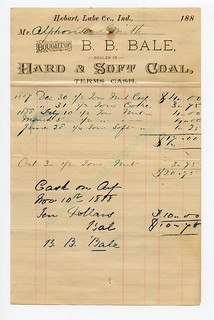
2022-11-04 Bale coal merchant papers 3a

(Reverse of the above:)

2022-11-04 Bale coal merchant papers 3b (verso)

2022-11-04 Bale coal merchant papers 4

Who (you might ask) was that Alphonso Smith guy who bought all that coal from B.B. Bale?

Searching on that name in that place on Ancestry.com brings up only one record: the 1870 Census, where he's a boy of 14 living in the household of Fanny Smith, in Hobart.

2022-11-29. 1870 census - Alphonso Smith
(Click on image to enlarge)
Image from Ancestry.com.


This census did not record how household members were related to each other. It didn't take me long to find out that Mariam Brock was Fannie's daughter, and Carrie Brock her granddaughter. But no other records places Alphonso and Fannie together in one household.

However, in the 1860 Census, Fannie's household includes a boy named Bernett who was then four years old — born the same year as the 1870 Alphonso. Once we assume they are the one and the same, it becomes easier to find this coal-purchasing guy. He was Bernett Elfonso Smith — and yes, it seems he spelled his middle name with an E; only when other people are writing it does the A appear.[1]

I think it was he who signed that promissory note to B.B. Bale:

2022-11-04 Bale coal merchant papers 2

Part of the signature was lost, but you can see the E plainly enough.

Bernett Elfonso was born to Henry and Fanny (Wheeler) Smith circa 1856. That was probably the same year his father died. His parents were in Porter County for the 1850 Census, but by 1860, as we've seen, the family moved to Hobart. There the widowed Fanny raised her children and spent the rest of her life. Although I can't find the family in the 1880 Census,[2] the Bale coal accounts place him there in the late 1880s, and the promissory note in 1892. And here we have another receipt placing him in Hobart in 1893 — buying some groceries and household goods from John Wood.
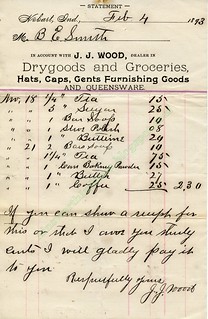
2022-11-29. J.J. Wood receipt to B.E. Smith 1893
(Click on image to enlarge)

Notwithstanding these appearances in Hobart, it seems that Bernett Elfonso also spent time in Illinois, probably Chicago: in 1888 he married Helen Brown in Cook County, and by 1900 they were living in Chicago with their young daughter, Sarah. At that time B.E. worked as a teamster.

But sometime after 1900 the family moved to California. The 1910 Census shows them in Pasadena (B.E. working as an "investigator" for a gas and electric company), and the 1920 Census shows B.E. and his wife farming in Fresno County (their daughter having moved out of the house and married). On May 30, 1929, B.E. Smith died in Fresno.[3]

2022-11-29. Smith, B.E. - death notice - The_Fresno_Morning_Republican_1929_06_03_page_3
(Click on image to enlarge)
Fresno Morning Republican, 3 June 1929.


♦    ♦    ♦

Having found that last death notice, I thought I had settled the whole life of Bernett Elfonso Smith, so you can imagine my confusion when I came across this obituary in the Hobart Gazette of October 29, 1942:

2022-11-29. Rites for B.E. Smith Held Tuesday, Hobart Gazette, 10-29-1942
(Click on image to enlarge)

Could there possibly be two Bernett Elfonso Smiths in Hobart's history? Unlikely as it seems, the answer is yes. The one who died in 1942 was the nephew of the one who died in 1929: the son of his elder brother, George.


_______________
[1] In the Union Sunday School record book that begins in 1868, a scholar named "Burnett" and one named "Alphonso" are (or is) recorded, although the actual dates of attendance are unclear.
[2] The 1880 census of Hobart is very hard to read, so the name could easily be mistranscribed; but I have looked through all 30 pages of it on Ancestry.com without being able to find Fannie or Bernett Elfonso — only her son/his brother, Frank Smith.
[3] The commercial papers in this post and my previous post about B.B. Bale (as well as another post to come) all came from a seller in Fresno.

Tuesday, November 15, 2022

"No Athletes, No Musicians!"

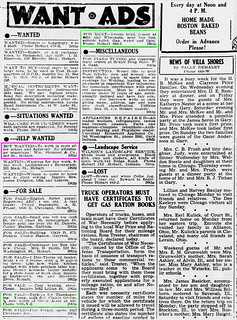
This Help Wanted ad appeared in the Hobart Gazette of November 11, 1942.

2022-11-15. 1942-11-12 Gazette, Want Ads
(Click on image to enlarge)

Is that the voice of Carl Krausse I hear, echoing down the years?


Further down the same column, we find an ad placed by Claude Groom of Ainsworth (or thereabouts). A few years ago someone mentioned him to me and I had to admit I did not know the first thing about him. Well, now I know the first thing about him: he sold milk-fed turkeys.

At the top of the middle column, we learn that in Hobart in 1942 you could still rent a house with an outdoor toilet, if you wanted to. On that note, do historians of Hobart (like historians of Munster, where I grew up) know the location of the last outdoor toilet in town?

Friday, November 4, 2022

Hobart's First Coal Merchant, and the Last of His Name

I recently bought a little packet of commercial papers, held together with a straight pin (because what else do you use when paper clips and staplers haven't been invented yet?).

2022-11-04 Bale coal merchant papers 1 in situ
(Click on images to enlarge)

Upon taking out the rusty straight pin and getting a good look at the individual papers, we find that they concern sales of coal in 1887 and 1888 by Hobart's own Bell Benjamin Bale.

2022-11-04 Bale coal merchant papers 3a

This is on the reverse of the above:

2022-11-04 Bale coal merchant papers 3b (verso)

2022-11-04 Bale coal merchant papers 4

2022-11-04 Bale coal merchant papers 2

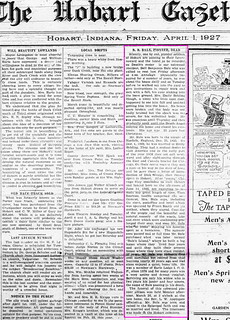
From the obituaries written up in the local papers following his death on March 25, 1927, we learn that he was Hobart's first coal merchant and established the first coal yard in town. We learn a good deal more, too, for B.B. Bale had been a Hobart resident for some 60 years, known to all, and so his death, and his life, received much attention.

2022-11-04 1927-04-01 Gazette, B.B. Bale, Pioneer, Dead
(Click on image to enlarge)
Hobart Gazette, 1 Apr. 1927.


2022-11-04 1927-03-31 News, B.B. Bale obit
(Click on image to enlarge)
Hobart News, 31 Mar. 1927


More details come from this write-up of his sixtieth wedding anniversary, which fell on December 1, 1922. (The text of the article comes from a photocopy of a typewritten manuscript in the Bale file at the Hobart Historical Society Museum, which has no date or source; while it reads like a newspaper article, it's not from the Gazette, and the issues of the News where it might have appeared are missing from the microfilm.)
Mr. and Mrs. Bale Observe 60th Wedding Anniversary

Mr. and Mrs. B.B. Bale, among Hobart's oldest and highly esteemed citizens, on Friday last passed the sixtieth anniversary of their wedded lives, the day being observed by no outward celebration but rather remembered quietly in their home together in keeping with their unostentatious lives.

Mrs. Bale, whose maiden name was Emily Turner Belding, was the daughter of George and Emily Belding and was born December 8, 1837, in the County of Norfolk, England, where her parents owned a large estate.

Mr. Bale, son of John and Mary Bale, also residents of Norfolk County, was born December 25, 1835. At the time of his marriage, December 1, 1862, which was celebrated in the Episcopal church of which both Mr. and Mrs. Bale have been life-long members, he operated one of the large farms of Mr. Belding's estate. Four years after their marriage Mr. and Mrs. Bale decided they would come to America, arriving in this country June 14, 1866. They came through to New York and soon thereafter to Hobart, then scarcely more than a wilderness with perhaps about a dozen and a half scattered homes.

They stayed at a little boarding house, located where the Kramer block now stands, for a few weeks after their arrival, while their own log cabin was being constructed on the beautiful little isle long since known as "Bale's Island." Traces yet remain there of what was once their home and its pleasant surroundings.

During the first year or two of their residence on the island they had no near neighbors, but later the Parks family located on the farm across the creek, [1] then quite a stream, and still later the Daniel Lightner family moved near on the place now owned by his grandson, Dick Johnston, and family. Four years, Mr. and Mrs. Bale lived on the island, then built their present home where they have resided for the past 52 years. At the time of their moving there, their own home and that of the Wettengel family and a little house occupied by the Decourcy family, located near where the Swedish Lutheran church now stands, were all the houses then built on the east side of the bridge over Duck creek.

"In town," Black's store was the center of business and the post-office. Andrew Wall, Sr., and family lived in a little house near Black's. Ernest Passow, a brother of the late Christian Passow, Sr., conducted a grocery and shoe shop in a little building located on the corner of Third and Main streets in the space now occupied by the Central Drug Store. Mr. and Mrs. John Mathews, both now passed away, had a home near what is now the Community building. The brick building on School Street at the rear of the M.E. Church, now remodeled and occupied as a dwelling by Mrs. Margaret Rohwedder, was once the public school building where also were conducted Sunday School and church services, a traveling preacher occasionally coming to officiate. Here Mrs. Bale, assisted by Mrs. Wedge, Mrs. DeCourcy, Mrs. Nixon and Alfred French as its superintendent, established the first Sunday school in Hobart, known as the "Union Sunday School." Their music was assisted by a little melodion which Mr. French carried to and from the building each Sunday.

Mr. Bale operated the first coal yard in Hobart. Some thirty years ago he was attacked with grip which settled in his hips leaving him a sufferer and partial invalid for life which caused him to retire from active business.

Mr. and Mrs. Bale have known Hobart through all its years of changes and development and, through their association with its interests, have contributed much to the upbuilding of the town.

May coming years be measured full of life's choice blessings is the wish prompted by the steadfast friendships they have won.
Emily Bale was interviewed in 1937 on the occasion of her 100th birthday.

2022-11-04 1937-12-12, Chicago Tribune, 100 Years Rest Gently on Lady of Old Norfolk

While the handwritten notes on this photocopy give the source as the Chicago Tribune of December 12, 1937, I have not been able to find this article in that issue online, or any other online paper.


I haven't finished with the Bales, or with this little collection of papers regarding coal sales, either, but this is all I have time for today.

_______________
[1] I believe the reference is to Duck Creek.