
The diversion of coal to the war effort made it scarce and expensive to civilians, who used it to heat homes and power electric plants. Government at all levels began to get involved in tracking the use and distribution of coal. In November 1917, Lake County Fuel Administrator W.S. Feuer* (representing the federal government) wrote to William Killigrew of Hobart, confirming William's appointment as Local Fuel Administrator. According to Mr. Feuer's letter, reprinted in the Gazette, William's new duties involved keeping a record of Hobart's coal supplies and demands, and making a weekly report to Mr. Feuer; impressing on coal dealers the need to conserve coal and to have their shipments unloaded from the rail cars within a set time limit, as well as making sure they understood the procedures for getting emergency supplies of coal from the County Administrator; urging farmers to burn wood instead of coal; and promoting harmony and fairness as a "patriotic duty" in the distribution of coal for domestic use.
In December the County Administrator distributed copies of an order from Washington requiring two "lightless nights" per week (Sunday and Thursday) when all electric signs and non-essential electric street lights must be turned off to conserve the coal that powered them.
A month later, Washington issued a more drastic coal-conservation order. Starting Friday, January 18, all industries east of the Mississippi must close for five consecutive days. That order applied to all factories and mills, and even munitions plants; the only exceptions were coal mines and factories that produced food. Furthermore, every Monday until March 25 was to be treated as a legal holiday: all office buildings, banks, theaters, churches and schools must close, as well as all stores except those selling food or drugs. Violations of the order could be punished by a $5,000 fine or two years' imprisonment.
The winter had not been kind to the conservation effort. December and January were snowy and cold, with the mercury often dipping close to zero. By the time the five-day closing order was handed down, the coal shortage in Hobart had already become so acute — "every yard in town was practically out of coal" — that William Killigrew confiscated a carload from the "J" railroad and diverted it for sale to the public. For the same purpose, he commandeered another load on its way to the main school house; in response, the Hobart school board declared a two-week school holiday, as there simply wasn't enough coal to heat the school.
In mid-January, the weather became spectacularly uncooperative. A three-day blizzard struck the Hobart area. The heavy snowfall closed roads, streetcar lines and even railroads, bringing delivery of food and coal to a standstill for two days. I can imagine people around here snowbound in their chilly houses, wrapping themselves in coats and shawls as they tried to stretch out their dwindling supplies of coal. (That scenario, in fact, played out in many Indiana homes over those few days, and on hearing of it, Indiana's federal fuel administrator authorized county administrators to prevent sales of coal to saloons and other places of amusement, such as dance halls, theaters and pool rooms, if necessary to relieve coal shortages in homes.)
The Hobart school board extended the school holiday an additional week.
Hobart businesses observed the first federally ordered Monday holiday on January 21 (though the blizzard would probably have closed many of them anyway). The News noted ironically that the only reports of holiday violations had come out of Crown Point, the county seat of law, and I'm not sure whether the paper was boasting or complaining when it said that in all of Hobart that Monday, you couldn't buy a cigar or a drink. The Gazette reported that in the afternoon you couldn't buy so much as a loaf of bread, while many Hobart citizens, freed from their usual weekday occupations, turned out to haul away the snow that still lay in piles around Main Street.
Things began to look a little better by early February. A thaw brought people out of their houses to clear away the lingering evidence of the blizzard. William Killigrew had promised a carload of coal especially for the schools, and the school board announced that Hobart schools would reopen on Monday, February 11, if the coal arrived.
I don't know if the federal fuel administration had changed the Monday-closing order to allow schools to open, or if Hobart intended to defy the order. But the coal shortage and the blizzard had kept the schools closed for so long that now the school board was considering a six-day week, to make up for lost time.
_________________________
*Apt, isn't it? Feuer is German for fire.
Sources:
♦ "A Five-Day Shut Down." Hobart Gazette 18 Jan. 1918.
♦ "Coal vs. Cold." Hobart Gazette 25 Jan. 1918.
♦ "For Information to the Public." Hobart Gazette 23 Nov. 1917.
♦ "From the State Fuel Administrator." Hobart Gazette 25 Jan. 1918.
♦ "Hobart Business Houses Observe 'Closing Day.'" Hobart News 24 Jan. 1918.
♦ "Hobart Schools to Open Next Monday If Coal Arrives." Hobart News 7 Feb. 1918.
♦ "Hobart's First Heatless Day." Hobart Gazette 25 Jan. 1918.
♦ "Industries East of the Mississippi Must Close for 5 Days." Hobart News 17 Jan. 1918.
♦ "'Lightless Nights' Is Latest." Hobart Gazette 21 Dec. 1917.
♦ "Local and Personal." Hobart News 24 Jan. 1918.
♦ "Relief from Zero Weather Comes Wednesday Morning." Hobart News 7 Feb. 1918.
♦ "Schools Closed Last Friday for Two Weeks." Hobart News 17 Jan. 1918.
♦ "Schools Closed Last Friday for Two Weeks." Hobart News 24 Jan. 1918.
♦ "Schools to Open Next Monday." Hobart Gazette 8 Feb. 1918.
♦ "The Monday 'Holiday.'" Hobart News 24 Jan. 1918.
♦ "Worst Snowstorm in Years Visits Hobart and Vicinity." Hobart News 17 Jan. 1918.
Saturday, April 9, 2011

Friday, April 8, 2011
Wildflowers of Ainsworth: Hairy Rock Cress

(Click on image to enlarge)
Found in my own field. Once again, incredibly tiny flowers, and a not very impressive specimen, except that it's blooming so early.
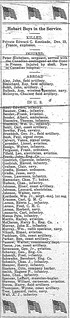
In the Service, December 1917
In December of 1917 the News began printing a running list of local men in military service. It probably cribbed from the Gazette, since it echoed that paper's recognition of George Severance, Jr. and Harold and Clarence Goodrich (but not Carlisle Dorman) as "Hobart boys." Here is the list as it stood on December 27, 1917.
Thursday, April 7, 2011
Wildflowers of Ainsworth: Harbinger-of-Spring

(Click on image to enlarge)
Also known as Pepper and Salt. I got the camera up as close to them as possible so you could see them, but this photo doesn't give you a proper idea of how tiny these things are.
Found on the forest floor in Deep River County Park.
The War Comes Home to Hobart
Most of the Kostbade family got together on Christmas Day 1917 for dinner. William and Emma were surrounded by six of their eight children: three boys and three girls, ranging in age from 24 to three. Even Mabel had come over from Gary with her husband, Lee Blake. Only two were missing — 19-year-old William Jr., who was stationed at Camp Shelby in Mississippi, and 18-year-old Edward, now with the army in France.
The family was just finishing their dinner when they heard a knock at the door — a messenger with a telegram from the War Department.
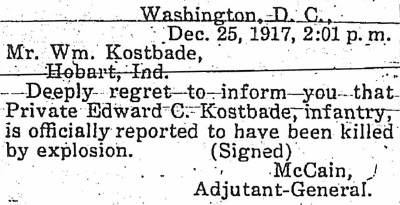
Edward had been among Hobart's first volunteers after the declaration of war. He had been stationed at Syracuse, New York when he volunteered to join an infantry regiment bound for France. His volunteer spirit had won for him the sad honor of being Hobart's first World War I casualty.
Two days later the News carried the text of a resolution passed by the Hobart town board, recognizing Edward's service and extending condolences to his family.
William Jr. got leave to come home from Camp Shelby and mourn with the family. There could be no proper funeral. William Sr. had wired to the War Department asking whether it were possible to bring his son's body home, but he had not yet received an answer.
Sources:
♦ 1910 Census.
♦ 1920 Census.
♦ "Edward C. Kostbade, First Hobart Boy to Be Killed in War." Hobart News 27 Dec. 1917.
♦ "Resolution." Hobart News 27 Dec. 1917.
♦ "Young Life Sacrificed in France." Hobart Gazette 28 Dec. 1917.
The family was just finishing their dinner when they heard a knock at the door — a messenger with a telegram from the War Department.
Edward had been among Hobart's first volunteers after the declaration of war. He had been stationed at Syracuse, New York when he volunteered to join an infantry regiment bound for France. His volunteer spirit had won for him the sad honor of being Hobart's first World War I casualty.
Two days later the News carried the text of a resolution passed by the Hobart town board, recognizing Edward's service and extending condolences to his family.
William Jr. got leave to come home from Camp Shelby and mourn with the family. There could be no proper funeral. William Sr. had wired to the War Department asking whether it were possible to bring his son's body home, but he had not yet received an answer.
Sources:
♦ 1910 Census.
♦ 1920 Census.
♦ "Edward C. Kostbade, First Hobart Boy to Be Killed in War." Hobart News 27 Dec. 1917.
♦ "Resolution." Hobart News 27 Dec. 1917.
♦ "Young Life Sacrificed in France." Hobart Gazette 28 Dec. 1917.
Wednesday, April 6, 2011
Hobart Then and Now: Third and Center, NE Corner
???? and 2011:


(Click on images to enlarge)
Top image courtesy of the Hobart Historical Society.
The top image shows the Amazon restaurant on the northeast corner of Third and Center Streets. The photo is undated. If you really want me to guess at its date … well, based on my general loosey-goosey impression of the clothing styles, I'd say 1910, give or take ten years.
Here's a photo of the restaurant in 1917. It's the building furthest to the right in the background. (The photographer was standing on Third Street, east of Center Street, and looking west toward Main. The man in the wheelchair is B.B. Bale.)

(Click on image to enlarge)
Image courtesy of the Hobart Historical Society.
I don't know when the building was built, nor what, if anything, it was before it was the Amazon restaurant. That, I know, was in business by 1918, and perhaps much earlier (I wasn't paying enough attention while reading the early-20th-century papers to get a more specific idea).
Sometime later this building became Amlong's restaurant. Or, at least, that's what someone has written on the back of this undated photo:

(Click on image to enlarge)
Image courtesy of the Hobart Historical Society.
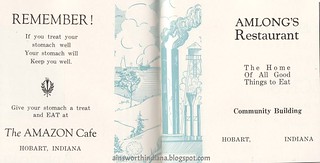
Amlong's Restaurant had previously operated in the former Hobart House building. In Hobart High School's 1927 Aurora, we find the two restaurants advertising side by side:
(Click on image to enlarge)
And here's a view of the interior of Amlong's circa 1927, when it was still in the Hobart House building.

(Click on image to enlarge)
Image courtesy of the Hobart Historical Society.
I do not know when the building at Third and Center was demolished. I think it was gone by the time they took that 1952 aerial photo on display in the window of that one building on East Third Street.
(Click on images to enlarge)
Top image courtesy of the Hobart Historical Society.
The top image shows the Amazon restaurant on the northeast corner of Third and Center Streets. The photo is undated. If you really want me to guess at its date … well, based on my general loosey-goosey impression of the clothing styles, I'd say 1910, give or take ten years.
Here's a photo of the restaurant in 1917. It's the building furthest to the right in the background. (The photographer was standing on Third Street, east of Center Street, and looking west toward Main. The man in the wheelchair is B.B. Bale.)
(Click on image to enlarge)
Image courtesy of the Hobart Historical Society.
I don't know when the building was built, nor what, if anything, it was before it was the Amazon restaurant. That, I know, was in business by 1918, and perhaps much earlier (I wasn't paying enough attention while reading the early-20th-century papers to get a more specific idea).
Sometime later this building became Amlong's restaurant. Or, at least, that's what someone has written on the back of this undated photo:
(Click on image to enlarge)
Image courtesy of the Hobart Historical Society.
Amlong's Restaurant had previously operated in the former Hobart House building. In Hobart High School's 1927 Aurora, we find the two restaurants advertising side by side:
(Click on image to enlarge)
And here's a view of the interior of Amlong's circa 1927, when it was still in the Hobart House building.
(Click on image to enlarge)
Image courtesy of the Hobart Historical Society.
I do not know when the building at Third and Center was demolished. I think it was gone by the time they took that 1952 aerial photo on display in the window of that one building on East Third Street.
Tuesday, April 5, 2011
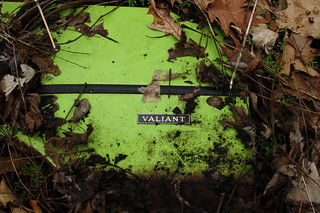
Valiant (Random Pointless Photo)
(Click on image to enlarge)
Found in the woods in Deep River County Park. I wonder what happened to the rest of the car?
Plymouth stopped making the Valiant in 1976 (or so Google tells me), but there's no telling how long they drove that beater around before the quarter panel fell off.
Subscribe to:
Posts (Atom)

