
On the morning of August 24, 1915, residents of Linda Street watched as an old frame building — familiar to them, since it had stood on Main Street for many, many years — moved slowly down their street, carried on the trucking equipment of William Croan, house mover. No one knew where William was taking it, and he wasn't telling.
When the creaky procession reached a point between the houses of Harrison Shearer and Charles Ockerline, it stopped in the middle of the street. Onlookers saw William and his assistants busy about their equipment, but not until the moving trucks actually started to move again minus their cargo did the witnesses realize that the building had reached its intended destination.
There it sat, blocking the street to team traffic — an obstruction, a fire hazard and a dilapidated eyesore. And yet someone had induced William to go to all the trouble of hauling it from Main Street and setting it down in the middle of Linda Street.
That someone was Oscar W. Carlson. He was well known to the town fathers already, as he had previously engaged in a lengthy battle with the town over the laying of some sewer pipes. He had also run for town marshal in 1911, unsuccessfully. As the Gazette put it, "[I]f there is really any one who loves a scrap it's Mr. Carlson."
The focus of his current "scrap" was his belief that he actually owned part of Linda Street itself. He possessed a tax title deed that he believed proved his ownership of it. And he had decided to move the building onto his alleged Linda Street property to test his right of ownership. Apparently his theory was not that far-fetched. Though Linda Street had been in use as a public highway since the town's infancy, the Gazette acknowledged that its legal status had "been in question for a number of years."
By early September, exasperated Linda Street residents had gotten up a petition to the State Fire Marshal, asking that Oscar be ordered to remove the building. It continued to sit there for another week as the Fire Marshal deliberated upon their request. Finally, in an order dated September 14, the Fire Marshal ordered Oscar to remove the building and all attendant rubbish within 20 days; if he failed to do so, he could be fined as much as $50 a day for as long as the house stood there.
Oscar had a right of appeal, but uncharacteristically he didn't pursue it. After considering the matter for about 10 days, he gave in and began the process of taking apart the old frame building. On the third day, as he stood high on a ladder, pulling siding off one of the walls, the structure collapsed, and Oscar and his ladder fell down onto the heap of rubbish. He sustained cuts and bruises to his face and legs, and two of his lower teeth were knocked loose.
Three days later he interrupted his work (or perhaps his convalescence) to travel to Hammond, where he petitioned the court for a temporary restraining order against William Scharbach, Sr., and his sons, Emil, William and Barney, and August Simon. Oscar claimed that they had interfered with his dismantling of the building, harassed him and threatened to do him bodily harm. The Scharbachs and Mr. Simon insisted they had done none of those things. After hearing both sides, the court ruled for the defendants.
Defeated, Oscar returned to his work in Linda Street. Although the deadline for the removal of the building had passed, apparently no one took the trouble to fine him; he was clearly attempting to comply with the order, albeit slowly. And so work progressed through the month of October.
On October 29, the Gazette reported that Linda Street was "about cleared of the rubbish" and again open to traffic. The matter had taken more than two months, and much trouble, injury and expense to various people. All of that probably suited Oscar's taste, but nothing had been settled, and the legal status of Linda Street remained a "muddle."
Sources:
♦ "Hurt in Building Wreck." Hobart Gazette 1 Oct. 1915.
♦ "In Hands of State Fire Marshal." Hobart Gazette 10 Sept. 1915.
♦ "Linda Street About Cleared." Hobart Gazette 29 Oct. 1915.
♦ "Linda Street Muddle Deepens." Hobart Gazette 8 Oct. 1915.
♦ "Locates House on Linda Street." Hobart Gazette 27 Aug. 1915.
♦ "Orders Building Removed." Hobart Gazette 17 Sept. 1915.
Thursday, October 14, 2010

Wednesday, October 13, 2010
In Which the Blogger Grows More Certain …
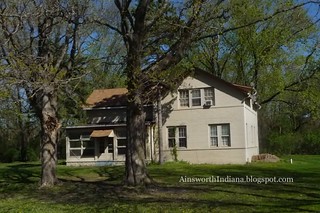
(Click on image to enlarge)
… that this was Henry Chester's house. Remember when I first speculated on the topic? Since that time, I've spoken to someone who grew up in the neighborhood and knew this to be the home of Charles Chester (Henry's son) in the early 1930s.
Now I just have to convince myself that Charles didn't pull down an earlier house and build a new one in the late '10s or '20s.
Wild Grasses of Ainsworth: Red Fescue

(Click on image to enlarge)
This can't possibly be the same red fescue people plant in their lawns, can it? Look at these humongous leaves:
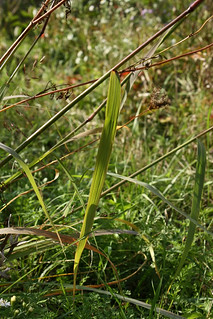
Maybe they behave themselves better if you mow them.
I have to say, identifying wild grasses is not nearly as much fun as identifying wildflowers, but I have learned some things I never knew before, e.g., that branchy formation at the top is called the inflorescence (because that's where the flowers, such as they are, blossom), and corn is considered a wild grass.
Tuesday, October 12, 2010
Nice Catch!
It was 2:30 in the morning, October 27, 1915. Somewhere in Chicago, a Winton Six from the Ashland Motor Livery Co. was being piloted along the dark streets by a company driver. Crowded into the seats behind him were the seven young people who'd hired the car — five men and two women.
One of the passengers called out to the driver that a tire seemed to be going flat. The driver stopped the car and jumped out to check the tires. Once out on the pavement, he found himself looking down the barrel of a revolver held by one of his young passengers. The man holding the gun relieved him of eight dollars and pair of gloves. Another passenger climbed into the driver's seat and gunned the engine. The car took off down the street. The driver was left on the pavement, dumbfounded, watching his car and the band of thieves disappear into the night.
♦ ♦ ♦
Four hours later, a car carrying four Ross Township farmers was heading out of Merrillville, just starting a trip to Chicago. John Miller was at the wheel — it was his car — and his passengers were Charles Chester, Henry Batterman and Lef Walters. They were on Broadway, northbound, when they spotted a curious sight: a Winton Six standing by the road, in flames. They stopped to investigate. Then they noticed another curious sight: a small group of young people on foot, leaving the area with suspicious haste — five men and two women. The farmers jumped out of the car and ran after them.
They caught the two young women and three of the young men quickly enough. John Miller, Henry Batterman and Lef Walters escorted the captives back to where John's car stood, intending to hold them until the law showed up.
But the other two young men were still running. Now Charles Chester threw off his coat and kept up the pursuit alone. Somehow he got hold of a shotgun, and as the chase moved north over open fields, one of the fugitives proved himself armed as well by taking a potshot at the engineer of the passing Grand Trunk milk train. And still Charles kept after them! And what is more surprising, he caught them, too — he, 45 years old — when the armed man either ran out of ammunition or decided his revolver was no match for a shotgun, and the two young fugitives surrendered. Charles turned them over to Ross Township Trustee A.M. Boyd, who took them to the county jail at Crown Point.
Meanwhile, back at the car, John, Henry and Lef were guarding the five young prisoners as they waited for the sheriff to show up and take charge. But they had made an amateur's mistake — they had neglected to search their prisoners for weapons. Suddenly one of the young men pulled out a revolver. The unarmed farmers could only stand back helplessly as the car thieves climbed into John's car and took off north on Broadway. And that was the condition Charles found his friends in when he returned.
The alarm had spread. The sheriff and deputies came on the scene. Someone called to alert the Gary police, since the stolen car seemed to be heading in that direction. Our four farmers got a lift from law enforcement, and once again the chase was on.
At 48th and Broadway in Gary, they came upon John's car abandoned by the side of the road, one of its tires sliced open. Evidently the thieves had bailed and taken off on foot. The area was less built up then, and there were wooded areas around for the fugitives to hide in.
But there were plenty of people to look for them, too. By now dozens of local farmers had shown up, many of them armed. They spread out through the woods, searching.
According to Charles Chester, credit for the ultimate capture belonged to a small dog that had joined the searchers. The fugitives had hidden themselves in a brush pile, invisible to human eyes but not undetectable to a canine nose. Once the little dog pointed them out, it was all over. Hopeless outnumbered by armed men, the thieves gave up and went meekly to the jail in Gary.
Sources:
♦ "Farmers Catch Auto Thieves." Hobart Gazette 29 Oct. 1915.
♦ "Personal and Local Mention." Hobart News 28 Oct. 1915.
One of the passengers called out to the driver that a tire seemed to be going flat. The driver stopped the car and jumped out to check the tires. Once out on the pavement, he found himself looking down the barrel of a revolver held by one of his young passengers. The man holding the gun relieved him of eight dollars and pair of gloves. Another passenger climbed into the driver's seat and gunned the engine. The car took off down the street. The driver was left on the pavement, dumbfounded, watching his car and the band of thieves disappear into the night.
Four hours later, a car carrying four Ross Township farmers was heading out of Merrillville, just starting a trip to Chicago. John Miller was at the wheel — it was his car — and his passengers were Charles Chester, Henry Batterman and Lef Walters. They were on Broadway, northbound, when they spotted a curious sight: a Winton Six standing by the road, in flames. They stopped to investigate. Then they noticed another curious sight: a small group of young people on foot, leaving the area with suspicious haste — five men and two women. The farmers jumped out of the car and ran after them.
They caught the two young women and three of the young men quickly enough. John Miller, Henry Batterman and Lef Walters escorted the captives back to where John's car stood, intending to hold them until the law showed up.
But the other two young men were still running. Now Charles Chester threw off his coat and kept up the pursuit alone. Somehow he got hold of a shotgun, and as the chase moved north over open fields, one of the fugitives proved himself armed as well by taking a potshot at the engineer of the passing Grand Trunk milk train. And still Charles kept after them! And what is more surprising, he caught them, too — he, 45 years old — when the armed man either ran out of ammunition or decided his revolver was no match for a shotgun, and the two young fugitives surrendered. Charles turned them over to Ross Township Trustee A.M. Boyd, who took them to the county jail at Crown Point.
Meanwhile, back at the car, John, Henry and Lef were guarding the five young prisoners as they waited for the sheriff to show up and take charge. But they had made an amateur's mistake — they had neglected to search their prisoners for weapons. Suddenly one of the young men pulled out a revolver. The unarmed farmers could only stand back helplessly as the car thieves climbed into John's car and took off north on Broadway. And that was the condition Charles found his friends in when he returned.
The alarm had spread. The sheriff and deputies came on the scene. Someone called to alert the Gary police, since the stolen car seemed to be heading in that direction. Our four farmers got a lift from law enforcement, and once again the chase was on.
At 48th and Broadway in Gary, they came upon John's car abandoned by the side of the road, one of its tires sliced open. Evidently the thieves had bailed and taken off on foot. The area was less built up then, and there were wooded areas around for the fugitives to hide in.
But there were plenty of people to look for them, too. By now dozens of local farmers had shown up, many of them armed. They spread out through the woods, searching.
According to Charles Chester, credit for the ultimate capture belonged to a small dog that had joined the searchers. The fugitives had hidden themselves in a brush pile, invisible to human eyes but not undetectable to a canine nose. Once the little dog pointed them out, it was all over. Hopeless outnumbered by armed men, the thieves gave up and went meekly to the jail in Gary.
Sources:
♦ "Farmers Catch Auto Thieves." Hobart Gazette 29 Oct. 1915.
♦ "Personal and Local Mention." Hobart News 28 Oct. 1915.
Monday, October 11, 2010
Wildflowers of Ainsworth: Arrow-leaved Aster

(Click on image to enlarge)
Here's yet another kind of wild aster! I think I'll just start saying, "Oh, those are wild asters," and hope no one thinks to ask, "Yes, but what kind?"
And if they do, I'll tell them it's a Dee's Aster.
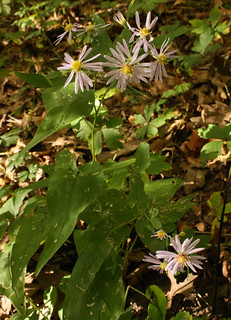
Wildflowers of Ainsworth: Short's Aster
(Click on image to enlarge)
I never knew there were so many kinds of wild asters. I'm getting seriously confused.
Sunday, October 10, 2010
To Lie Down in Green Pastures
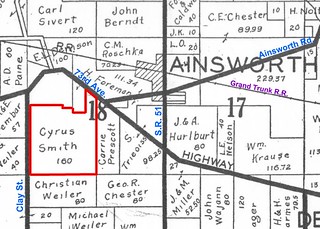
(Click on image to enlarge)
This is Cyrus Smith's land as shown in the 1926 Plat Book. The 1874 Plat Map shows him holding 240 acres in this location, but by the time of the 1890 Plat Book, he had apparently disposed of some of his land, including 50 acres sold or given to his brother, William. His remaining 160-acre parcel roughly accorded with the image above.
Cyrus E. Smith was not the joining type. He belonged to neither church nor lodge. Yet he was liked and respected by his Ainsworth and Hobart neighbors, who knew him well, as he had been farming southwest of Ainsworth since 1863. In testimony of their fondness, a group of friends gathered at his home on September 29, 1915, to celebrate his 76th birthday along with his little family.
And his own family was comparatively little. Cyrus and his wife, Ellen, had had only one son of their own, William, born in 1875; they had also raised from childhood a girl named Pearl, presumably an orphan. At the age of 22 William married Emily Hayward, daughter of some farming neighbors, but after only a year of marriage he died, childless. After that, Cyrus and Ellen took the formal steps to adopt Pearl, making her their daughter legally as well as emotionally. In 1911 Pearl married Ellen's favorite nephew, Robert Harper; the young couple lived and worked on the Smith farm, and by the time of Cyrus' birthday party, Pearl had already delighted her parents with a grandson — and in August 1915, a brand-new granddaughter.
The crowd gathered at the Smith home probably included Cyrus' younger brother, William, along with William's daughter Mabel and her family. For about three decades William had farmed a parcel next to Cyrus' own; it had once been Cyrus' own. In 1907 William sold his farm and moved with his wife, Caroline, to Hobart. In 1908 Caroline died; about a year later William moved south of Ainsworth to live with Mabel, who was by then the wife of Frank Peterson and the mother of four children.
The birthday celebration went off well. Cyrus was still an active and energetic man at the age of 76. Two days after the party, he and Ellen traveled to Crown Point and spent a pleasant day at the Lake County fair.
They returned home about five o'clock. Going about the evening chores, Cyrus noticed that a cow and a calf had not returned from the pasture. He went out to look for them.
As a few hours passed, as darkness approached and Cyrus had not come back, Ellen began to fear some accident. She sent for help, and her neighbors responded quickly. Word spread that Cyrus was missing, and more and more neighbors showed up at the Smith farm, until there were about 50 lantern-bearing searchers wandering over the dark fields and among the dark woods.
It was about 11:00 p.m. when they found him. He was not injured — he was dead. He had simply collapsed and died in his own pasture. Dr. C.C. Brink of Hobart was called to the scene; he gave the cause of death as acute gastritis.
Cyrus was born in September 29, 1839, in Pennsylvania, on the farm where his grandfather had settled in 1801. The first vote he ever cast was for Abraham Lincoln. In 1861 he married Ellen Harper, and two years later they came to Lake County, to the farm southwest of Ainsworth where they would spend the remaining 52 years of their marriage.
As a young man, Cyrus taught school in Ross Township for eight years. He was elected a county commissioner in 1884 and served for six years. He was also appointed to fill out a vacant term as township trustee. He became affiliated with the First State Bank in Hobart, serving as a director and vice-president. Two weeks after his death, the First State Bank published its last statement bearing Cyrus' name:
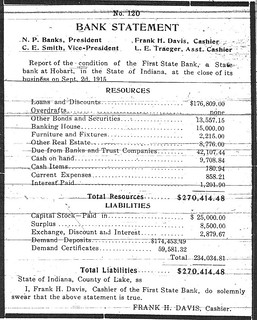
(Click on image to enlarge)
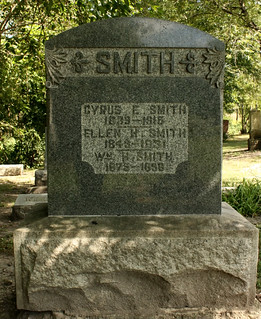
And so Cyrus Smith, defender of the Ainsworth Grand Trunk crossing as well as the dairy farmer's interests — and would-be defender of the Ainsworth saloon's character — was laid to rest in Merrillville Cemetery beside his son, and where his wife would one day join him.
Sources:
♦ "Bank Statement." Hobart Gazette 15 Oct. 1915.
♦ "Cyrus W. Smith Found Dead in Pasture Field." Hobart News 7 Oct. 1915.
♦ "Death of Ross Township Citizen." Hobart Gazette 8 Oct. 1915.
♦ "Local Drifts." Hobart Gazette 4 Oct. 1907; 6 Nov. 1908; 6 Aug. 1909.
♦ "Merrillville." Hobart News 23 Jan. 1913.
♦ "Personal and Local Mention." Hobart News 19 Aug. 1915.
Subscribe to:
Posts (Atom)

