Friday, October 15, 2021

The Aurelia Building in Gary

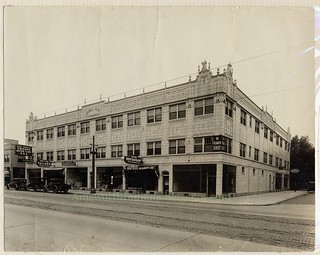
I don't usually deal with Gary history, because it's a huge topic and there are thousands of people better qualified to talk about it, but this lovely structure has an Ainsworth connection.

2021-10-15. Aurelia Building 900 5th Ave Gary Ind
(Click on image to enlarge)
Image courtesy of David Conley.


It was built by Teofil H. Grabowski, and named for his daughter, Aurelia. We can assume that the building went up sometime after Aurelia's birth in September 1922; that's as exact as I can get at this point.

It stood on the north side of West Fifth Avenue in the 900 block. In addition to office space, it held apartments: for example, the dentist whose sign we can see on the nearest corner, Samuel De Haven, appears in the 1930 Census in a rented residence at 902 West Fifth, and his office is listed at the same address in a 1929 city directory.[1] In the same directory, Dr. Sophie Solf is listed at 914 W. Fifth. The awning of the Fifth Avenue Restaurant gives its street number as 904.

I'm guessing the photo dates to roughly 1929 (although some of the businesses in the photo are not listed in the 1929 directory).[2]

The Aurelia Building is no longer standing. My source tells me that family members saw it as late as (approximately) 1967 as they were driving through the region. According to Lake County records, the Rally's restaurant now on the site was built in 1989. A few years after that, Aurelia Grabowski Conley came to the area for a brief visit and found her namesake building replaced, but she did get to visit her childhood home north of Ainsworth.


_______________
[1] Polk's Gary (Indiana) City Directory 1929. Chicago: R.L. Polk & Co., 1929. Via Ancestry.com.
[2] Ainsworth's own vintage-car expert tells me that he can't see anything inconsistent with that approximate date in the vehicles on the street.

Thursday, October 7, 2021

Tressy's Secret

Theresia Chester
(Click on image to enlarge)
Image courtesy of the Hobart Historical Society.


When a stranger named Mandy Haggerty contacted me out of the blue to tell me that her grandfather was Theresia Chester's illegitimate child, I was astonished. Tressy? Who would ever have thought…?

But the birth certificate is easy enough to find, if only I had known to go look for it. I wonder that I did not stumble across it before in all these years of research.

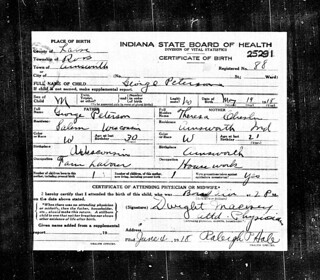
2021-10-07. George Peterson Jr. Birth Certificate 1918-05-14
(Click on image to enlarge)
Image from Ancestry.com.


The father, George Peterson, was born December 24, 1888, somewhere in Wisconsin (sources vary). His parents, Danish immigrants, were farmers (1900 Census, and I am relying on Mandy's research for his background, since a guy with a name like George Peterson — well, you have to have a special interest in him to do the work of separating him from all the other George Petersons). At about 20 years of age George married for the first time and had a child; the 1910 Census shows him living in Chicago with his in-laws. I do not know what became of that marriage. George somehow found his way down to Ross Township. When the Great War broke out and he had to complete his draft card on June 5, 1917, he described himself as single (WWI Draft Cards). He was working as a hired hand on the farm of Nicholas Fleck, Jr.

Living in Ross Township, he not surprisingly came to know Tressy Chester. She was about ten years his junior.

What is surprising about this episode is that throughout the late autumn of 1917, and the winter and spring of 1918, none of the local papers mentioned a word about Charles Chester's taking any legal action against his daughter's seducer — or even illegal action, as might be the first impulse of the hot-headed Charles.

To his credit, Charles apparently did not do anything against his pregnant daughter, either. It was probably under his roof, on May 14, 1918, that George Jr. was born. As noted on the birth certificate, George Sr. was then residing back in his home state, Wisconsin.

We have no way of knowing how Tressy felt about giving her child up for adoption. The fact that birth certificate recorded a name rather than just "baby boy" would suggest emotional attachment — but I ought not to subject Tressy to my amateur psychologizing.

At that time and place, of course, her keeping the child as a single mother would have come at a very heavy social cost. As to letting her parents raise the child as their own — as the Ols family had done with little Lela — well, Charles and Constance were both about 46 years old at that time; I suppose they could have brazened it out if they'd really wanted to. But that didn't happen.

The child having been adopted out, Tressy's life resumed all appearance of normality. As we know, in September 1919 she married Robert Shaw. The ceremony took place in Holy Name Cathedral in Chicago. The bride wore white crepe de chine and was attended by her sister, Jennie.[1]

Our knowing what we know now makes it all the more poignant that the first child of that marriage, a little boy names James, died shortly after birth (Cook County, Illinois, Deaths Index). Robert and Tressy went on to have two more sons whom they raised to adulthood.

I wonder if Robert knew about Tressy's first child?

The Chesters kept quiet about it all even within the family, it seems. In contrast to the Ols descendants, to whom the story of Jennie and Lela was just a part of family history, none of the Chester descendants I'm in touch with knew anything about Tressy's secret. The story was equally unknown among the descendants of Tressy's baby. Mandy Haggerty needed an Ancestry.com DNA test, with its suggestions of possible relatives, as well as the help of a "search angel," to figure out that the grandfather she knew as Donald Robert Haggerty had come into the world as George Peterson, Jr.

I will talk about him and his adopted family in a future post.

_______________
[1] "Hobart," The Times (Hammond, Ind.), 5 Sept. 1919.

Friday, October 1, 2021

Collared Dart and Bristly Cutworm. Maybe.

Here's a bad moth pic, taken with my phone.

2021-10-01. Collared Dart, maybe
(Click on images to enlarge)

I think it might be Collared Dart, but I could be wrong. Wouldn't be the first time.


Here's an even worse pic of a different moth.

2021-10-01. Bristly Cutworm or something, who knows

The only thing I can find in my Peterson Field Guide to Moths that looks like it is the Bristly Cutworm moth.

Thursday, September 23, 2021

Frederick and Fredericke

2021-09-23. Suhr, Fredericke and Frederick
(Click on image to enlarge)
Fredericke and Frederick Suhr. Images from findagrave.com.


Returning to the Harms 73rd Avenue farm, we left off in 1873 when Mary Chester bought the lower forty of the 80-acre parcel.

In September 1874, Mary lost her husband, Charles. In November, she sold her 40 acres to a German immigrant family by the name of Suhr, lending them $921 of the $1,000 purchase price.
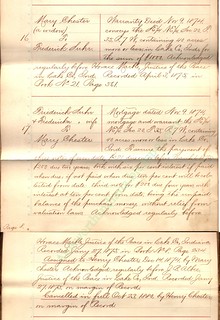
2021-09-23. 1874 Chester to Suhr - Harms Abstract of Title
(Click on image to enlarge)
Image courtesy of the Eldon Harms family.


I did not recognize that name at first, but I should have: from the early days of this blog, when I was researching the Chester Cemetery, as that is the final resting place of the couple who bought these 40 acres. Back then, I was able to find very little information on them: just the 1880 Census showing Frederick and Fredericke, along with their 27-year-old son, Henry, farming somewhere in Ross Township.

Since 2009, I have discovered findagrave.com, which, through the collective effort of many people, has become a remarkable resource. From information there, I can now fill in some of the missing background, as well as post photos of the Suhrs (above) from the same source.

Frederick and Fredericke (Lichtwarle) Suhr had been married in Germany, their native land, where Frederick worked as a miller. (It was Fredericke's second marriage; her first had produced one son, Charles Schmidt, named for his father.[1]) They came to the U.S. in 1870, evidently just missing the census, and brought with them their three children: Fredrika, Henry, and Emma.[2] They lived in South Chicago at first, but, as we see from our documents above, by 1874 the family moved to Indiana.

Their children all married — most importantly, Emma, in 1887, to Conrad Bender, a man prominent enough in Porter County to rate a biographical sketch in a regional history book, whence I have gleaned some of this information.[3] The other children, Fredrika and Henry, appear to have spent much of their married lives in Illinois.

The Suhrs evidently did well enough on their farm to pay off their mortgage by 1880.

In 1882, at only 65 years of age, Fredericke Suhr died. She was buried in the Chester Cemetery, west of their farm. Frederick then sold the farm and left Indiana to spend the next 15 years in Illinois, probably with one or both of his married children there. He died in 1897, and they brought his body back to Ainsworth, to rest beside Fredericke.

Through their daughter, Emma Bender, their descendants were spread around northwest Indiana. Emma, who died in 1918, was survived by seven children: "Edward F. Bender, of Gary; Mrs. Martha Lute, of Hobart; Mrs. Ida Schenelter of Crown Point; Mrs. Bertha Malone, who lived with her mother in Hobart; Albert C. Bender and Frank J. Bender, who live on and operate the Bender farm in Portage township and Walter F. Bender, of Chesterton."[4]

♦    ♦    ♦

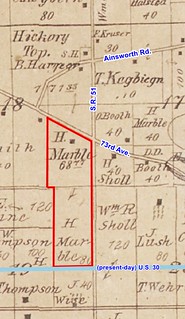
The real estate transaction we're looking at brought up two other names I recognize from past posts. The mortgage of the land in October 1874 was acknowledged before Justice of the Peace Horace Marble, whose 140-acre parcel just south of Ainsworth included the cemetery. (He was listed there, as a farmer, in the 1870 Census, but by 1880 had moved to Hobart and become a "commission merchant.")
2021-09-23. Marble, H., 1874
(Click on image to enlarge)
The Horace Marble farm as it appeared on the 1874 Plat Map. Hickory Top had not yet been renamed "Ainsworth."


The assignment of the mortgage, in December 1874, by Mary Chester to her son, Henry, involved J.P. Jesse B. Albee.

_______________
[1] Pictorial and Biographical Record of La Porte, Porter, Lake and Starke Counties, Indiana. Chicago: Goodspeed Brothers, 1894.
[2] "Long Illness Proves Fatal to Mrs. E. Bender," Vidette-Messenger (Valparaiso), Oct. 20, 1933 (transcribed at findagrave.com).
[3] Goodspeed (1894).
[4] "Long Illness Proves Fatal," 1933.

Monday, September 13, 2021

Climbing False Buckwheat

Lately this vine has been growing so vigorously, not only did it climb up my old apple tree, but great lengths of it are growing over the goldenrod around the tree, weighing it down.

2021-09-13. Climbing False Buckwheat vine
(Click on image to enlarge)

I found it hard to identify because Newcomb's Wildflower Guide expects you to know how many petals a wildflower's blossoms have. And among all these white appendages, I wasn't sure whether I was looking at fruit or flower.

2021-09-13. Climbing False Buckwheat blossoms

Eventually I just had to go paging through the "vine" parts of the book, looking for a resemblance … which I found in the drawing of Climbing False Buckwheat. Newcomb says the tiny blossoms have five regular parts. The bigger, frilly, oval or teardrop-shaped things are the fruit.

2021-09-13. Climbing False Buckwheat blossoms - ID

Perhaps because what's shown in this photo is the farthest growth of the vine, hence the youngest, the stem hasn't turned red yet. Here is an older part, showing the distinctive red stem and heart-shaped leaf.

2021-09-13. Climbing False Buckwheat stem, leaf

Wednesday, September 8, 2021

Little Jerks of Ainsworth

2021-09-08. Tomato Fruitworm
(Click on image to enlarge)

Here's one of the little jerks who've been nibbling on my tomatoes all summer: a Tomato Fruitworm.

They grow up to be really boring moths.

Wednesday, September 1, 2021

"A Decent, Sober Indian Woman"

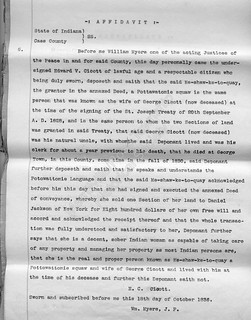
While looking through some land title abstracts at the Merrillville/Ross Township Historical Society, I came across this strange document:

2021-09-01 land009
(Click on image to enlarge)
Image courtesy of the Merrillville/Ross Township Historical Society.


What struck me was Edward Cicott's description of his aunt-by-marriage: "a decent, sober Indian woman as capable to taking care of any property and managing her property as most Indian persons are." In all of the title documents I've looked at, I have never encountered any such characterization. The affidavits I've seen have dealt with factual matters: "I know So-and-so to be who he says he is," or "I was well acquainted with Such-and-such and she died five years ago."

I suppose the Indian Affairs Bureau wanted this affidavit to ensure (or to give the appearance of ensuring) that Me-shaw-ke-to-quay was not being taken advantage of in the sale of her land.

The land she was selling was Section 36, Township 36 North, Range 8 West of the Second Principal Meridian:

2021-09-01 Section 36, Hobart Township
(Click on image to enlarge)
Image from 1939 Plat Book. Don't ask me to explain Clark and Dearborn Streets.


I have marked the Hoffman eight acres at the section's southern edge because the abstract in question came to us through the purchase of that land in 1924.

Earlier in the abstract is a statement that Me-shaw-ke-to-quay held formal title to the land through a treaty made in 1828:

2021-09-01 land005
(Click on image to enlarge)
Image courtesy of the Merrillville/Ross Township Historical Society.


This may be what is meant by the term "floating claim." Per the treaty, Me-shaw-ke-to-quay was entitled to select two sections of undeveloped land within a certain region. This Section 36 was one of her selections. I don't quite understand the timeline: Me-shaw-ke-to-quay sold the land in 1836, but her selection of it wasn't formally approved in Washington until 1837, if this abstract is correct.

All I know about Me-shaw-ke-to-quay is that she was Potawatomi, and married a white man, George Cicott. He is almost as elusive. A 1913 history of Jefferson Township, Cass County,[1] gives us a little information:
George Cicott was the first white man to set foot within the present boundaries of this township. He was a French-Canadian who for many years lived and traded with the Pottawattomie Indians and married an Indian wife.

The Indians looked upon him as one of their number and he was, so far as the rights and privileges of the tribe were concerned. By the treaty of 1826 a reservation of over one thousand acres in the southern part of the township was ceded to him, as were also other tracts of land, including the present site of Logansport. From the sale of these lands he accumulated quite a fortune. Immediately after the cession of these lands in 1826, or possibly 1827, Mr. Cicott settled on his reservation as what was afterwards known as Georgetown, and opened a trading post and dealt almost exclusively with the Indians, as there were at the time no white settlers in the township. He erected the first mill in the township in 1829 near the present site of Georgetown … Mr. Cicott died about 1833.[2]
George had an older brother, Zachariah, who seems to be a bit better known, and this essay about Zachariah gives some interesting context.

In spite of the "fortune" that George Cicott accumulated for himself, by 1836 his widow was "poor and destitute," according to our title abstract:

2021-09-01 land006
(Click on images to enlarge)
This image, and the images below, courtesy of the Merrillville/Ross Township Historical Society.


2021-09-01 land007

I cannot identify the purchaser, Daniel Jackson.

An interpreter was involved in at least part of the transaction:

2021-09-01 land008

Everyone (except perhaps the buyer) was in Cass County at that time. I have no evidence that Me-shaw-ke-to-quay ever lived on this Section 36.

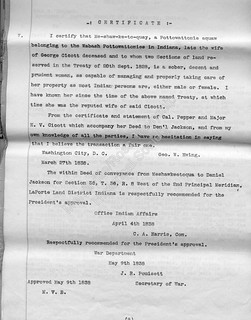
In addition to the affidavit of her nephew with which I began this post, another trader named George W. Ewing certified, in 1838, to Me-shaw-ke-to-quay's competence to conduct the transaction …

2021-09-01 land010

… but based on what I've learned about him, I wouldn't take his word for it. (And I'm not sure Edward V. Cicott was any better.)

George Ewing uses much the same language as Edward Cicott did to describe Me-shaw-ke-to-quay: "sober, decent and prudent." Now, I can understand "sober" and "prudent," but what does "decent" have to do with competence to sell one's land?

_______________
[1] Powell et al. (eds.) History of Cass County, Indiana. Chicago and New York: The Lewis Publishing Company, 1913. Reproduced at https://play.google.com/books/reader?id=exgVAAAAYAAJ&pg=GBS.PA616&hl=en.
[2] Most sources give 1833 or 1832 as the year of George Cicott's death; it's interesting that Edward Cicott gives it as 1830 in his affidavit.