Wednesday, January 8, 2014

Well House? Watch Tower?

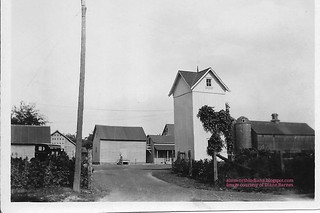
Another photo from Lillie Newman Barnes' "John Gruel Farm" envelope, and this time I believe it may actually be the farm. The photo is undated, but a partially visible car at left, behind the fence, looks 1920s-ish to me.

JohnGruelEnvelope4
(Click on image to enlarge)
Image courtesy of Diane Barnes.


I think (though I'm not sure) that the barn in the background at right is still standing.

But let us look at that tall, thin, gabled structure in the foreground. What the heck is it? My guess is a well house, perhaps with a water tank in the upper part, which would create water pressure via gravity.

It's interesting to compare the above photo with one from the Chicago Daily Tribune "fortress" article. One of the aerial photos in that article identifies a tall, thin structure near the entrance to the farm as a "watch tower."
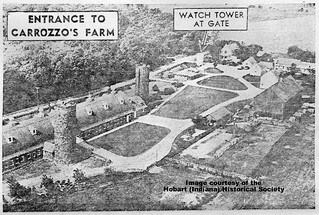
Entrance to Carrozzo farm
(Click on image to enlarge)
From the Chicago Daily Tribune, date unknown.


This photo isn't clear enough to see the details of the "watch tower" for comparison, but notice its location with respect to the other outbuildings, especially the barn towards the right edge of the picture. Whatever purpose it served, I think we may be looking at the same structure in both pictures.

Tuesday, January 7, 2014

Friendless

Even knowing that he grew up to be a cold-blooded murderer, I can't help feeling sorry for the eight-year-old Richard Chapman, sent away from his foster home in the winter of 1921:

Dunhams send Richard away
(Click on image to enlarge)
From the Hobart News, 24 Feb. 1921.


I haven't heard of any illness or other trouble that would make Louis and Gertrude Dunham unable to care for the boy. The problem may have been that they were at their wits' end in trying to deal with his behavioral problems; years later, Louis would testify in court about Richard's "early tendencies toward crime and his peculiarities."

I do not know exactly where this "Home of the Friendless" was, as that name was not uncommon for charitable institutions. A 1905 Chicago directory of such homes mentions two with "Home for the Friendless" in their names, and Chicago was a convenient distance.

Anyway, with Richard gone on Friday, he could not be blamed for the vandalism at the school the next Monday. From the wording of that news item, I get the impression that there might have been specific suspects for that and the earlier crime.

Monday, January 6, 2014

The Secret Lake of Ainsworth Road

From the steamer trunk.

This spring-fed lake didn't used to be such a secret; this photo (probably dating to the 1920s or early 1930s) shows it lying amidst open fields.

Secret lake 1
(Click on images to enlarge)
Images courtesy of E.H.


Nowadays, it's screened by grown trees. You can see part of it from the road if you know where to look, and you can see it in satellite images on-line.

The photo below may have been taken a little later (in the 1930s?), as here the lake's surroundings look slightly more grown-up — or perhaps it's just the angle of the shot.

Secret lake 2

I don't know whose barn that is in the background.

At the time these photos were taken, the lake was on the Harms farm, lying northeast of the house. Herman Harms, Sr. kept the lake stocked with fish, and rented boats to people who wanted to fish on it. That brought in a little money for the family.

Sunday, January 5, 2014

Shearer & Son

Shearer & Emery ad for coal
(Click on images to enlarge)
Who knew there were so many kinds of coal? (Ad from Hobart Gazette 14 Jan. 1921.)


Shearer & Son announcement
From the Hobart News 24 Feb. 1921.

Paul Emery, as you may remember, married Bliss Shearer in 1915, so the firm had been, in effect, Shearer & Son-in-Law. It was just losing the "in-law."

Scharbach ad for coal
The competition.
(Ad from the Hobart Gazette 4 Feb. 1921.)


♦    ♦    ♦

Speaking of things that are almost indistinguishable, the Gem Theater would be hosting an ambitious demonstration — live music v. recording.

Is it live or is it Edison? demo
From the Hobart News 24 Feb. 1921.

Could an audience of 1921 really not hear any difference between a live performance and an Edison Chippendale phonograph?

(The "Mr. Tilford" who was kind enough to lend his phonograph for the occasion was probably Thomas Tilford, described in the 1920 Census as a 56-year-old railroad lineman.)

Saturday, January 4, 2014

Schmidt's: Good Food Served Right

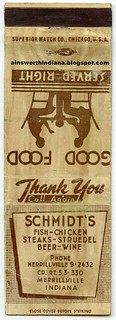
Bought ages ago but just recently unearthed from the mess on my desk, a matchbook cover from Schmidt's in Merrillville:

Schmidt's matchbook cover
(Click on image to enlarge)

Per the description, it was at the intersection of Broadway and 73rd Avenue. Anybody remember exactly where?

♦    ♦    ♦

[1/6/2014 update] Mystery solved thanks to Steve S., who sent this information and image:
Attached is a photo of Schmidt's Restaurant location. This current building is still standing just west of Broadway and has been converted to apartments. In the early '60s I remember Schmidts also had a 2 (or 4?) lane manual bowling alley operated by pinboys. The restaurant and bowling alley lasted until 'Merri-Bowl' opening at 7610 Broadway.

Schmidts
(Click on image to enlarge)

Friday, January 3, 2014

A Bloody Night at the Opera House

Not only did the Strattan Opera House hold a big boxing match in February 1921, but ladies attended, and none of them fainted!

This event's connection to the American Legion post lent it an air of respectability, with such upstanding citizens (and military veterans) as Dr. Dwight Mackey and Carl Krausse conducting the proceedings.

Boxing in the Strattan Opera House
(Click on image to enlarge)
From the Hobart Gazette, 18 Feb. 1921.

Thursday, January 2, 2014

Aunt Larson's Other Awesome Dress

From Mildred Lindborg's photo album.

52a Anna and Aunt Larson
(Click on image to enlarge)
Image courtesy of N.B.


No caption, no date. Fortunately we recognize these two: at left, Anna Lindborg; at right, Aunt Larson, wearing a variation on the winged skirt.

That building behind them looks like the one behind the smiling Gust.