
John Chester's pool-room venture did not last long after that very public squabble with his landlady. In mid-December came the announcement that John had purchased the Main Street garage business of Dale Taylor. Immediately afterward, he closed the pool room "to devote his entire attention to the garage business." He continued to run a livery or taxi service out of this garage (we find a taxi driver employed by John getting into a wreck in March 1916).
Charles Bradley, a machinist who operated a shop in the rear of the garage, said he intended to continue doing auto repairs there, as he had for the last six months. But in early January 1916 he moved out. That doesn't necessarily mean he couldn't stand John; it may have been simply a case of rising ambition, as he immediately opened his own shop on north Center Street, offering auto repairs and selling gasoline and tires.
Emma Chester fell ill at the time of John's purchase of the garage, but I suppose that was just coincidence.
We'll see how long this venture lasts.
Sources:
♦ "Chas. F. Bradley Opens Garage and Auto Repair Shop." Hobart News 6 Jan. 1916.
♦ "Local Drifts." Hobart Gazette 24 Dec. 1915; 7 Jan. 1916.
♦ "Personal and Local Mention." Hobart News 23 Dec. 1915; 23 Mar. 1916.
♦ "Sells Garage." Hobart Gazette 17 Dec. 1915.
Monday, October 18, 2010

Sunday, October 17, 2010
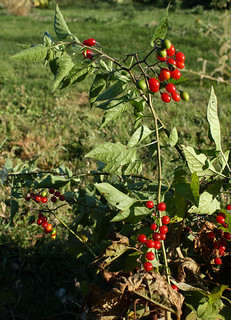
Bittersweet Nightshade Berries
(Random Pointless Photo)
(Click on image to enlarge)
I'm sure you've all been wondering what bittersweet nightshade berries look like when they're ripe. Now you know. Remember, they're only "somewhat poisonous."
Saved by His Gut
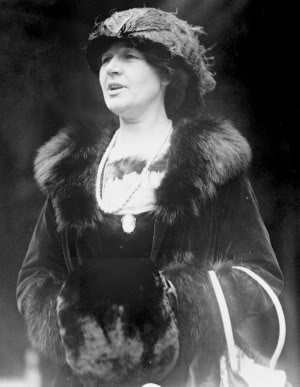
An unknown woman of respectable appearance, in early 20th century fashions, carrying a muff.
Image credit: National Photo Company Collection/Library of Congress, Washington, D.C. (Digital File Number: cph 3c12574)
I used to devour true-crime books like candy and now do the same to judge shows, which means I've seen case after case of people walking into trouble with their eyes wide shut ("But I trusted him!") — which has caused me to develop a keen appreciation for those rare stories where someone's gut instinct alerts them to a problem before they become a victim and they actually heed their instinct.
Just such a case happened in Hobart in November 1915.
On Thanksgiving Day, a couple of strangers arrived in town. They registered at the Hobart House as man and wife; since the newspapers don't report what name they gave, let's just call them Mr. and Mrs. Skinner. Their manner was genteel, their appearance prosperous. They were from Utah, they said, but were traveling, and had just arrived from Chicago. Now they wanted to buy a small touring car to continue their journey and would be glad to hear of anyone in town interested in selling such a vehicle.
They were told that Paul Newman, who kept a garage, sold cars. They came to see him, asking for a new Ford. He had none in stock. But one of his patrons, Thomas Ingram, kept a used Ford touring car there that he was willing to part with. The Skinners got in touch with Mr. Ingram, and on Friday the parties came together to negotiate.
Once they had settled on the price, the Skinners explained that they did not have sufficient cash on hand to pay the full amount. Since they were due in Laporte that evening, they wanted to take the car immediately, so they proposed giving Mr. Ingram a 60-day promissory note along with something of value as security — for instance, the two diamond rings that Mrs. Skinner wore, worth $400 each. Mr. Ingram consented on the condition that the diamonds be determined by a jeweler to be genuine.
So the little party walked over to the Dell F. Beach jewelry store, Mrs. Skinner's ring-bedecked hands snuggling inside the muff she carried for protection from the chilly November air. Once in the store, Mrs. Skinner took off the rings and gave them to Mr. Beach. He examined the diamonds carefully and pronounced them genuine. He handed the rings back to Mrs. Skinner, who put them back on.
Now the Skinners had their own request: they wanted the rings held in safekeeping at a local bank. The three of them agreed upon the American Trust & Savings Bank. As the group walked out of the Beach jewelry store to go to the bank, Mrs. Skinner again slipped her hands into her muff. At the bank, she surrendered her rings, and a cashier placed them in the vault.
All that remained was to go to the Newman garage where Mr. Ingram kept his car, and fill out the paperwork to transfer ownership.
On the walk to the garage, and as he set about with the paperwork, Mr. Ingram found himself increasingly uneasy. The memory of that seemingly insignificant gesture just outside the Beach jewelry store — Mrs. Skinner's hands, with the rings on her fingers, disappearing into her muff — kept intruding into his mind, or rather, into his gut. He couldn't shake the feeling that something was wrong. It occurred to him that a switch might have happened under cover of that muff, and that the rings now safely stowed away in the bank vault were not the rings that Mr. Beach had pronounced genuine. At the same time, it seems, Mr. Ingram did not feel sure enough to make an outright accusation against such a respectable-looking couple. But after a few words privately with Mr. Newman, who advised him to be careful, his made up his mind. Abruptly he announced that he didn't want to go through with the deal; he'd keep his car, give back the promissory note, and the Skinners could go retrieve their rings.
The couple quietly left the garage. Sometime on Friday night they quietly left town as well, in a car, apparently their own, which they had "planted" somewhere in town.
If Mr. Ingram needed confirmation of his suspicions, he got it the next Wednesday when a report turned up in a Chicago paper of just such a con game having been attempted in Elgin, Illinois. The description of the couple involved and their technique of substituting phony diamond rings for real ones was so similar to his experience that he had to believe it was his own Skinners. The Elgin attempt ended with the arrest of the couple. To the police they gave their names as M. Randall and Mrs. Fern Hiller, she being allegedly recognized as a well known diamond thief. Among the couple's personal effects the police found promissory notes for three other autos that had been successfully "purchased" by the same technique.
Marshal Fred Rose lamented that he hadn't been alerted at the first suspicion — he felt sure that he could have collared the thieves. But at least Mr. Ingram's gut saved him from the being skinned.
Sources:
♦ "Diamond Swindlers Couldn't Pull Their Game in Hobart." Hobart News 2 Dec. 1915.
♦ "Diamonds for an Auto." Hobart Gazette 3 Dec. 1915.
Saturday, October 16, 2010
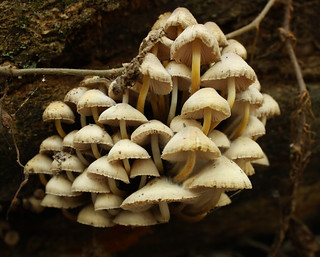
Wild Mushrooms of Ainsworth: Common Mycena
(Click on image to enlarge)
Found on a fallen tree in Deep River County Park.
We've had such a long spell of dry weather that I can lie flat on my stomach on the forest floor to get a shot like this, without getting all wet and muddy.
Lovisa Quits Farming
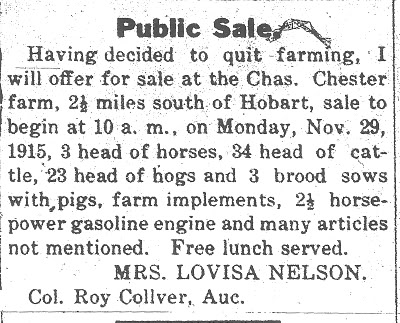
In the Hobart News of November 25, 1915, Lovisa Chester Nelson announced that she was retiring from farming.
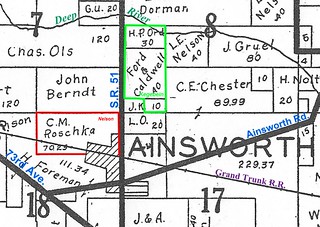
I think the land that Lovisa farmed is the parcel shown as belonging to her sister, Carrie Raschka, in the 1926 Plat Book:
(Click on image to enlarge)
The 1891 Plat Book shows that same parcel as the property of "H. Chester," and who could that be but their father, Henry? So its being in 1915 in the hands of his son Charles makes sense.
You're probably wondering why I outlined that other parcel, marked "Kegebein," on that map. (That's rhetoric. I know you don't care, but I'm going to tell you anyway.) I did that because early in 1916, we come upon this little news item: "Albert Witt moved [on January 26] to the Chas. Chester farm, and Glen Nelson moved to the Kegebein farm, both exchanging farms."
Oh, you crazy guys! The grass is always greener on the other side of State Road 51, isn't it?
Perhaps I was wrong about where Glen and Elsie were running a dairy in 1920; perhaps it was the Kegebein farm; but there are four more years until the 1920 census, plenty of time for more farm-switching.
In February, Glen and Elsie had a little boy — Lovisa's first grandson. Evidently something went wrong: although the baby was delivered at home, the following day Elsie had to be taken to Gary General Hospital.
Sources:
♦ 1891 Plat Book.
♦ 1926 Plat Book.
♦ "Additional Local." Hobart News 10 Feb. 1916.
♦ "Personal and Local Mention." Hobart News 27 Jan. 1916.
♦ "Public Sale." Hobart News 25 Nov. 1915.
I think the land that Lovisa farmed is the parcel shown as belonging to her sister, Carrie Raschka, in the 1926 Plat Book:
(Click on image to enlarge)
The 1891 Plat Book shows that same parcel as the property of "H. Chester," and who could that be but their father, Henry? So its being in 1915 in the hands of his son Charles makes sense.
You're probably wondering why I outlined that other parcel, marked "Kegebein," on that map. (That's rhetoric. I know you don't care, but I'm going to tell you anyway.) I did that because early in 1916, we come upon this little news item: "Albert Witt moved [on January 26] to the Chas. Chester farm, and Glen Nelson moved to the Kegebein farm, both exchanging farms."
Oh, you crazy guys! The grass is always greener on the other side of State Road 51, isn't it?
Perhaps I was wrong about where Glen and Elsie were running a dairy in 1920; perhaps it was the Kegebein farm; but there are four more years until the 1920 census, plenty of time for more farm-switching.
In February, Glen and Elsie had a little boy — Lovisa's first grandson. Evidently something went wrong: although the baby was delivered at home, the following day Elsie had to be taken to Gary General Hospital.
Sources:
♦ 1891 Plat Book.
♦ 1926 Plat Book.
♦ "Additional Local." Hobart News 10 Feb. 1916.
♦ "Personal and Local Mention." Hobart News 27 Jan. 1916.
♦ "Public Sale." Hobart News 25 Nov. 1915.
Friday, October 15, 2010
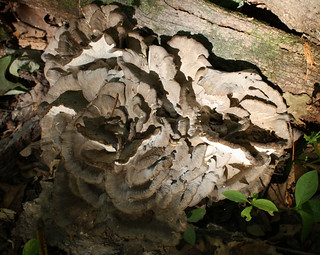
Wild Mushrooms of Ainsworth: Vase Thelephore
(Click on image to enlarge)
Found in Deep River County Park in the neighborhood of the Jack O'Lanterns.
My mushroom guide has no edibility information on this one, which means no one knows if this thing is poisonous or not. "Do not experiment," the guide says. Well, how else are we going to find out? … But, mind you, I'm not volunteering.
Hobart Then and Now: Downtown from the North
Circa 1908 and 2010.


(Click on images to enlarge)
I can't figure out exactly where the 1908 photographer stood. Has the angle at which Main Street connects to the bridge changed since 1908? And then there are all those trees nowadays; you can't see Hobart for the trees.
In the 1908 picture, at the right edge is the old mill. The next structure I can identify is the steepled church, which must be the Evangelical Lutheran Church. The little x marks (I believe) the Hobart House (see reverse of postcard below). Just to the left of that, I think we're looking at the Strattan Opera House superstructure. I don't know what any of those other buildings are.
Here's the reverse of the postcard:

Someone later did a colorized version of the same scene, which I've got on a postcard postmarked 1915.


(Click on images to enlarge)
I can't figure out exactly where the 1908 photographer stood. Has the angle at which Main Street connects to the bridge changed since 1908? And then there are all those trees nowadays; you can't see Hobart for the trees.
In the 1908 picture, at the right edge is the old mill. The next structure I can identify is the steepled church, which must be the Evangelical Lutheran Church. The little x marks (I believe) the Hobart House (see reverse of postcard below). Just to the left of that, I think we're looking at the Strattan Opera House superstructure. I don't know what any of those other buildings are.
Here's the reverse of the postcard:
Someone later did a colorized version of the same scene, which I've got on a postcard postmarked 1915.
Subscribe to:
Posts (Atom)

