Tuesday, September 22, 2026

Stoltz 1941 Advertising Novelty

Let me end my Stoltz obsession with this photo of an advertising novelty with a 1941 calendar, on display at the Merrillville History Museum:

2026-09-22. Stoltz advertising novelty 1941
(Click on image to enlarge)

I suppose, after all, there was no particular story behind the 1911 plate. The Stoltzes just handed out calendar things in the hope that people would consult and calendar and be reminded of the store.

Sunday, September 20, 2026

Stoltz Family Stories: The Tragedy

While searching in the online newspapers for any explanation of 1911 plate from the John Stoltz store of Merrillville, I came across a story of a 1914 tragedy that devastated another branch of the Stoltz family.

It's odd that I was shocked to find that story. I must have seen it before: it was reported on by both of the Hobart newspapers, which I had read on microfilm long ago. Not only did I neglect the story the first time, I forgot I that my eyes had ever swept over it. The fallibility of human memory is a topic that comes up sometimes in this blog, and I have to say that my own memory heads the list of the fallible.

But let us proceed.

Among John Stoltz's many siblings was an older brother, Joseph, born in Illinois (like John) in 1868. By the time we catch up with Joseph in the 1880 Census, with the family living in Hammond, he was 12 years old and already gainfully employed. In what capacity, the census doesn't say; I hope he wasn't working in the slaughterhouse with his father.

In February 1891, Joseph married Mary Diedrich, and the young couple quickly started a family. In the 1900 Census, they were the parents of five children, four of whom were still living. Joseph described himself as an "express man." Trying to find out exactly what that meant took me on a side trek and I'm still not sure exactly what his job entailed. But evidently it didn't pay a great deal, as the household included two boarders.

Joseph and Mary lived more quietly than his brother John, so I'm not sure when they moved their family from Hammond to rural Ross Township. But that is where we find them in the 1910 Census. They were farmers, not storekeepers. Their rented farm appears to have been south of Merrillville (to judge by those of their neighbors who were not also renting). The household included seven children: Daniel (15), Cora (13), Margaret (9), Philomena (6), Fredrick (4), and Theresa (1); their oldest daughter, 17-year-old Katherine, is not listed with them (which may be a mistake by the enumerator).

A couple years after the census, Joseph's mother, Elizabeth — widowed in 1899 — came to live with them.

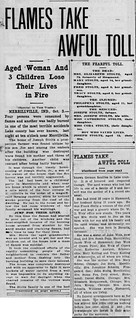
On October 2, 1914, tragedy struck the family.

2026-09-20. 1914-10-03. Flames Take Awful Toll, Lake County Times (Hammond, Ind.), 3 Oct. 1914
(Click on image to enlarge)
Lake County Times (Hammond, Ind.), 3 Oct. 1914.


The reference to "Tracy Stoltz, aged 6," is to little Theresa, who was one year old in the 1910 census.

Two days later, the Times reported on the funerals and burials of the victims.

2026-09-20. 1914-10-05. Bury All in One Coffin, Lake County Times p. 1
(Click on image to enlarge)
Lake County Times (Hammond, Ind.), 5 Oct. 1914.


Besides adding some heart-rending details, the article mentions a "passing Chicago autoist." Some days later, he and his wife, who also helped, were identified:

2026-09-20. 1914-10-15 Jess Nichols Proves Himself to Be Real Hero, North Judson News, p. 1
(Click on image to enlarge)
North Judson News, 15 Oct. 1914.


As mentioned in the October 5 article, all the children were buried in SS. Peter and Paul Cemetery. Their entry on FindAGrave does not include a photo of a grave marker; nor does NWIGS' Ross Township Cemeteries note their grave in its listing, so it may be unmarked.

The grandmother, Elizabeth Weis Stoltz, is buried in Hammond.

♦    ♦    ♦

The exact location of the Stoltz farmhouse is unclear. The family was probably still on rented land. One of the newspaper articles describes the house as "about a quarter of a mile south of the four corners in Merrillville" — the "four corners" being the intersection of 73rd and Madison. That would translate to a bit south of the intersection of 75th and Madison, which means Section 16, or Section 21 if the article's writer underestimated the distance south from the "four corners."

If we look at the 1908 Plat Map, we find some interesting names on the east side of Madison in Section 16, and just below its southern boundary:

2026-09-20. Section 16, Twp. 35 N and surrounding, 1908
(Click on image to enlarge)

Andrew Popp was Elizabeth Weis Stoltz's brother-in-law. And her own brother, John Weis, was among the "et al." in the "Elizabeth Weis et al." who owned 120 acres south of the Popp land. (John and Elizabeth Weis were the parents of Michael, whom we met in my previous post as the manager of the Marion Pierce store that preceded the Stoltz store.) It seems likely to me that the Stoltz family would rent land from relatives. However, according to A Pictorial History of Merrillville, both the Popp home and the Weis home were (and still are) the original structures — there is no mention of either burning in 1914.[1] There may have been another house on the land, or the Stoltzes may have rented on the west side of Madison. In short, I don't know the location of the farmhouse that burned.

Nor do I know where the surviving family lived after the loss of their rented home. The 1920 Census shows them living in their own home in Merrillville. It was probably a home in town, or close to town with a much smaller lot, as the 1926 Plat Book doesn't show any parcel belonging to them. Joseph was no longer farming; he had gotten work in the steel mills. The family was again taking in boarders.

♦    ♦    ♦

At the Merrillville History Museum is a three-ring binder full of notes that we believe were gathered through interviews conducted by Jan Clemens (and any helpers she may have had) in the mid-1970s in preparation for writing A Pictorial History of Merrillville. The 1914 Stoltz tragedy is not mentioned in A Pictorial History, but it is mentioned in the notes in the three-ring binder, along with another tragedy in the family.

2026-09-20. p. 200 Geneology Notes 1970s
(Click on images to enlarge)
Images courtesy of the Merrillville-Ross Township Historical Society.


2026-09-20. p. 201 Geneology Notes 1970s-201

2026-09-20. p. 202 Geneology Notes 1970s-202

I think there were two interviewees, one of whom comes in on the third page with only a few lines. The first interviewee, covering the first two pages plus the top of the third, is surprisingly familiar with the tragedy some 60 years after it happened, naming all the young victims of the fire.

There is one odd detail in the story — the house that burned is described as "the old cheese factory." Now, among the people who run the Merrillville-Ross Township Historical Society, the old cheese factory in Merrillville is thought to be still standing at 7200 Madison Street. According to A Pictorial History, that house/cheese factory was built in 1880 to replace an earlier cheese factory on Walter Avenue. (The county records give it a build date of 1900, which is often a way of saying, "We don't know the exact year, but it was a long time ago.") The only other cheese factory mentioned in A Pictorial History was one built in 1855 by Dudley Merrill along 73rd Avenue — that one was donated to the Methodist Church's Ladies Aid Society by Charles Merrill (1850-1913).

So, was the interviewee confused, or was there yet another cheese factory south of Merrillville that has been lost to memory?

The second interviewee has only a few remarks on the tragedy: "Grandmother [Mary Diedrich Stoltz?] had to jump out the window; broke both ear drums — stone deaf. Spark from train set house on fire." Although the Times article of October 5, 1914, describes the house as one story high, I suppose a fall from a first-story window could rupture eardrums. The detail about the fire's originating with a spark from a train is more confusing — there were no train tracks between 73rd and (present-day) U.S. 30, so if the newspapers were correct about the Stoltz house being south of Merrillville, this detail could not be true. The "old cheese factory" house was close to train tracks, but it (so far as we know) never burned.

Could the second interviewee's memory have been shaded somehow by that other family tragedy mentioned on the first page of notes — Mary Stoltz's death on the C&O train tracks?

2026-09-20. 1943-09-24 Deaf Woman Hit, Killed by Train, Hammond Times
(Click on image to enlarge)
Hammond Times, 24 Sept. 1943.


It's interesting how this event is retold by the first interviewee in the 1970s notes:
Mary … was killed by a train while walking from Walter Demmon's grocery store. She used to walk on the railroad track to the store…..they had a path worn from their house to the store…..she had thought about stopping to visit next to the store but changed her mind and decided to take the short-cut home.
How on earth could anyone have known what she was thinking in those last minutes before she was killed?


It is just possible, of course, that the odd details in these retellings resulted from confusion on the part of the note-taker!


_______________
[1] Per the county assessor's records, both the Popp home (7489 Madison), and what I believe to be the Weis home (7883 Madison) were built in 1870. Build dates in the 19th century are often approximations. Incidentally, A Pictorial History does not give an address for the Weis home, but says that it is south of U.S. 30; I believe this to be an error. No plat map shows John and Elizabeth Weis owning any land south of what is now U.S. 30.

Thursday, September 10, 2026

Stoltz Family Stories: The Merrillville Store

This 1911 calendar plate was recently donated to the Merrillville-Ross Township Historical Society museum.

2026-09-10. Stoltz plate
(Click on image to enlarge)

I started looking into the newspapers of the time to figure out if this plate marked any special occasion, or if the Stoltz store was simply in the habit of handing out yearly promotional items, as this might have been. I didn't find the answer, but I did find some stories that I had previously overlooked.

Many years ago I posted a brief history of the Stoltz store in Merrillville. I was relying on A Pictorial History of Merrillville, which seems to be largely based on oral history — in other words, human memory. As so often happens, memory got it close but not 100% correct.

Memory was off by only a couple of years regarding the year when the store at 40 W. 73rd Avenue was built — it was not 1905, as per A Pictorial History, but 1907. The project started in July 1906 with the destruction by fire of the building that previously stood there:

2026-09-10. 1906-07-03 Lake County Times (Hammond, Ind.), Business Section Burning, p. 1
(Click on image to enlarge)
Lake County Times (Hammond, Ind.), 3 July 1906, p. 1


That earlier store may have been built circa 1860: that is the build date listed for the current structure in the Lake County assessor's records, which apparently were not updated to reflect the fire. Perhaps the destruction was not complete enough.

Mike Weis had been born around 1873 to immigrant parents, John and Elizabeth, who spent some time in St. John Township before relocating to Ross Township around the time of the Civil War. In 1902 Mike had married Elizabeth Gerlach.

The "Weis" store, we soon learn, was actually owned by Marion F. Pierce:

2026-09-10. 1906-07-19 To Rebuild Merrillville Store, Lake County Times (Hammond, Ind.), p. 1
(Click on image to enlarge)

Marion gave his occupation for the 1900 Census as "general merchant." Writing in 1904, T.H. Ball described him as a "merchant and well-known business man of Merrillville, Ross township, [and] one of the oldest native sons of Lake county still engaged in the active pursuits of life. Three generations of the Pierce family have been identified with the industrial and commercial affairs of the county, covering a period of seventy years…"[1]

Mike Weis' health, incidentally, was a serious matter. He had tuberculosis. His visit to Rome City may have involved the Kneipps Springs sanatorium, but he did not find a cure there. After relocating to St. John, he and his family went to New Mexico and Texas, probably in search of a climate cure that failed to materialize. They were on their way back to St. John when Mike died in Topeka, Kansas, on April 3, 1910.[2]

But to return to the store: by April 1907, Carl Gerlach had purchased the land from Marion F. Pierce and announced his plan to rebuild the store, possibly in partnership with John Stoltz.

2026-09-10. 1907-04-10 Carl Gerlach Will Build Store in Merrillville, Lake County Times (Hammond, Ind.), p. 1
(Click on image to enlarge)
Lake County Times (Hammond, Ind.), 10 Apr. 1907, p. 1.


Carl Gerlach, born in St. John in 1887, was one of a large family. Among his sisters were Elizabeth Weis (Mike's wife) and Margaret Stoltz, wife of John Stoltz. So there were family connections around the store, even before the original one burned.

John Stoltz's parents were Gottfried Franciscus ("Frank") and Elizabeth, both German (or Prussian) by birth but U.S. residents from childhood. Frank Stoltz served in the Civil War, then came home and married Elizabeth Weis (yet another family connection to the store?). The family moved around a bit between Illinois and Indiana, then settled in Hammond, where Frank worked in the slaughterhouse (1880 Census). With the 1890 census missing and John Stoltz unidentifiable in the 1900 census, I don't know exactly what he was doing in his early adulthood.[3] He married Margaret Gerlach in the summer of 1900. They lived in Hammond, as we can gather from a few Hammond social-column items from 1906 into early 1907. His story, as far as we can tell it, starts in 1907 with the proposed new store in Merrillville.

The new store was completed in May 1907.[4] Per this social column, by September 1907 John Stoltz had become "the merchant" to Merrillville, and Margaret was part of Merrillville's social news.

2026-09-10. 1907-09-14 Lake County Times (Hammond, Ind.), p. 6
(Click on image to enlarge)
Lake County Times (Hammond, Ind.), 14 Sept. 1907, p. 6.


According to A Pictorial History: "Business was good but the operation was not profitable enough to support two families, so John and Margaret bought her brother [Carl Gerlach] out …." The buyout happened only a few months after the store's opening — by August 1907.[5] Carl moved to St. John; the 1910 Census finds him there, working as a salesman for a general store.

The Stoltz store was a Merrillville fixture for decades. My earlier post gives an outline of its subsequent history per A Pictorial History, and I'm not going to double-check all the dates because the Stoltz store is not really what I came in here to talk about! — that is another story I came across while researching the 1911 plate that started this whole thing. But it will have to wait for another post, because I have worn myself out with this origin story.


_______________
[1] Lake County Encyclopedia, p. 218. See also his entry in Alice Flora Smedstad's Soldiers & Veterans Memorialized at the Merrillville Cemetery, pp. 40-41.
[2] "Death of Mr. Weis," Lake County Times (Hammond, Ind.), 6 Apr. 1910, p. 6; "Funeral of Mr. Weis," Lake County Times (Hammond, Ind.), 8 Apr. 1910, p. 1.
[3] Per a Hammond directory of 1891-92, he might have been working for the "C&E Ry" (Hammond, IN, 1891-92. Hammond, IN, USA: Frank E. Gero, 1891, via Ancestry.com).
[4] "St. Johns News," Lake County Times (Hammond, Ind.), 8 May 1907.
[5] "It is reported that Carl Gerlach has sold his interest in the new store to his partner, John Stultz." "Merrillville News," Lake County Times (Hammond, Ind.), 1 Aug. 1907.

Monday, September 7, 2026

Dogs in Cemeteries, Part II

Another addition to my collection. Yesterday I was helping to clean up the storm-related damage in Ross Cemetery when I came across this lovely grave marker:

2026-09-07. Michael Cash marker with doggie
(Click on images to enlarge)

2026-09-07. Michael Cash doggie

In this case we find an explanation of the dog statuette in Mr. Cash's FindAGrave entry. It memorializes his bond with Lady and Brittany.

♦    ♦    ♦

I was glad I had the opportunity to be part of the clean-up effort at the cemetery. (Most Sunday afternoons I spend in the Merrillville-Ross Township Historical Society museum, but the museum was closed for the Labor Day weekend.) Ross Cemetery is a beautiful and serene place, like a nature preserve, with the added interest of history all around you. Volunteers will be meeting there every Sunday from 2 to 4 p.m. for as long as it takes to clean up the storm damage.

Thursday, September 3, 2026

Unidentified Pugnacious Teenager

Another entry into our growing collection of teenagers who managed to get through the eighth grade, or through catechism classes, but didn't appreciate having to get photographed for the occasion.

This one looks as if she intends to hurt somebody once this is all over.

2026-09-03. Unidentified teenage girl - 8th grade graduation or confirmation – Showman's Gallery - 1893-1898
(Click on image to enlarge)

Since the photo was taken at Showman's Gallery, we can date it somewhere between about 1893 and 1898.

She is standing in front of the same painted backdrop as the teenage zombie linked above. I wonder if they were in the same class? How often did Showman refresh his painted backdrops?

Wednesday, August 26, 2026

Female Zabulon Skipper

I think I finally found a female Zabulon skipper to match the male I found eight years ago. Time flies like a skipper, doesn't it?

2026-08-26. Zabulon skipper 01
(Click on images to enlarge)

2026-08-26. Zabulon skipper 02

♦    ♦    ♦

Bonus shot of buckwheat — real buckwheat, not climbing false buckwheat.

2026-08-26. Buckwheat 01

2026-08-26. Buckwheat 02

2026-08-26. Buckwheat 03

It volunteered under one of my bird feeders. The birdseed mix I use must include buckwheat seeds. It's pretty, but it's not native.

I'm still too busy and tired to do any real posting.

Friday, August 14, 2026

[Formerly] Unidentified People with Food ca. 1962

[8/19/2026 update: the people in the photo have been identified, at least tentatively. Left to right: Ralph Kennedy, Dick Boyd(?), Dwight Mathis, Chief of Police William McGinn, and Officer Dick Raiza. My thanks to Suzi Schnabel Emig and Barbara Phillips Rowley.]


All the good people who have been sharing food in the wake of the August 11 derecho/tornadoes made me think of this photo.

2026-08-14. Unidentified people with food
(Click on image to enlarge)

There are no notes on the back to tell us who these people are or what sort of event this was. But this photo was one of three that I recently bought as a package, and the other two pertain to the Hobart Police Department and date to the early 1960s, so this one likely does too. Not to mention the uniformed officer at right, and the fashions.

No reason to believe it involved a disaster, though.

♦    ♦    ♦

[further update] While searching for Chief McGinn's first name, I came across this article from the Hammond Times of June 26, 1963, which teaches us that if we're going to try to start a bookie operation, we should not order five telephones all at once.

2026-08-14. 1963-06-26 Hobart Bookie Nabbed, Hammond Times, p. 20
(Click on image to enlarge)

Friday, July 31, 2026

Milkweed Leaf Beetle Larva

Since I'm too busy to write about anything that requires research, here's some bug pictures.

2026-07-31. Milkweed leaf beetle larva 02
(Click on images to enlarge)

2026-07-31. Milkweed leaf beetle larva 03

2026-07-31. Milkweed leaf beetle larva 04

This ugly little guy will eventually become less ugly.

I have only just learned about Mullerian mimicry and Batesian mimicry. The adult Milkweed Leaf Beetle is an example of the former: it shares the vivid orange-and-black coloring of several insect species that hang around on milkweeds and are toxic to predators. Milkweed Leaf Beetles, Milkweed Bugs, Monarch butterflies, etc. — they all have the same color scheme, and they will all give a bird an upset stomach. In the case of Batesian mimicry, a non-toxic species adopts the coloring of a toxic one to "borrow" protection from predators.

There, now you have some information to bore people with at parties.

In conclusion, if you would like to see some pictures of "frolicking" insects on milkweed, go here. I appreciate this guy's sense of humor.

Friday, July 24, 2026

Dogs in Cemeteries

Today we have two tales of dogs in cemeteries.

The first comes from the "Local Drifts" column of the Hobart Gazette of February 22, 1924:
An incident of "dog faithfulness" is told of the pet dog of the late Wm. Kruse, who was buried Feb. 3 in the Hobart cemetery. The dog remains almost constantly upon the grave, departing only when forced to go to his master's late home for something to eat.
I previously wrote about William Kruse's death. I suppose it was the kind housekeeper, Emma Dunn, who was feeding the dog.

♦    ♦    ♦

The second dog in a cemetery came to my attention through a Facebook post by Michael White about one of his recent visits to some historical places in northwest Indiana. The post included some photos taken in Adams Cemetery, in Morgan Township, Porter County.

2026-07-24. Dog statuette in Adams Cemetery 01
(Click on images to enlarge)
Images courtesy of Michael White.


As a dog person, I was charmed by this little cast-stone canine, but also mystified: surely there could not be a dog buried in a human cemetery?

The dog statuette is near the grave of John B. Covert.

2026-07-24. Dog statuette in Adams Cemetery 02

That does not necessarily mean it has anything to do with Mr. Covert, or even that the statuette is now in the spot where it was originally placed.[1]

I went looking online for anything that could explain the presence of the dog. The only thing I could find involving both the Covert name and a dog is this story from the Valparaiso Vidette-Messenger of September 6, 1949:

2026-07-24. Valparaiso-Vidette-Messenger-September,6-1949-p-3
(Click on image to enlarge)

But, again, this canine WWII veteran could not be buried in the Adams Cemetery. Wilford Covert is not buried there, either; his grave is in Portland, Oregon.

Wilford and John Covert were cousins of some degree — Jeremiah Covert (1829-1906) was John's grandfather and Wilford's great-grandfather, if I'm reading the family trees on Ancestry.com correctly.

Maybe the Coverts in general were dog lovers. Maybe the statuette was indeed intended for John, to honor a beloved dog he had lost or left behind. Or maybe the statuette has wandered from its original placement and has nothing to do with the Coverts.

"Maybe" all kinds of things, right? I could sit here all day and think of possible explanations, and still not be close to the truth. I hope it has not been lost to time. I hope someone out there knows the story of this little sleeping dog.

_______________
[1] Recall my then-and-now post of the Chester Cemetery where in one case I could not produce a definite "now" because the arrangement of the old stones had seemingly changed so much since 1963.

Monday, July 13, 2026

Just In Case You Want Some Bricks

2026-07-13. Kulage postcard 1
(Click on images to enlarge)

2026-07-13. Kulage postcard 2


I'm guessing maybe this thing was handed out by salesmen calling on prospective clients?

As we know, the Kulage Brick Works operated for about 30 years, starting circa 1892[1] and ending sometime during the 1920s. I previously posted about the brickyard's being indefinitely shut down in 1921, but I don't know if that was the end of it.[2]

The one-cent McKinley postage stamp tells us that the postcard must date to 1902 or later, since a president must be dead for at least a year before appearing on a postage stamp. [7/16/2026 update: the stamp dates to 1907 or later; see the comments to this post.] I have found an Ebay listing for such a postcard with a 1910 postmark; another listing elsewhere dates an unused postcard ca. 1907. But I can't find any information about when this particular stamp stopped being used.[3]

_______________
[1] I previously posted a 1919 article stating that Otto Kulage "purchased the plant about twenty-seven years ago," i.e., 1892.
[2] Notes on the back of some photos at the Hobart Historical Society give the approximate starting and ending dates as 1885 to 1925-26. Per the 1919 article cited above, the brickyard was already operating when Otto Kulage bought it and gave it his name.
[3] A history of postage rates for postcards can be found here.

Wednesday, July 8, 2026

What Happened to Lillian

This doesn't concern Ainsworth, but it concerns the Ainsworth historian.

When I was 16 or 17, I bought a little 1883 diary … somewhere. I think it was in Michigan, where I was in the habit of buying antique items on family vacations; but it may have been on a trip to New England. I wish I could remember, because this 1883 diary came from New York, and if it ended up in Michigan, how it got there would be an interesting puzzle to solve.

2026-07-08. Diary 001 - cover
(Click on images to enlarge)

The diary itself presents a mystery. Its writer is the teenaged Lillian Todd, who lives in Penn Yan, New York.

2026-07-08. Diary 002 - inscription

Her entries run from January 1 to October 4, 1883. As the months go by, her handwriting gradually deteriorates from a delicate, controlled script to a blotted scrawl. Compare her first entries …

2026-07-08. Diary 1883-01-01

… to her last:

2026-07-08. Diary 1883-10-04

The diary is clear on one point: Lillian is not well. She is tired all the time; she can't do the things she used to; she is headachy, irritable and nervous. She takes some unnamed medicine on a daily basis, while friends and relatives send her recipes for home remedies. She alludes to some serious illness that happened before the diary opened, perhaps the previous autumn. "I have felt real well today. How good it would be to be entirely well again. I little thought I would be sick so long …" (Jan. 15); "I made a pie crust today. That is worthy of note for it is the first baking I have done since I was sick" (Jan. 20); "I took a good long walk today[,] … the longest I have taken since the middle of October. I think that is quite encouraging but my hand trembles worse than ever. This is the pay for my walk, but I don't care if it doesn't make me worse" (Jan. 26). On her 17th birthday — March 7, 1883 — she spends much of the day lying down, and then some well-meaning person arrives with a recipe for homemade cough medicine.

2026-07-08. Diary 1883-04-07

"Howard Woodrough called and left a receipt for cough medicine. I wonder what would become of me if I should take everything prescribed."

In this April 4 entry, she wishes she could return to school:

2026-07-08. Diary 1883-04-04

That entry mentions painting, one of the few things Lillian could still do. On a blank page (rare before October; she generally made an entry every day, even when there was nothing much to note), she gives us an example of her artwork:

2026-07-08. Diary 1883-04-15

Lillian painted pictures and cards, and on ribbons and in autograph albums, for family and friends. In early February, she made her first attempt at a landscape, which she gave to (I believe) her eight-year-old half-brother. She records the event with her typical self-deprecating humor:

2026-07-08. Diary 1883-02-12

Her family tree, by the way, is complicated. Lillian was one of four children born to Eli Gilbert and Sarah (Miller) Todd, who were married circa 1858. Sometime around 1869, her parents divorced. Her father remarried, took himself off westward, and started a new family. Lillian never mentions him in the diary, although he was still living. Around 1870, her mother married John Crakes, a man with children from past relationships — he had been widowed once, and possibly divorced once — and had two more children with him. So Lillian had stepsiblings and half-siblings in her life. Her stepfather died in 1881, and her mother did not remarry.

As I've looked through the diary now and then over the years, it has occurred to me to wonder if the deterioration in Lillian's handwriting was due less to her illness than to the medicines she was taking. In 1883, as we all know, there would have been patent medicines available that contained intoxicating and addictive ingredients. In this June 12 entry, she goes to the doctor's office and gets some kind of medicine.

2026-07-08. Diary 1883-06-12

Even medicine given by a doctor might contain such things as opium derivatives and alcohol. After that visit to the doctor, Lillian spends the next day resting — "that is all I do about two thirds of the time now." In her July 10 entry, she says: "This morning I have felt as if I was about used up; perhaps it is because I haven't taken any medicine today."

Surprisingly, the latter part of the diary records a lengthy trip, with Lillian setting out on July 18 and returning home October 2. She takes a boat down Keuka Lake to Hammondsport, and after staying a few days with friends there, takes a train to Campbell. There she stays with relatives, I believe, in the house where she was born. She visits family, old friends, and scenes of her childhood. She makes side trips to nearby towns. (On July 10, in the town of Corning, she and her companions have their pictures taken; how I wish I had that picture!) It's a remarkable exertion for one in her condition.

The vacation doesn't do anything for her health, however. As the weeks pass, she is still tired; she is coughing; her uncle brings her a bottle of medicine. Near the end of September, Lillian sees two different doctors. Neither gives her good news.

2026-07-08. Diary 1883-09-22
"Dr. Everitt … examined my lungs[;] he thought they were very bad but did not say much about it."

2026-07-08. Diary 1883-09-29
"Rob Cristler took Sarah and I to Corning to day to see Dr. Bryan[;] he examined my lungs and said they were very bad and he did not know wether they could be helped or not."

The vacation ends October 2, with a strenuous trip back to Penn Yan involving a 4:00 a.m. wake-up call, a train that was two hours late, and torrential rain. Lillian arrives home safely, but comments the following day that she is "about played out."

The diary ends on October 4 with this very ordinary entry:

2026-07-08. Diary 1883-10-04 last entry

After that, silence.

♦    ♦    ♦

What happened to Lillian? Did the diary end because she suddenly became too ill to write? Did her disease claim her at 17? Or, perhaps, did she recover and go on to lead a full life? I have been wondering for 50 years.

When I first got an Ancestry.com subscription, of course I looked for her, and found her, easily enough, in the 1880 census, living in Milo, Yates County, New York, with her widowed mother, three siblings and two half-siblings.

2026-07-08. 1880 Census - Lillian Todd
(Click on image to enlarge)
Image from Ancestry.com


Go back ten years, and we find the family in Campbell, Steuben County.

2026-07-08. 1870 Census - Lillian Todd
(Click on image to enlarge)
Image from Ancestry.com


Beyond that, I could find nothing. No record of her death. No record of the events that might have marked her recovery, like marriage and children.

But when I first researched her, Ancestry.com and Findagrave.com had not yet become the resources they are now. I just recently thought to take another look on both websites for more information about her. This time I found it. There are now some family trees on Ancestry.com to explain the complicated history of the Todd/Crakes family, which gives me a better idea of who some of the people mentioned in the diary were.

And further, some helpful history detectives have done the reading of old newspapers and posted their discoveries to Findagrave.com. So, at last, I finally know what happened to Lillian.

Sometime after her diary ended, she, along with her Uncle Newman Miller (and possibly his wife, Carrie) left Penn Yan for Bernalillo, New Mexico, in the hope that the New Mexico climate would cure Lillian's tuberculosis. It was a vain hope. Lillian died there on March 17, 1884, ten days after her 18th birthday. She is buried in an unmarked grave.

I am grateful to those people who have solved this mystery for me, 50 years after I first encountered it. I have made my own contribution to Lillian's Findagrave entry by adding some images from her diary.

Ten years after Lillian's death, Uncle Newman died in the same place of the same cause. His grave is at least somewhat marked.

♦    ♦    ♦

There's just one more thing I want to add. Let's look again at Lillian's last entry:

2026-07-08. Diary 1883-10-04 last entry

"Fannie and Herman came up a little while …" Fannie was Lillian's sister, Frances, who was about three years older. Fannie is a recurring figure in the diary, visiting Lillian's home often although she no longer lived there, helping around the house, keeping Lillian company.

Herman was Fannie's husband. They had married in 1879. Can you guess what Herman's surname was?

It was … Ainsworth. Yes. This is one of those weird little coincidences that make me think the universe is winking at me.

Sadly, Fannie did not long survive her sister. She died exactly one year after Lillian: March 17, 1885. Fannie was laid to rest back home in Penn Yan, some two thousand miles from Lillian's unmarked grave.

Herman Ainsworth remarried before the year was out and fathered two children with his second wife, but when he died in 1923, he was buried beside Fannie.

Tuesday, June 30, 2026

Moonshine Again

It's the winter of 1924. In spite of the cold weather, local entrepreneurs are busy supplying consumers' wants.

2026-06-30. 1924-01-11 Gazette, Capture big still
(Click on image to enlarge)
Hobart Gazette, 11 Jan. 1924.


The article is worded for an audience that already knows where this is — "the road," "the farm." I suppose "the road" is Lake Park Avenue, but that's just a guess. I do not know how many roads the New Chicago area had in 1924. And I'm guessing that "the farm" was the C.J. Smith farm as shown in the 1926 Plat Book:

2026-06-30. Section 19 in 1926
(Click on image to enlarge)

I cannot identify John Kopek (spelled Kopack in the story below), except possibly as John Kopec, a Polish immigrant (born mid-1880s, arrived in the U.S. circa 1909) residing in Gary in the 1920 Census but later moving to Hobart. He was married, as described in the article below, and old enough to be running a booze operation. But I can't be sure that's our guy: all the vital records I have found thus far show only that this John Kopec lived the blameless life of a steel-mill employee, and now rests from his labors.

As for the other guy, his name was probably Szymanski, but he lived out his life in Gary, so he's Gary's historical problem.

They were found guilty:

2026-06-30. 1924-02-15 gazette, still operators found guilty
(Click on image to enlarge)
Hobart Gazette, 15 Feb. 1924.


In the next column over is an item about several Rossows attending the funeral of Mrs. Herman Borck — Christina Kummerow Borck — about whom I know almost nothing except that she was the mother of "mom's godmother." The weekend after the funeral, Ella Rossow came down from Chicago to visit her parents (William and Antonia), bringing along August Rolff,[1] whom she would marry in June of that year.

♦    ♦    ♦

Here's a near-death experience involving liquor:

2026-06-30. 1924-02-21 News, Moonshine Continues to be Sold to Young Men
(Click on image to enlarge)
Hobart News, 21 Feb. 1924.


The idea of taking the midnight train to Valparaiso seems so evocative. I guess I've heard too many songs about midnight trains. Actually, I'm surprised there even was a midnight train to Valparaiso.

To the right of that story, we find that on Valentine's Day, Lena Maybaum Barney, who had lost her first husband in 1921, married Henry Schavey, who had lost his first wife in 1920.

_______________
[1] "Local and Personal," Hobart News, 14 Feb. 1924.