Friday, January 21, 2022

The Willy Family

This photo of the Willy family, who lived on the farm under the big boxes, was taken in 1934.

2022-01-21. 1934 Willy family Alice & Cathy holding pets
(Click on images to enlarge)
Images courtesy of Nick Hopman.


Here they are again with names:

2022-01-21. 1934 Willy family Alice & Cathy holding pets - with IDs

Frank Sr. came up with nicknames for his wife and children. His wife, Catherine, was "Cattie"; Phyllis (born 1921) was "Pheidippides";[1] Bernice (b. 1922) was "Bunny"; Arlyne (b. 1924) was "Kayo"; Frank Jr. (b. 1926) was — of course — "Junior"; little Catherine (b. 1927) was "Coky"; and the baby of the family, Alice (b. 1929), was "Iggy."

Unfortunately, the names of the animals that Coky and Iggy are holding have been lost to history. I'm not even sure what kind of animals they are. At first I thought they were cats. Now I think they are puppies, but Coky's might even be a little kid.

_______________
[1] My best guess is that she liked to run around a lot as a toddler.

Thursday, January 13, 2022

The Burge-Underwood House

The Merrillville/Ross Township Historical Society museum has a three-ring binder labeled "Places" that includes numerous photos of local homes, farm buildings, and businesses, some of them identified more or less clearly, some not at all. One of the projects on my "when I have some time" list is to research the locations of the originals.

Among them was this photo, which looks as if it had been taken in the late 20th century (as opposed to early 20th/late 19th).

2022-01-13. Burge-Underwood
(Click on image to enlarge)
Image courtesy of the Merrillville/Ross Township Historical Society.


I had this filed as "Burge-Underwood house," so of course when I started researching the history of the Willy family farm and came across both of those names, I started wondering what the connection was. And when I received a photo of the Willy house, which looks similar (with differences that could be explained by half-a-century's remodeling), I jumped to the conclusion that they were the same house.

I was wrong about that. Looking more closely at the notes on the back of the museum photo, I find a different location specified: "Burge-Underwood House / 73rd Ave — next to town hall / 1976 / the right view."[1] What was the town hall in 1976 is now the historical society museum.

However, the house is still connected to the farm on Colorado because both were occupied by the same family for a time. According to A Pictorial History of Merrillville, the 73rd-Avenue house was built in 1880 by Winfield Scott and Mary Jane (Demmon) Burge. They lived there until, according to the book, Mary inherited a farm from her father, Julius Demmon, who died in 1898.[2] That was probably the Colorado-Street farm; so when when the 1900 Census recorded them there, they hadn't been occupying it for long.

After the Burges left the house in this photo shortly before 1900, A Pictorial History skips over the next 20-some years, and then tells us that in the 1920s it was bought by Frank Underwood — hence the "Burge-Underwood" appellation. Frank lived there for some time with two of his sisters, Clara Underwood and the long-widowed Mary Castle. "Frank, a confirmed bachelor for many years, startled the community when, at the age of 60, he took Mrs. Nettie Macy as his bride." (Nettie, a widow, married Frank in 1933, in Kankakee County, Illinois.)

I came across this item about the house in a 1937 newspaper:

2022-01-13. Hammond Times, 25 Aug. 1937
(Click on image to enlarge)
Hammond Times, Hammond (Ind.), 25 Aug. 1937.


The 1940 Census records them still in the 73rd Avenue house, apparently. Frank died in 1956. My 1958 Merrillville directory shows Nettie still at 15 W. 73rd Avenue. She died in 1965.

That is all the specifics we can find in A Pictorial History: after the Underwoods, "[o]ver the years, the house was rented or owned by several families." When Jan Clemens was writing up the first edition of the book, which came out in 1976, the Burge-Underwood house was still standing. She mentions that it was then owned by the Town of Merrillville and its fate was uncertain. But its fate was decided soon, I imagine — perhaps before the book was actually printed, since the Merrillville Public Works Department building, which now stands on the site, was built in 1975 per the county records. The house probably had to be demolished to make way for it.

Here's the site as it looks now, from Google street view (2019):

2022-01-13. Former site of Burge-Underwood house - Google street view
(Click on image to enlarge)
Image from Google.com.


The first photo I posted above was taken from the west side of the house. The Historical Society has another taken from the east — a negative, but with photo editing software, easily enough turned positive:

2022-01-13. Underwood - positive
(Click on image to enlarge)
Image courtesy of the Merrillville/Ross Township Historical Society.


In the foreground you can see the sign pointing to the town hall parking lot and entrance. The house stood very close to the driveway of the town hall (now the museum).

I wonder if those are the same asbestos shingles from 1937?

_______________
[1] The "right view" in contrast to the wrong view, which we also have: I think it's the same photo but printed backwards.
[2] Julius Demmon does not appear as owner of the farm on any of the plat maps I have, but he have might been if only the farm had been included in the 1891 Plat book.

Thursday, January 6, 2022

Setting Sun Through Snow-Laden Branches
(Random Pointless Photos)

Artsy cell-phone shot taken on a trail out back of Big Maple Lake.

2022-01-06. Snowy branches

Same place, same time: dog in blue boots.

2022-01-06. Blue boots

Friday, December 31, 2021

New Year's Greetings for 1910

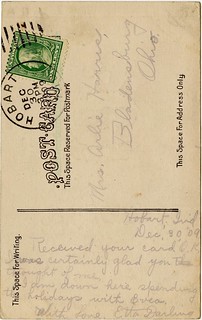
On December 30, 1909, two sisters sent out New Year's greetings from Hobart.

2021-12-31. Miller, Evea 1909-12-30 a-1
(Click on images to enlarge)

2021-12-31. Miller, Evea 1909-12-30 a-2

2021-12-31. Miller, Evea 1909-12-30 b-1

2021-12-31. Miller, Evea 1909-12-30 b-2

The senders were Mrs. Evea Miller and her younger sister, Miss Etta Darling.

Evea had married Jesse Miller in 1905, in Kosciusko County, Indiana, where the Darling family lived at the time. Shortly after that, the remaining Darlings moved permanently to South Bend, whence they traveled to Hobart in 1909 for this holiday visit with Evea and Jesse, as both postcards mention.

The 1910 Census shows Jesse (27) and Evea (22) living on Lillian Street with their first child, a two-year-old named Floyd. Jesse is described as an "operator" for an unnamed railroad — probably the Pennsy, if he had to hike to Liverpool every day (as Evea says in her postcard message). Their Lillian-Street neighbors apparently included Lewis Barnes and Rose Hendrix Gilpin.

It was probably Jesse's railroad job that brought them to Hobart. Neither had any previous local connection that I can find, or any subsequent either. By 1920 they had relocated to Warsaw, Kosciusko County, Indiana, which became their permanent home. Both Jesse and Evea are buried there.

Bladensburg, Ohio (where Etta was sending her postcard), was where her and Evea's father, Otto Darling, had been born in 1863 and where he married Stella Mason in 1885. The family moved to Indiana by 1900.

In 1911 Etta married a man named Clyde Carr in South Bend. There they lived out their lives and raised their three daughters, and both are now buried in South Bend's Highland Cemetery.

Saturday, December 18, 2021

Keep On Keepin' On

Keep on keepin' on
(Click on images to enlarge)

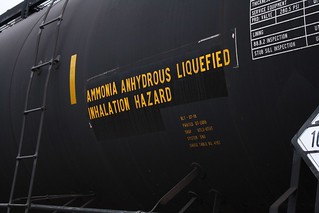
It's been a while since I've been able to get any photos from a stopped train blocking State Road 51 and inconveniencing dozens of people. Keep on keepin' on indeed.


Do not look at this:

Stop looking at me

…The train had started moving again when I shot that one.


This little guy looks so happy:

anonymous


One of these days, a freight train is going to derail in my back yard and kill me.

Inhalation hazard

Friday, December 10, 2021

'Tis the Season to Get a Nagging Cough

In addition to Uncle Dan's meat-curing recipe, the 1907 Methodist cookbook at the Merrillville/Ross Township Historical Society museum includes a handwritten recipe for cough syrup. The ingredients include pressed horehound, water, sugar, lemon juice, and licorice.

2021-12-10. cough syrup_0006
(Click on image to enlarge)
Image courtesy of the Merrillville/Ross Township Historical Society.


This recipe leaves me with questions. First of all, what form did "pressed horehound" take? The directions — to boil it until "all the strength is out," then strain — suggest that we're dealing with dried herbs rather than a "cold-pressed" liquid infusion. Secondly, where did the pressed horehound come from? — was it commercially prepared and bought at the local store, or did the family grow the horehound in their garden and press it themselves? Did you pay a visit to the old lady down the street, who always had herbs on hand? Or did people normally have this stuff lying around in their pantries?

The "5¢ licorice piece" was evidently bought at the local store. Licorice has a history of medicinal use, but a lack of "high-quality evidence" to support such use. Horehound has a similar history, with a similar lack of scientific support.

Now I wonder, if the person making this concoction had to go to the grocery store anyway to get the two lemons, the licorice and/or the horehound, why didn't they just buy a pre-made patent cough syrup? But then I have to remind myself that — first, it may have been cheaper to prepare the syrup at home, and secondly, if you buy all the ingredients yourself, at least you know what's in the final product. When this cookbook was printed, the Pure Food and Drug Act was still in its infancy, having been passed in 1906. Your ordinary citizen of Merrillville in 1907 may have been aware of that buying a bottle of patent medicine was a roll of the dice.

And then, too, I suppose that when you go to all the trouble of putting these ingredients together and boiling them down to a syrup, you feel as if you are really doing something for the poor suffering cougher, even it's that cougher is yourself. The power of the placebo effect might extend to the person making the syrup as well as the person taking it: "You're coughing less now, dear." "Why, yes (cough, cough), that's true!"

Wednesday, December 1, 2021

Puppy Break

I have a foster puppy this week.

2021-12-01. Foster puppy 1
(Click on images to enlarge)

Hmm, should I research Ainsworth history, or play with my foster puppy?

2021-12-01. Foster puppy 2

Sorry, Ainsworth.