Sunday, August 22, 2021

Heartbreak, Nebraska

In our tracing of the history of the Harms farm on 73rd Avenue, we left off in May of 1869, when Jacob and Hannah Smith had just bought back the 80-acre parcel from the estate of their deceased son, Luther.

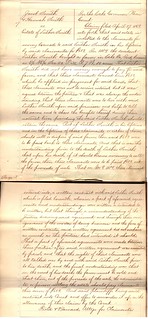
In October 1869, Jacob and Hannah sold those 80 acres to their only surviving son, Charles L., for $1400.

2021-08-22. Smith, Charles, 1869-10-27
(Click on images to enlarge)
Images courtesy of the Eldon Harms family.


Charles, in turn, immediately gave his parents a lifetime lease on the northern half of that parcel, along with a pledge of support in the amount of $800, if needed.

2021-08-22. Smith, Charles, 1869-10-27 lease

Possibly Charles was farming the southern half for himself.

Not quite a year later, Charles gives up all ownership of the 40 acres his parents were farming.

2021-08-22. Smith, Charles, 1870-10-11

From this transaction we learn that Charles, now about 33 years old, was a single man.

In 1873, Charles — who is now in Clay County, Iowa — sells the southern 40 acres back to Mary Chester (who, with her husband, had sold the land to Charles' parents in 1857).

2021-08-22. Smith, Charles, 1873-03-24

Thus we learn that in the two and a half years between October 1870 and March 1873, Charles had found and then lost a wife. I have no idea who the wife was. I can't identify any record during these years of Charles' marriage. Of course, my galloping imagination races to the conclusion that he left Indiana to get away from the heartrending memories after his wife died. But he may have married her in Nebraska. I just don't know.

A year later we find Charles in Hamilton County, Nebraska, as he recruits James Sanders to collect his mortgage money from Mary Chester.

2021-08-22. Smith, Charles, 1874-12-08

In 1876 Charles married Mary Jones,[1] who apparently had had an earlier marriage with at least one child (1880 Census). But previously Charles had entered yet another marriage, according to the 1910 Census, which notes that Charles was on his third marriage and Mary her second. So between 1873 and 1876 Charles may have suffered heartbreak yet again.

♦    ♦    ♦

Albert Van Doozer, who bought the northern 40 acres, is a bit of a mystery. We encountered him for the first time in my earlier post about the Smith family, when (for quiet-title purposes, I believe) he wrote letters saying that he had been "well acquainted" with the late Jacob and Hannah Smith and their late daughter-in-law, Sarah.

I don't know how he became acquainted with this family of farmers, or what he wanted with farmland: he doesn't seem to have been the farming type himself. Born in New York in 1838, he shows up in the 1850 Census as a city boy, living in Buffalo, New York. His father was a joiner. Then I lose track of him until 1866, when he marries Emma Bevans — but the marriage is recorded in both Lake County, Indiana and Cook County, Illinois.

Not coincidentally, I'm sure, this was the same Emma Bevans, or Bevins, who had appeared in the 1850 Census living in the household of Jacob and Hannah Smith. She was a native of Canada. How and why did she get to Ross Township, Indiana, and into this particular household? I have no clue.

In the 1880 Census, Albert and Emma were living in Chicago and he worked as a shoemaker. By 1900, they were living in Wheatfield, Jasper County, Indiana; Albert described himself as a watchmaker. Ten years later, in the same town, he owned a jewelry shop. In 1920, at the age of 81, he was still a jeweler, still making watches, but Emma had died. Albert lived only three more years and was probably making watches to the end.


_______________
[1] Ancestry.com. Nebraska, U.S., Select County Marriage Records, 1855-1908 [database on-line]. Lehi, UT, USA: Ancestry.com Operations, Inc., 2017.

Thursday, August 12, 2021

More Grabowski Photos (Calling All History Detectives!)

Teofil Grabowski's relatives in Poland have kindly sent us a few more photos of Teofil and his immediate family members. We do not have many details about these photos, but I'm hoping that might change once the history detectives who read my blog get their hands on them.

The first shows Teofil in a military uniform, possibly during World War I.

2021-08-12. Military service
(Click on images to enlarge)
Images courtesy of Aneta and Zenon Grabowscy.


In the lower right-hand corner is part of the photographer's imprint. The name looks like "Moffit" and the address "346 Morrison St." Unfortunately, our correspondents' original does not include the city and state. It could be a town in Indiana; or Chicago; maybe even New Britain, Connecticut; or near whatever training camp Teofil might have been sent to. (He shows up in the "Veterans Administration Master Index, 1917-1940" on Ancestry.com, so he must have served in the military, but I don't have any details.) He was living in East Chicago, Indiana, when his WWI draft card was filled out.


The second photo shows a group at an orphanage that Teofil supported financially.

2021-08-12. Orphanage

One ring marks Teofil, standing in the back row, with his mother, Marianne, seated in front of him. The other ring marks his daughter, Aurelia, in the front row. We don't know the name or location of the orphanage, but obviously it was Catholic. Aurelia was born in September 1922 and here she looks about six years old. That would date to photo to 1928 or so (which might explain why Wanda wasn't with them: she was at home with her new baby, Edwin).


The third photo we know nothing about.

2021-08-12. Unknown

A young-looking Teofil is marked in the front row. Based on the women's fashions, I would date this roughly to 1910, 1912, which would put Teofil in his early 20s. The Methodist Episcopal Church in the background is in the U.S., evidently, since its sign is in English, but that's all we can say at this point. In his early years, Teofil spent time in Indianapolis and South Bend, and probably in New Britain, Connecticut, as well; by 1916 he was in East Chicago. I can't even try to guess where this is.

Monday, August 2, 2021

James S. Sanders (Or Do You Spell It Saunders?)

Curious about the administrator of Luther Smith's estate, I looked into James S. Sanders and found that he was a long-time resident of Winfield Township and usually recorded as James Saunders.

He was born in Virginia in 1809. According to a family tree on Ancestry.com, by 1829 he had moved to Pennsylvania, where he married Mary Haines. The same family tree tells us that the young family left Pennsylvania for Ohio around the mid-1830s. Mary gave birth to a child in Ohio in January 1846, but early in May of the same year Early Land Sales, Lake County shows James S. Sanders buying land in Winfield Township, Lake County, Indiana: 160 acres in Section 16, along the Porter County line. The 1850 Census records James, Mary, and their eight children farming what seems to be the same parcel.

In December 1852, James purchased 80 acres in Section 5, and then in February 1854 another 160 acres — thus, the 240-acre farm we find on the 1874 Plat Map:

2021-08-02. Sanders 1874
(Click on image to enlarge)

The Sanders home appears to be on the north side of 109th Avenue not far east of its intersection with Grand Boulevard. No trace of the home remains as far as I can tell. (As for the 1846 farm, it's now buried under the Lake of the Four Seasons development.)

Here the Sanders family was recorded in the 1860 Census and the 1870 Census. Around 1874, apparently, James got tired of farming. He and Mary moved to Jackson Township, Porter County, where James became postmaster in the village of Jackson Center and started the first store there in 1874, and ran it for a couple of years.[1]

But by the 1880 Census James and Mary had moved to Westville in LaPorte County, and James, now 72, served as a justice of the peace. Living with them was their 16-year-old granddaughter, Melissa Shaw, whose mother, Joanna Sanders Shaw, had died.

James died in 1891 and Mary in 1900.

One would think that Deer Creek Cemetery, the Sanders' neighbor for some 20 years, would hold much evidence of the family, but the only person by the name I can find there is Alma Sanders — about whom nothing is known but her name.[2] I do not know where Joanna Sanders Shaw is buried.

I have satisfied my own curiosity about James S. Sanders, estate administrator, and to judge by the family tree on Ancestry.com, this family has already been well researched.

_______________
[1] Goodspeed and Blanchard (eds.), Counties of Porter and Lake Indiana (1882), p. 203.
[2] I haven't been out to the cemetery to find out why we know her name but nothing else. Perhaps there is a grave marker that is illegible (or blank) but for the name.


Friday, July 30, 2021

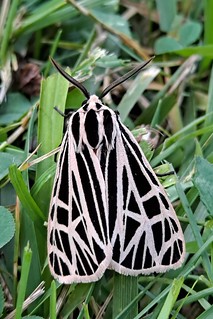
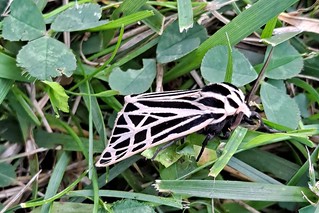
Virgin Tiger Moth

Virgin Tiger Moth 1
(Click on images to enlarge)

Virgin Tiger Moth 2

I wonder how this species propagates itself.

This is yet another moth that I scared up while mowing. It was well over an inch in length. What I could see when it fluttered up, but couldn't catch with my phone camera, is that its hindwings are red.

Nobody seems to know how it got its common name.

Sunday, July 25, 2021

Made in Bohemia

2021-07-25. Soda Bottle
(Click on images to enlarge)

This soda syphon bottle, once used by Zobjeck & Havens of Hobart, Indiana, somehow ended up in Ontario, Canada, whence I bought it on Ebay; but it originally came from Bohemia — at least, the glass part did, according to the legend etched on the bottom and proudly incorporating the lion rampant of the Bohemian coat of arms.

2021-07-25. Made in Bohemia

The detachable syphon at the top was made by the Crown Syphon Bottling Works, which seems to have been a Canadian company according to what Google tells you when you search on that name.

2021-07-25. Crown Syphon Bott. Wks

The firm name, Zobjeck & Havens, is prominently etched on the side and includes an intricate logo joining the owners' initials.

2021-07-25. Logo

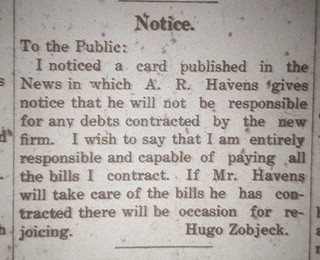
Hugo Zobjeck, Sr., and Albert Roy Havens were in business together in Hobart starting around October 1907[1] and ending sometime in the summer of 1910 — not, perhaps, on the best of terms, as we might infer from this notice that Hugo Zobjeck ran in the Hobart News of September 1, 1910.

2021-07-25. 1910-09-01 Hobart News - Notice


(I spent a ridiculous amount of time trying to come up with a title for this post that involved a pun on Bohemian Rhapsody. I don't think it can be done.)

_______________
[1] "Local Drifts," Hobart Gazette, Oct. 11, 1907.

Sunday, July 18, 2021

"The Pleasure of Motoring, 1928"

… he wrote sarcastically.

2021-07-18. lh086
(Click on images to enlarge)
Images courtesy of Eldon Harms.


"He" being Lester Harms, probably, as this photo came from the Lester Harms collection. I'm posting it now because I just recently came across a relevant newspaper item from the Hobart Gazette of July 6, 1928:
Clarence Harney and Lester Harms were to motor to Yellowstone Park, but they encountered muddy roads in the Black Hills section and gave up going further and returned via Minnesota and Wisconsin, visiting the points of interest enroute. Mr. Harney, who works at the local postoffice, had to return last Saturday at the close of his two-weeks' vacation.
The way Eldon Harms told me the story, they were heading to California. In both stories, they turned back because of the bad roads.

If Yellowstone Park was their destination, I wonder if they traveled on the Yellowstone Trail?

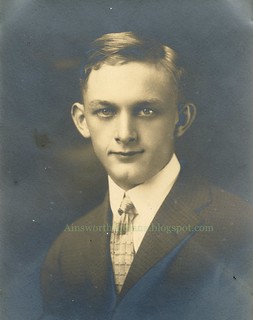
Lester Harms and Clarence Harney were cousins, born in 1904 and 1907, respectively. (Lester's father, John, was a half-brother of Clarence's mother, Mamie.) With the photo being so out-of-focus, it's hard to say which one of them is fixing the flat, but I am inclined to think it's Clarence. Here is his high-school senior portrait from 1925 for comparison:

2021-07-18. lh012

And a photo of Lester from 1932 can be found here.

♦    ♦    ♦

This story got me wondering whether they were in the Black Hills area in hopes of seeing the Mount Rushmore monument, which led me to research how much of the monument there was to see in 1928. As it turns out: very little. The enormous work of carving the mountain had only begun in October 1927. I found some early photos here — if you scroll down, you will find one from about 1928 in which only the rough planes of Washington's face can be distinguished from nature.

Saturday, July 10, 2021

Death and Dollars

When we left off with the Harms 73rd Avenue farm, Charles Chester had just bought those 80 acres.

That was August 1856. Some seven months later, in March 1857, Charles and his wife, Mary, sold the land to Luther and Sarah Smith for $900. The purchase was financed with six promissory notes coming due at intervals over the next six years, their payment secured by a mortgage.

2021-07-10. 1857 Harms Abstract of Title 003 a - Chester sale to L. Smith, mortgage
(Click on image to enlarge)
Image courtesy of the Eldon Harms family.


The Smith family and the Chester family had been neighbors for a few years before this sale. If we look at Early Land Sales, Lake County, we find that in May of 1850, Charles and Mary Chester bought the northwest quarter of Section 17. The following year, Jacob and Hannah Smith (Luther's parents) bought the adjacent northwest quarter of the northeast quarter — that is, the land where someday Henry Chester would build his brick farmhouse.

Chester 1850, Smith 1851 on 1874 map
(Click on image to enlarge)
This image is from the 1874 Plat Map.


The Smiths had been in Ross Township early enough to be counted in the 1850 Census: Jacob, 49, a native of Connecticut; his wife, Hannah, also 51, born in New York; and their children, Luther and Charles L. (16 and 13, respectively, and both born in Ohio), plus a 19-year-old woman named Emma Bevins, of Canadian birth. They were recorded with only one intervening entry between them and the Chester family, so perhaps the Smiths were renting farmland nearby.

In 1854, Luther Smith married Sarah Maxwell (Indiana Marriage Collection), who was only about 15 years old.[1]

Then in 1857 comes this sale to Luther and Sarah of the Chester 80 acres along Randolph Street. And that is where the 1860 Census finds them, with their children, Emma (5), Albert (2), and Sarah (10 months). Also in the home were Luther's parents, Jacob and Hannah.[2]

The mortgage on the land was cancelled in 1861, a year before the final promissory note was due. It may have been paid off early with money raised through what happened in 1859: Luther gave his parents a life-long lease on the land, for which they paid him $600.

2021-07-10. 1859 lease
(Click on images to enlarge)
This image and the images below courtesy of the Eldon Harms family.


In January 1865, Luther enlisted in the Union Army. By August of that year he was at home (not discharged yet, so perhaps on leave, possibly due to poor health). On August 10, he died.

He had made no will, and it seems that for a few years, his survivors went on farming that land together peaceably, not even seeking to have Luther's estate probated. But in 1868, something began to stir, and that's when the county court finally appointed an estate administrator.

2021-07-10. 1868 estate administrator
(Click on image to enlarge)
Image courtesy of the Eldon Harms family.


And in 1869 Jacob and Hannah sued the estate for the return of the $600 they had paid Luther ten years earlier.

2021-07-10. 1869 suit

The 1859 transaction between them and their son, they said, wasn't just a lease for $600. It was a promise of a home: "these claimants were to live with said Luther Smith upon said premises and help to till the same and to share the benefits thereof throughout their natural lives," and if ever Luther sold the farm out from under them, Jacob and Hannah would get their $600 back. But that provision was not included in the lease "through a misunderstanding of the Justice [of the Peace] drawing said agreement, and through their own ignorance of the modes of doing business and the force of written contracts."

Reading between the lines of the last paragraph, it sounds as if, in August of 1865, Luther did not expect to recover from his sickness — he and his parents "talked over" these arrangements, "and the final understanding was that in the event of his death the farm must be sold." He did die, as we know, but the farm wasn't sold, and his parents went on without their $600 for several years.

I wonder if Sarah — still a young woman — was getting restless around 1868, wanting to sell the farm, take her share of the money, and move on with her life somewhere else.

A sympathetic court decided that the lease of the farm should be cancelled, and the $600 returned to Jacob and Hannah.

2021-07-10. 1869 ruling

The estate administrator then petitioned the court to be allowed to sell the farm, and summarized the estate:

2021-07-10. 1869 summary

After the required publications to advise potential buyers, the sale went forward. And Jacob and Hannah bought the farm.

2021-07-10. 1869 report of sale

Luther's widow and four minor children received a total of $506.22 from the estate (about $10,000 in today's money).

2021-07-10. 1869 summary

The estate administrator duly conveyed the land to the elder Smiths.

2021-07-10. 1869 transfer of title

Sarah may have moved on with her life, but unfortunately she did not have much life left. According to the penciled note in the bottom margin of page 6 of the abstract, above, "Sarah P. Smith died Aug 9th 71." Perhaps that was written circa 1896, when Henry and Johanna Harms were buying the land. But a statement from 1878 says approximately the same thing:

2021-07-10. 1878 statement re Sarah Smith

By 1877, Jacob and Hannah had died too.

2021-07-10. 1877 statement re Jacob and Hannah Smith

Concerning the four minor heirs of Luther's estate, someone jotted notes on the abstract, again probably circa 1896: Emma, Elbert, and Ambrose were dead; Adna was living in Denver (where he is now buried). The little Sarah from the 1860 census is unaccounted for; she may have died in infancy. The rest of Luther's survivors named in the abstract are a mystery to me — their lives, their deaths, their final resting places.

Luther Smith himself is buried in the Woodvale Cemetery, but he is not alone. His and Sarah's son rests there too — a two-month-old infant, named Jacob for his grandfather.

_______________
[1] I don't know much about Sarah's family of origin. Her marriage is the earliest record I can find of her locally.
[2] The other son, Charles L., was not in the household and in fact I can't find him in 1860, but we will hear from him again.