Saturday, February 13, 2010

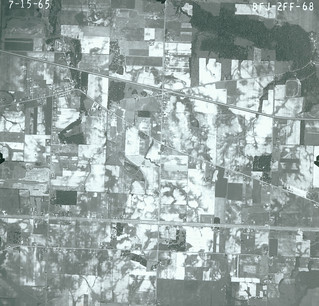
Aerial Photo: 1965

1965bfj-2ff-68lake
(Click on image to enlarge if you really want to, but it's a big file and not very interesting)
Photograph courtesy of the Indiana State Archives, Indiana Commission on Public Records.


Here we have Ainsworth in 1965. Not a lot has changed since 1958. A few more houses. The most notable addition is on the extreme right, about one-third of the way from the top: a big (race?)track in the area that is now the toy airplane field in Deep River County Park. No idea what, if anything, was raced there. The buildings directly north of it, whose foundations can still be seen among the trees east of Big Maple Lake, are still standing. The Ainsworth depot north of the Ainsworth Triangle seems to be gone; the little toolshed that replaced it may be there but too small to be visible. Ainsworth Road still in its old configuration, crossing the tracks. No Shilo Ranch yet.

Friday, February 12, 2010

"Kills Insane Brother in Law"

GeorgeChester
George and Ruth Chester's land is outlined in red.
(Click on image to enlarge)


George and Ruth Chester owned 80 acres of land fronting on State Road 51, just south of the old Lincoln Highway. The 1930 census recorded a small household: George, 36, working as a mechanic in a refinery; Ruth, 33, a housewife; her mother, Madeline Mack, 56; and George's brother, Frank Booty, 39 and also working in a refinery.

George and Frank had been born to Constance Booty during her first marriage. Upon her second marriage, to Charles Chester, George adopted his stepfather's surname, while Frank retained their father's.

The household was small, but it was not cozy. Frank had problems that must have made the others uneasy at times. According to Ruth, he had been "deranged" since World War I. At the war's outbreak, he had already served three years in the military and was a corporal in the artillery. Then he was sent to France where he saw heavy fighting, including poison-gas attacks. He returned from the war suffering from shell-shock — or, as we would call it, post-traumatic stress disorder.

On the morning of Monday, June 12, 1933, something went horribly wrong.

George was not home that morning — perhaps he had gone to his job at the refinery. Madeline was in the house. Ruth went out back to feed the chickens.

And Frank went "suddenly violently insane."

He first attacked Madeline with a lead pipe, breaking her arm. She escaped and fled down the road to get help. As Ruth came back into the house, Frank turned his frenzy on her, striking her in the head. She fought back and managed to push him out of the house and lock the door. Somewhere outside Frank found a heavy axe and came back swinging it. He chopped his way into a shed attached to the house, then starting battering down the house door. By now Ruth was armed, too: she had grabbed a 12-gauge shotgun kept inside the house. She brandished the gun at Frank, but he hardly seemed to notice it. He came in waving the axe, threatening to kill her. Ruth leveled the shotgun and pulled the trigger.

Later, she testified that she had meant to shoot him in the legs. In the terror of the moment, her aim was bad. The full force of the blast struck Frank in the abdomen.

He collapsed, and then seemed to come back to his senses. He was even able to speak. "I'm sorry for what I did," he said. "Get a doctor."

Ruth called neighbors, who called the Miller Clinic, but it was no use. Frank died within a matter of minutes.

Ruth was taken to Crown Point for questioning, but the Lake County Prosecutor concluded that she had clearly acted in self-defense. No charges were brought against her.

Frank was buried in the Chester Cemetery, on George and Ruth's land. The Hobart post of the American Legion held military services in his honor.


Sources

Thursday, February 11, 2010

When An Amateur Historian Has a Bad Day

Suppose you've written a stirring account of a violent death, entitled A Tragedy at Chester's Camp, based on reports from Hammond and Valparaiso newspapers. And suppose you finally track down the Hobart newspaper's version of the story on microfilm, and it says the incident didn't happen at Chester's Camp. And suppose you look at the roughly coeval non-newspaper evidence of who lived where and did what for a living (census report and plat maps), and decide the Hobart version is more credible. What does it all mean?

First, it means you have to re-write your stirring account. Secondly, it means your Chester's Camp article is now a pathetic stub, but you have to leave it where it is because you've been yammering on and on and on about Chester's Camp ever since — but you better try to gather up what random facts you've been collecting (once you remember where you put them) to fill it out more. Thirdly, it means you have to go searching through your blog looking for links that don't go to the right place anymore.

Nonetheless, I'm eternally grateful to the Hobart newspaper, because it answered a question that had been tormenting me: how could George Chester and Frank Booty be full brothers, and have different surnames? Now I understand.

And I managed to find an image of the Chester family tree:

Chester Family Tree
(Photo by Nate Steiner, from Wikimedia Commons)

♦    ♦    ♦

On a lighter note, here's a picture of Maya having fun. She calls diving head-first into a pile of snow fun.

HeadFirstinSnowpile
(Click on image to enlarge)

Wednesday, February 10, 2010

W.G. Haan I.D.'d

Haan article
(Click on image to enlarge)

This article from the Hobart News of November 14, 1929 identifies the W.G. Haan for whom the Ainsworth school was named: "Major-General William G. Haan, of Crown Point, who commanded the 32nd division of the World war" (that is, WWI).

I'm still confused about the chronology of the building and the naming of the two school buildings.

Tuesday, February 9, 2010

Tuberculosis and the Nolte Family

Earlier I mentioned the tragic history of the Nolte family. Let me lay it out for you simply:

NameCause of DeathAge at Death
Henry R. (father)Tuberculosis59 yrs.
Mary (mother)Tuberculosis*42 yrs.
WilliamUnknown1 day
LouisaTuberculosis**16 yrs.
AlvenaTuberculosis15 yrs.
OttoUnknown1.5 mos.
Henry T.Gunshot wound (murder)45 yrs.
BerthaUnknownUnknown, but more than 28 yrs.
LouisKidney disease33 yrs.
EdwardTuberculosis20 yrs.
_______________________
*"Lung trouble."
**"Consumption."

I still haven't been able to trace Bertha beyond 1920; she may have lived to a ripe old age. The infant or child whose name is unknown died in January 1897. The newspaper notice of the burial did not give a name — a practice you sometimes see in the case of an infant or very young child. (I have not found a grave marker for this child, but I will have to go and look again when the weather gets better.)

No cause of death is given in Alvena's obituary. In a family so infected with the disease, it may well have been tuberculosis, but we just don't know. 6/28/10 update — I have come across an obituary of Henry R. Nolte that states, "All the deaths in this family have been from tuburculosis [sic]." I hesitate to accept that as a cause of the two infant deaths, but in Alvena's case it is probably true.

So that's five who died of tuberculosis in a family of ten. This brings home how real a threat it was, this disease that nobody around here gives a second thought to these days.

Monday, February 8, 2010

Arrested For Bastardy

Perhaps Carrie Raschka and Lovisa Nelson had to become so strait-laced just to balance out the antics of their stepbrothers: Exhibit A was John Chester's Prohibition troubles; now I've found Exhibit B in the form of a Hobart Gazette article from July 31, 1908, delicately entitled: "Arrested For Bastardy."

On July 27, 1908, a woman by the name of Mary Kovanek, age unknown, Bohemian by birth, filed a complaint against Jerome Chester alleging that he was the father of the child born to her on February 28, 1908.

She had been hired by Henry and Mary Chester as a live-in domestic beginning in mid to late May 1907. Jerome was then about 27 years old, unmarried, still living with his parents. She remained with the Chesters no more than two months. During that time, she said, Jerome "visited her room" on several occasions.

Mary left the Chester household on July 16, 1907, and was married to Mr. Kovanek the following day. Seven-and-a-half months later, she gave birth to a child. (She already had another "fatherless" child about four years old.)

She claimed that Jerome had earlier acknowledged his responsibility, and given her a little money now and then, but by July 1908 he had so completely reneged on his promise to support the child that she was obliged to file the complaint. The Kovaneks were in financial straits and needed the money.

Jerome was arrested the same day and brought in for a hearing before Judge Mathews. (My reading of the article is that the hearing took place in Hobart, but it isn't clear.) Attorney R.R. Peddicord argued the state's case; Jerome was defended by F.T. Fetterer and W.W. Bozarth. Witnesses included Dr. Mackey, who delivered the baby, and Drs. Bulhand and Gordon, expert witnesses on "evidence concerning maternal cases." Both sides gave spirited arguments, and the hearing carried over into the following day. At the end of it, however, Judge Mathews found Jerome not guilty.

The large crowd attending the hearing was outraged. As word of the verdict spread, so did the scandal. The Gazette said, "This community is almost of one opinion and firm in the belief that this poor, ignorant mother, who belongs to that race of people who are taught from infancy to obey their masters, told the plain, cold facts, uncolored and uncoached." (Again I find myself surprised: I wouldn't have thought people in 1908 would be so sympathetic towards a woman who admitted to being the mother of two illegitimate children.)

On the evening of July 29, R.R. Peddicord went to Hammond to pursue Mary's case with City Judge McMahan. The judge issued a warrant for Jerome's re-arrest, and before dawn on the 30th, Jerome was again in the hands of the law — riding the early Nickel Plate train to a new hearing in Hammond.

There, Judge McMahan "decided that Chester was the father of the child and bound him over to the superior court in the sum of $300 bonds, which were furnished. The case will probably come up for trial at the September term."

I have been searching the Gazette and other 1908 papers for follow-up reports, but I haven't found any.

Weren't things complicated before we developed the science of DNA?


[4/6/2010: Update here.]

Sunday, February 7, 2010

Alex's Place

I just had brunch at Alex's Place in the old Ainsworth School building. I had the spinach-and-feta omelette. They use fresh spinach — yummy! The breakfast-and-lunch dining room is on the lower level, where the cafeteria was when the building was used as a school. I think the Friday night fish fries are held upstairs, but I've never actually been to one.